 Brooke Larsen
St George • Val Palmer cherishes memories of summer days in the swimming pool with his kids.
“When my girls were young, we spent every summer in the pool,” he said.
Now he tries to create those memories for others. In January 2020, a few months before the Covid pandemic hit, he opened Palmer Pools in St. George. Business took off quickly, and it has continued to grow, averaging around 50 pools per year.
As a former excavator, Palmer finds the work fun and rewarding. “Most of the time we start, it’s just nothing but dirt,” he said. “Then when you’re done, it turns into a masterpiece. It’s beautiful. And it brings families together.”
The average pool he and his crew build is 20 feet by 40 feet. But lately more and more people want massive pools. One of his current — and largest projects to date — is 107 feet long and 53 feet wide. The pool includes waterfalls, a bar, platforms for tanning and a hammock hanging over the water.
(Trent Nelson | The Salt Lake Tribune) Val Palmer splashes the edge of a private pool in St. George on Monday, Sept. 15, 2025.
Palmer and other pool builders may not be able to build such projects for much longer, though. The Washington County Water Conservancy District is hoping to get ahead of the growing trend and is working with the industry and municipalities to potentially limit pool sizes for new construction.
“People are wanting larger and larger and larger pools in a place where water is becoming scarcer and scarcer,” said Doug Bennett, conservation manager for the district. He characterized this uptick in large, elaborate pools as a “recreational arms race.”
All of southwest Utah is currently in severe or extreme drought. To prepare for a future with more people and less water, the district is investing in reuse infrastructure and conservation. All the eight cities and towns the district delivers water to have implemented limits on lawns for new residential homes and bans on grass in new commercial and government developments, except for places such as an athletic facility or childcare center.
There’s no such agreement on pools, though. The district has implemented some pool standards for areas where they directly provide water, but those are currently voluntary in cities and towns.
“We think by having a reasonable water use standard, we’re actually protecting the long term viability of the industry. … If there’s no water, there’s no house, and there’s no swimming pool,” said Bennett. “All these things need to be working together to ensure that we have the ability to continue to draw building permits in the region.”
Pools in southwest Utah
In July, Bennett analyzed pools in Washington County. According to data he reviewed from the assessor’s office, there are over 9,000 pools in the area. He then looked at pool building permit data from 2020 to 2023 for St. George, where roughly half of the pools in the county have been built.
He found that pools are growing at a faster rate than people.
“Our communities are growing at four to five percent per year, but the swimming pool population is growing at eight and a half percent per year,” Bennett said.
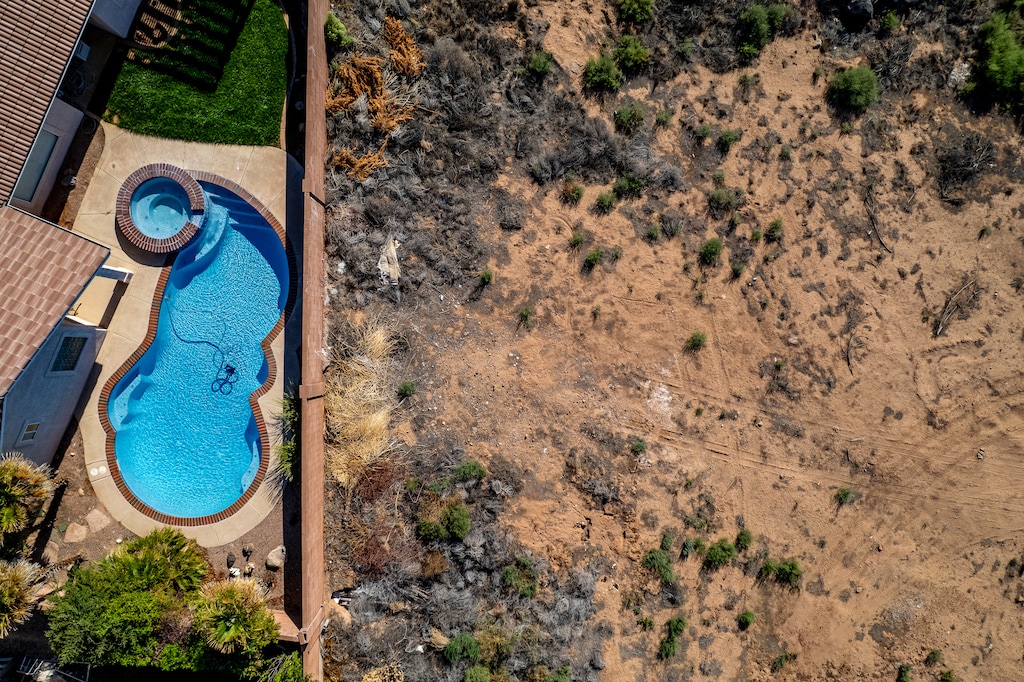
(Trent Nelson | The Salt Lake Tribune) Backyard pools in St. George on Wednesday, Sept. 17, 2025.
After analyzing a random sample of the permit data, Bennett found that the median pool size was 571 square feet, but the average was 605, driven up by mega pools.
“We had one pool in this sample that was almost the size of my house, and it was actually valued at more than my house,” Bennett said.
A 600-square-foot pool uses 33,000 gallons per year. That’s comparable water use to lawns, according to Bennett. “An open body of water that’s evaporating to the air and an irrigated lawn have about the same water demands on a square foot basis,” he said.
There’s a way to prevent 90% of that evaporation off pools, though, Bennett added: mechanized covers.
Even though some pools already have these, not everyone uses them, Bennett said. Some pools also aren’t standard shapes, so people have custom covers that they must lay on the pool themselves, which takes added time and work. Others just want to see their pool.
“I don’t like covers,” Palmer said. When people spend $100,000 to $150,000 on a pool, he added, “you want to see it, right? You don’t want to cover it up.”
What a pool standard may look like
Pool regulations may be a harder sell to industry leaders than lawn standards. Homebuilders were already planting less grass as landscaping requirements were developed, Stacy Young, government affairs director for the Southern Utah Home Builders Association, told The Tribune.
“The momentum was kind of working with us in that case and coming against us in this one,” he said.
(Trent Nelson | The Salt Lake Tribune) A private pool in St. George on Monday, Sept. 15, 2025.
Pool regulations aren’t completely new to the county, though. The district has already implemented limits on pools for the areas it directly serves as part of its “ultra water efficiency standards.” Currently, developers in municipalities may opt into the standards. Those that do will experience a lower fee, which the district is still finalizing.
These “ultra” efficient standards include bans on private pools, except for freestanding spas up to 100 square feet. Community pools are allowed in new developments with at least 15 homes or apartments. The size of the pool depends on the number of residences, starting at 600 square feet, with an additional 10 square feet allowed for each additional dwelling unit. No pool may be larger than 13,500 square feet, about the size of an Olympic swimming pool.
While Bennett doesn’t believe the cities will have an appetite for prohibiting private pools, he said there may be ways for them to incentivize community swimming areas and limit the size of backyard pools.
A 500-square-foot limit would affect roughly two-thirds of pools being permitted, according to Bennett’s research, and reduce pool water consumption by 25%. A more generous standard, such as a 700-square-foot limit, would impact roughly one-third of pools and reduce water use by 10%.
The district is also talking with industry leaders to come up with solutions that will conserve water and limit impacts on companies.
“We’re trying to be very cautious about where water conservation may literally take a bite that takes away somebody’s livelihood,” Bennett said. “Instead of saying something’s absolutely prohibited, if you can downscale it, then you have a lot of opportunity to preserve the jobs and the economic activity without the big water footprint.”
Industry response
(Trent Nelson | The Salt Lake Tribune) Backyard pools in St. George on Tuesday, Sept. 16, 2025.
In August, Bennett presented his pool analysis and potential proposals to home and pool builders. At the start of the meeting, company heads had their arms crossed and head cocked. But at the end, everyone loosened up a bit.
“There was a huge difference in the reaction from the pool builders after I went through the whole presentation,” he said.
Bennett found that a limit on pool sizes likely won’t have a significant impact on home values, tax revenue or the pool maintenance sector.
He also concluded that, like home construction, as the pool gets bigger, the cost per square foot decreases. “The good news is that if we’re going to build smaller pools, we’re actually chopping off the lowest valued square footage in terms of economic activity,” he said.
Palmer doesn’t think he’ll have a problem staying afloat if the district and municipalities implement size limits. The days of a million dollar pool may be over, though, he said, so he may have to build more pools. There’s also the possibility, he added, that rather than sizing up, customers may spend the same amount of money on extra features.
“I don’t know that it would hurt us,” Palmer said. “I mean, I’m not excited about it. I don’t think it’s a good thing for our industry.”
(Trent Nelson | The Salt Lake Tribune) A large private pool Palmer Pools is constructing in St. George on Monday, Sept. 15, 2025.
A pool size standard “definitely constrains the upper end of that market,” said Young. “The percentage of people that want a larger, more elaborate pool do exist, and so it would just sort of eliminate that buyer pool.”
The industry has offered up some other possible solutions like allowing residents to subtract the square footage of a pool from their grass allowance, Young said. Ivins currently requires residents to deduct their pool square footage from their lawn allowance.
Pool builders have also proposed a policy similar to the Corporate Average Fuel Economy standard, which requires vehicle manufacturers to meet an average fuel efficiency standard across their fleet. Such a model for pools may allow builders to still build large pools as long as they’re offsetting those with enough smaller ones, Young said.
Such a policy may come with additional complexity for regulators, builders and customers, though, Bennett said.
Living within the limits
As builders and the district continue to discuss possibilities, Bennett hopes to have a clear mission and direction for a pool policy by the end of the year.
(Trent Nelson | The Salt Lake Tribune) A backyard pool in St. George on Tuesday, Sept. 16, 2025.
Bennett said it is important to him not only because of the direct water conservation from pools, but also the potential ripple effect on attitudes in the community. Large pools in the southern Utah desert can be “visually offensive” to people, he said, and may affect someone’s willingness to conserve water at their own home.
Ultimately, water is the limiting factor in Washington County, and while pool and home builders may not completely embrace new standards, such regulations may help secure those industries’ futures in Washington County over the long term.
“There’s only a certain amount of water to be had in this region, and when that water is completely spoken for, and we’ve exhausted all our conservation opportunities, that could be the end of the road for how large this community can grow,” said Bennett. “I think more so than the availability of land, it’s water that will decide what the maximum size of this region is.”