 Courtney Tanner
More than 8,000 students who would like to enroll in Utah’s technical college programs are stuck on waitlists, unable to access what is supposed to be one of the fastest and most affordable options for higher education in the state.
“We’ve really heard a lot about this unmet student demand,” said Nate Talley, deputy commissioner and chief financial officer for Utah’s public college and university system.
For the first time, the Utah Board of Higher Education released Friday an official count for students in queue.
That includes 5,634 adults who would like to get some kind of professional training, as well as 2,421 high schoolers who are not being served, tallying up to 8,055.
Not all of those would-be students have applied to attend full-time; some are just trying to get in for a class or two. Talley calculated the full-time equivalent at 2,244.
The counts are the highest at Davis Technical College in Kaysville, where 2,520 adults are on the waitlist along with 1,041 high schoolers, with a 991 full-time equivalent.
(Bethany Baker | The Salt Lake Tribune) Davis Technical College President Darin Brush speaks during an event at the Thomas S. Monson Center in Salt Lake City in 2024.
But each institution doesn’t keep counts uniformly. One school — Uintah Basin Technical College in Vernal — isn’t keeping track at all of how many students are waiting in line.
Overall, Utah has eight standard technical colleges and three more that are run out of traditional public colleges or universities (at Salt Lake Community College, Snow College and Utah State University) for 11 overall.
Each offers a slate of shorter, highly specialized career programs for those wanting to pursue anything from automotive repair to hair styling, firefighting or plumbing.
Tech programs are shorter than traditional university degrees, dropping things like general education classes as they focus instead on specific job readiness.
Students can take a class to brush up on skills or work toward a formal certificate.
In recent years, state lawmakers have touted tech colleges as a smart path for adults later in life who want to switch career paths.
They also have been held up as a solution for students who want to start work sooner or seek new training as technology and artificial intelligence advances.
“I think the trades have been neglected through our higher education system, personally,” said Sen. David Hinkins, R-Ferron, during a legislative education committee meeting earlier this year.
(Trent Nelson | The Salt Lake Tribune) Dixie Technical College in St. George on Thursday, Sept. 18, 2025.
The constraint, though, has long been that technical schools collect less money from students in tuition and fees — plus less money, overall, from the state.
That leaves them without much money to expand to new buildings and hire more teachers. One Utah technical college president previously told the Legislature that his school simply didn’t have any more desks to put students in — even as they offered classes around the clock each day.
That leaves capacity relatively stagnant, even as demand increases. Last academic year, the state’s technical colleges enrolled 40,914 total students. That hasn’t changed much over the past five years, growing by a few hundred annually.
Meanwhile, the state’s eight traditional universities and colleges enrolled 218,741 students last fall. And that number has tended to see hearty growth each year, up nearly 20,000 students from four years ago.
To address the problem, the Legislature passed SB216 this year. That requires the Utah Board of Higher Education to standardize how technical colleges track their waitlists.
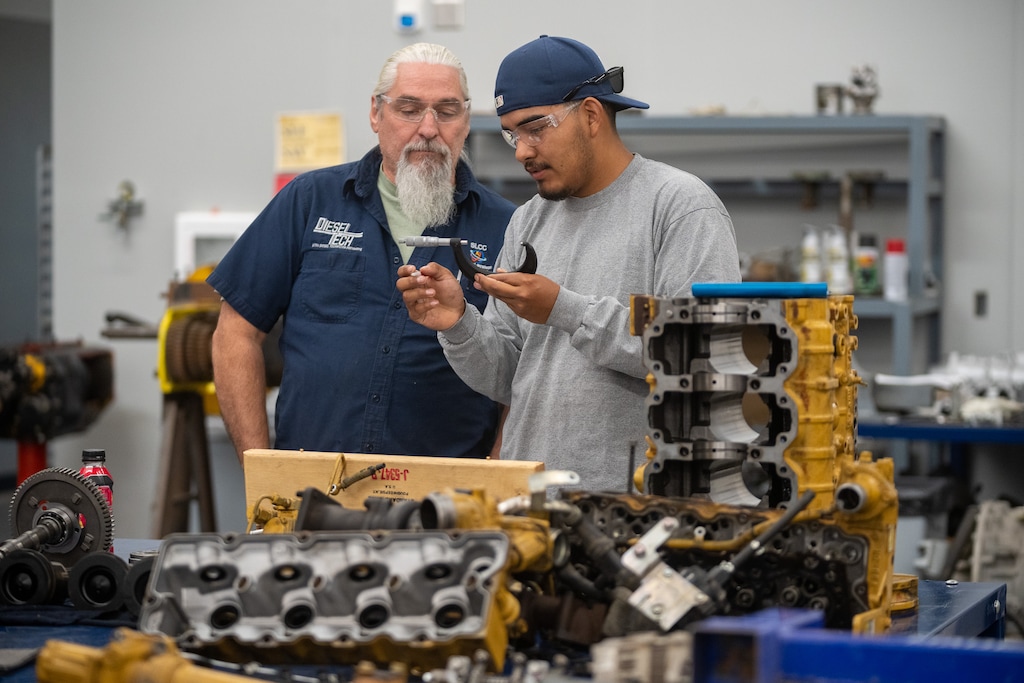
(Trent Nelson | The Salt Lake Tribune) A student works in a diesel systems technology course at Salt Lake Technical College in Salt Lake City in 2022.
It also adds a new calculation for capacity — where tech schools can get more money than typical based on their enrollment.
For this year, that pool is $7 million.
Based on Talley’s calculation, more than 60% of the programs at each of Utah’s technical college would be eligible for the extra funding.
The state Board of Higher Education has also given each technical college permission to propose tuition rate hikes of up to 6.2% starting next fall.
Talley said if schools only relied on raising tuition rates, though, it would lead to “arguably outsized increases” and still might not be enough.
If every technical college increased to the 6.2% maximum cap, that would create an extra $1.4 million systemwide.
Tech school tuition rates are typically calculated by how many credit hours a student enrolls for. The lowest rate is shared by Tooele Technical College and Snow College’s tech school, which charge $85 per credit hour. The highest is Mountainland Technical College at $125.
Typically, a full-time credit load costs about $2,500, on average, per year. That’s about half of the annual cost for the lowest tuition rate at a traditional college or university in the state.
Courtney is a reporter at The Tribune, where she has worked since May 2016. She unwinds by fishing in the mountains far away from cell service. She’s a fan of bacon and Kevin Bacon.