 Andrew Christiansen
Extreme fire behavior, communication problems and gaps in aerial supervision contributed to the deaths of four firefighters in western Colorado, according to a federal investigation report released Nov. 12.
Five firefighters were battling the small Knowles and Gore fires west of Grand Junction in Mesa County on June 27 when the larger Snyder Fire overtook them.
Emily Barker, Nick Hutcherson and Sydney Watson died that day. Nathan Matthews died July 24 from his injuries. The fifth firefighter continued to recover when investigators prepared the report.
The Snyder and Jones fires started across the border in Grand County, Utah, drawing a response from crews and dispatch centers in both states.
The joint U.S. Wildland Fire Service and U.S. Forest Service investigation found that overwhelmed personnel, unreliable communications and complications coordinating across jurisdictions left firefighters and managers without a shared understanding of the approaching danger.
In Utah, dispatchers serving the Moab and Uintah Basin interagency fire dispatch centers repeatedly switched between separate radio configurations and computer systems to track resources and process requests. That effectively doubled the workload for a reduced staff, investigators found.
“No single decision or system failure fully explains the outcome,” investigators wrote.
The Interior Department said the findings would inform efforts to improve communications, real-time fire observation and dispatch coordination.
The agencies did not respond before publication to follow-up questions about corrective actions already taken, specific changes planned and how implementation would be tracked.
Smoke and wind blocked helicopter evacuation
The five firefighters were working with Rifle Helitack, a crew that reaches fires by helicopter. They relied on a helicopter to remove them from the remote Knowles and Gore fires, according to the report.
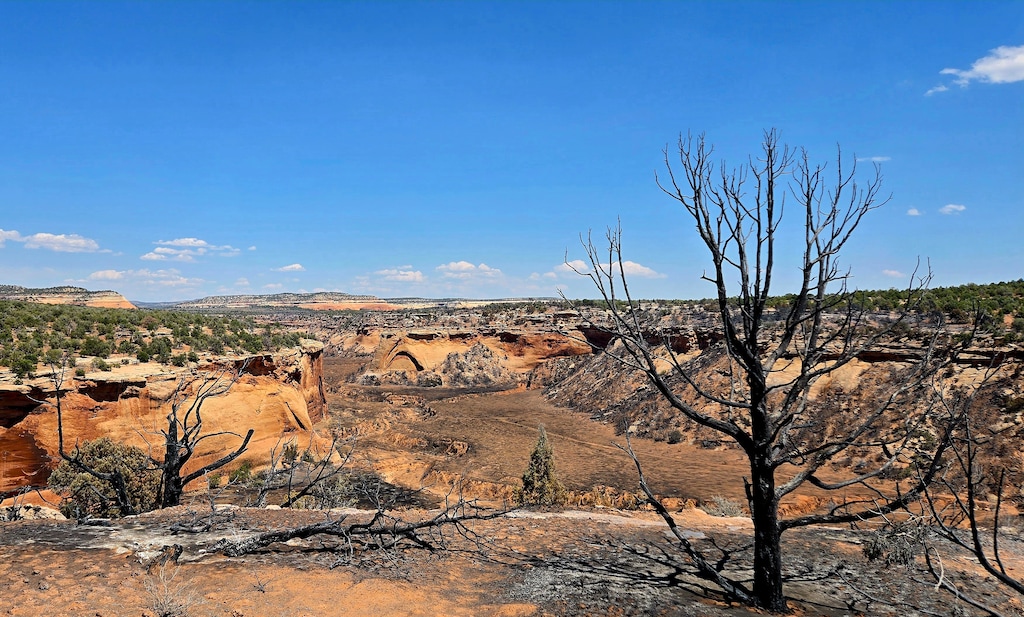
Investigators calculated that the larger Snyder Fire traveled nearly 7½ miles across mesas and canyons in less than three hours. Extremely dry vegetation and severe weather produced fire behavior that exceeded local expectations.
Earlier information placed the Snyder and Jones fires 7 to 8 miles from the crew — a distance local experience suggested would provide a safe buffer. Terrain and dense smoke blocked the crew’s view of the approaching flames, investigators found.
An aircraft carrying supervisors who coordinate firefighting aircraft and monitor conditions left the Snyder and Jones fires for fuel about 2:30 p.m. Severe turbulence and crosswinds of 40 to 50 mph prevented its replacement from taking off, leaving a roughly two-hour gap in coverage.
Helicopter personnel did not know about that gap. Confusion over radio frequencies and aircraft call signs led them to believe they were communicating with a supervisor monitoring those fires. The supervisor was actually working on another fire about 30 miles away, investigators found.
At 2:56 p.m., a helitack superintendent called Barker to tell her the helicopter was coming to evacuate all five firefighters, according to the report’s timeline. The pilot tried to reach them but could not find a safe path through the smoke.
By the time the flames approached, the crew could not reach a safe area on foot.
At 3:19 p.m., the firefighters deployed emergency fire shelters — portable, tentlike coverings designed to protect them from heat and flames — at the helicopter landing site between Knowles and Gore.
Investigators found that only nine seconds separated a radio transmission indicating the helicopter could no longer land from another reporting that firefighters were deploying shelters.
The surviving firefighter told investigators they struggled to remove their shelter from a compartment on their pack, and Barker offered hers.
“I thought she was talking about radios, but she was offering me her shelter,” the firefighter said in the report.
The firefighter freed their own shelter within seconds. Barker called out instructions to stay together and point their feet toward the fire, according to the survivor’s account.
A helicopter later rescued Matthews and the fifth firefighter. Both were eventually transferred to a Denver burn center.
Dispatch problems complicated the response
Investigators found that personnel on the Snyder and Jones fires did not know where the Knowles and Gore firefighters were relative to the advancing flames. The response lacked shared, real-time information about crew locations.
At the Grand Junction Interagency Dispatch Center, dispatch positions were staffed predominantly by trainees. Aircraft dispatchers also worked separately from those coordinating the initial ground response. Those conditions slowed information sharing and prioritization, according to the report.
Aging radio infrastructure, overloaded networks and an unfilled telecommunications position contributed to unreliable coverage and missed weather broadcasts. Personnel relied heavily on personal cellphones.
Delays in formally transferring the Snyder Fire between dispatch centers created additional work. Grand Junction dispatchers put resource requests on paper forms and sent them to the Moab center. Personnel there entered the orders into a computer system and routed them back to Grand Junction to fill, according to the report.
Investigators also found that staffing vacancies within Rifle Helitack limited its flexibility when responding to multiple new fires.
The crew members met or exceeded their position qualifications and complied with mandatory work and rest standards, investigators found. They described the emergency medical response as rapid, coordinated and thorough.
This story also appeared in The Times-Independent.