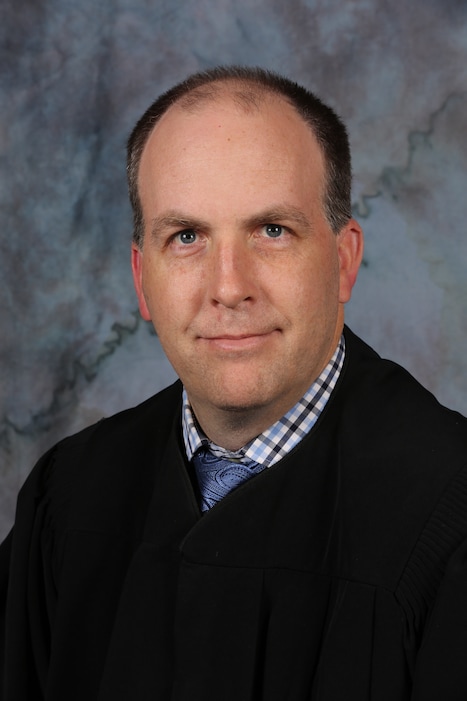
 Jordan Miller
Only one Utah judge on this year’s ballot received a recommendation from a state panel that he lose his job, but he’s asking voters to let him keep it.
Weber County Justice Court Judge Trent Nelson received the lone negative review from the Utah Judicial Performance Evaluation Commission, recommending his removal from the bench. All 13 members concluded he didn’t meet the standards.
When judges receive a negative review, they usually choose to retire, which keeps those evaluations from becoming public. Nelson is taking a rarer path: letting voters decide whether he stays.
Justice court judges are appointed by local government officials. Their names generally appear on the ballot every six years, when voters have the opportunity to decide if they should stay on the bench. The judges are not allowed to campaign or put up billboards because they aren’t running against another judge, only against public opinion.
The Salt Lake Tribune asked Nelson for an interview. He declined, saying he worried that commenting publicly could violate judicial rules which bar judges from campaigning for themselves. He did respond in writing to the commission’s recommendation, saying that he respected the evaluation process and was “happy to receive feedback,” which helped him “grow as a judge and a person.” He also invited people to form their own opinions by observing him in court.
“Independent court observers were universally positive about my courtroom abilities,” Nelson wrote in his reply to the results. “They unanimously find me to be professional and consistent, and reported with confidence that they would be treated fairly in my courtroom. Judicial philosophy: Once there’s a guilty finding, the focus turns to solving problems and addressing patterns of unsafe behavior.”
The Utah Judicial Performance Evaluation Commission is a group of experts who give the public recommendations. Its website provides assessments for all Utah judges who are on the ballot.
It includes information on a judge’s perceived legal abilities, judicial temperament and administrative skills. That feedback comes from attorneys and those who work in the justice system, as well as courtroom observers. Voters can explore the data and feedback so they have more information when they fill out their ballots.
After the commission’s recommendation, a Tribune reporter visited Nelson’s courtroom and observed how he handled cases, which are generally low-level misdemeanors. He worked with defendants whom he was fining and tried to ensure they could afford the monthly payments. He repeatedly told defendants that if financial issues came up and they couldn’t make a payment, they should call the court to work something out.
Nelson also didn’t hold back when repeat offenders showed up in his courtroom, and let them know if he thought they had been caught doing “dumb things.” He encouraged defendants to take responsibility: When a hearing was nearly over, he often would ask defendants, “Are you going to be successful? Who can stop you?”
Some respondents to a survey conducted by the commission reported that he often wasn’t patient with defendants and could be demeaning to those in his courtroom. One survey participant said the judge “indulges in extreme rhetoric and lecturing.” Survey respondents were attorneys, jurors, court staffers and litigants.
The commission’s evaluation also found that Nelson also failed to meet minimum performance standards for “legal ability, integrity, judicial temperament and procedural fairness.”
Nelson is the first judge in a decade to remain on the ballot after a negative recommendation. The last time a sitting judge chose to remain on the ballot after the commission called for removal was in 2016, said Mary-Margaret Pingree, the commission’s executive director. That year, the commission voted 7-2 against retaining 3rd District Judge Su Chon, who went on to be retained by voters in her area.
More recently, in 2020, nearly every judge was unanimously approved for retention by the commission — except for Tooele Justice Court Judge John Dow. Dow was still approved for retention but received the lowest tally from the commission that year after he shared a video of a man’s scrotum in a group text with people who work for him.
Dow was retained but resigned from the bench six years later.