 Jordan Miller
The Salt Lake City religious organization Summum has fought its share of battles through the years.
In the 1980s, it secured the state’s first wine license to create its sacred vino. Decades later, it took a free speech case all the way to the U.S. Supreme Court.
So when a proposal to build a 10-story development that could threaten the group’s sanctuary started making its way through City Hall, Summum decided the plan went a shade too far — and it started fighting back.
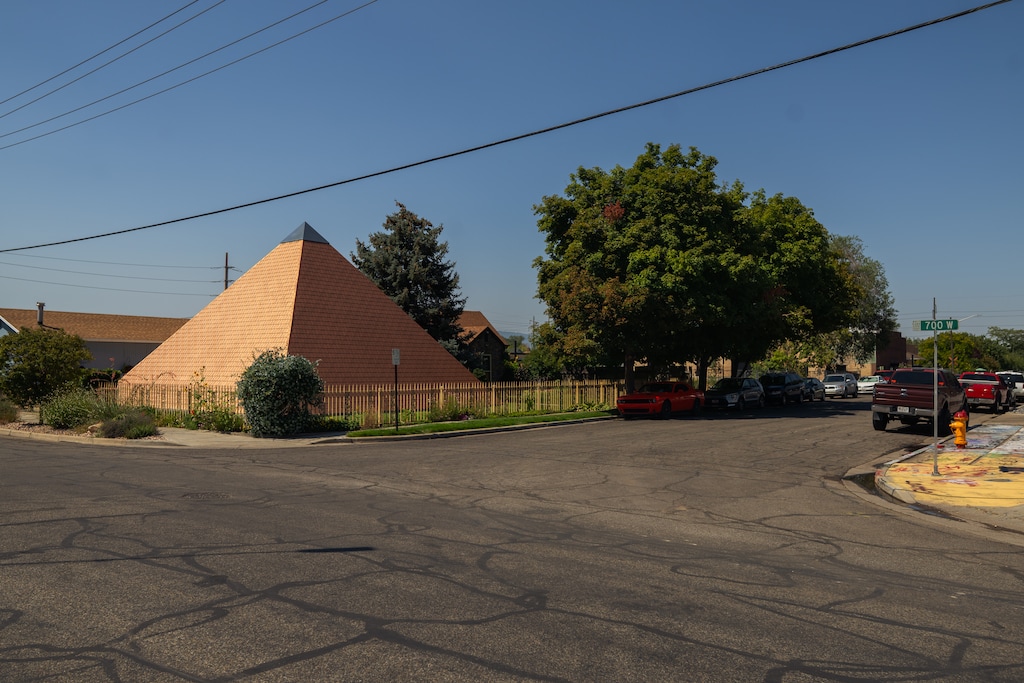
Summum built the glittering pyramid on its property at 707 Genesee Ave. in 1979 specifically for the location’s access to the sun, which is “vital” for the group’s practices, President Su Menu said. These practices include meditations, candle-lighting using the sun’s rays, and growing plants that are used to create sacred wines — what the group calls its “nectar publications.”
West End Apartments, which would be located immediately southwest of the sanctuary at 730 W. 900 South, would threaten the pyramid’s access to that sunlight for at least four months out of the year, disrupting its religious rites, according to documents Summum filed with the city.
Helix Architecture + Design, the company behind the development, first submitted its application for design review to the planning commission in December 2024, according to an appeal Summum filed with the panel. The proposal detailed two new structures: a parking garage and 10-story apartment complex.
The proposal did not include any information on how the design could impact Summum, according to the appeal.
The planning commission approved the design in June 2025, but Summum appealed that decision, and the city rescinded its approval the following September. The planning commission directed Helix to “provide additional information” on how the development would impact Summum’s religious practices.
Last month, after the company submitted a “shadow study” with that supporting information, the planning commission issued a preliminary approval for the structure.
When compared with other developments that could be permitted under current zoning laws, the planning commission’s decision letter says, the proposed development “provides equal or greater sunlight availability” across all dates and times measured throughout the year.
The developer could not be reached for comment.
Summum wrote in its most recent appeal — filed Oct. 2 — that the development’s study confirmed the building would create “substantial amounts of shade on Summum’s sacred property.” The study, the religious organization said, found that the new development would place Summum in some degree of shadow in March, June, September and December each year.
“Summum’s adherents cannot perform their religious sunlight practices in a different location because the Summum property was consecrated specifically for its religious purposes,” the appeal states, “and contains religiously significant crystals that are positioned in various locations on the grounds which are spiritually ‘programmed’ and which interact with the sunlight.”
Summum filed its second appeal with the assistance of Fabian VanCott, a Salt Lake City law firm. That appeal alleges the planning commission’s recent approval “amounts to a substantial burden of [Summum’s] religious free exercise,” and if the project goes ahead, it will violate the group’s rights under Utah’s Religious Freedom Restoration Act and its constitutional rights under the First Amendment.
“My Summum spiritual name means ‘giver of life to plants,’” Menu said in the appeal. “I don’t see how I can do that without the life-giving properties of the sun. With light being significantly diminished, our spiritual plants cannot survive and thrive in our greenhouse.”