 Jose Davila IV
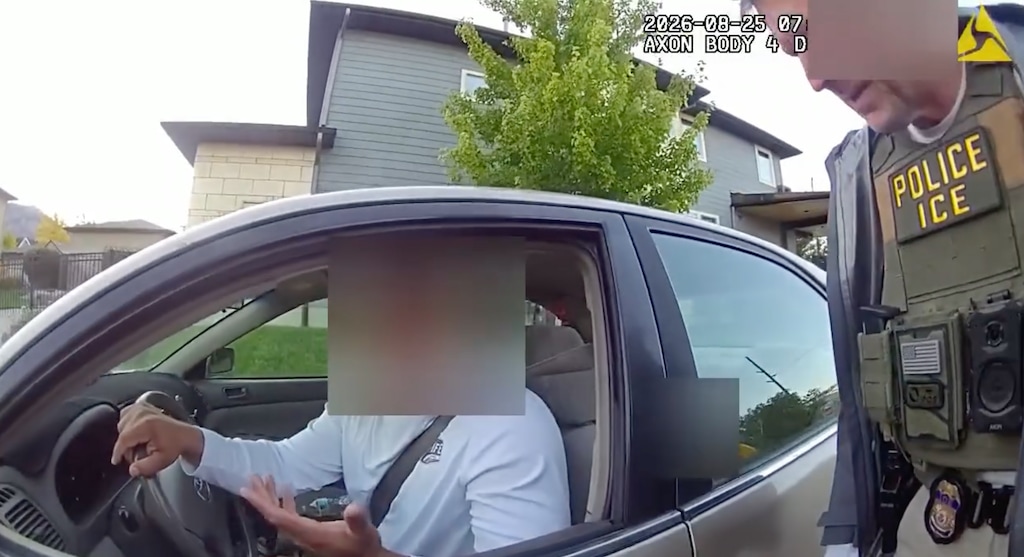
When he flagged down an Ogden police officer for help, the man was worried about the SUV that was following him.
A few minutes later, he was cuffed by a U.S Immigration and Customs Enforcement agent and put into that pursuing car’s front seat.
The Tuesday encounter, captured on a City Council member’s phone and shown more extensively on body camera footage shared by Ogden police on Facebook, sparked debate online about the city’s role in immigration enforcement. The officer, the department said in an accompanying statement, stayed on scene to ensure everyone’s safety.
“The Ogden Police Department did not initiate the stop, did not conduct the arrest, did not ask for or run any information, and did not assist with immigration enforcement,” the department said.
But while Ogden police insist they don’t help ICE, the video shows even officers are sometimes confused about their roles.
“I just don’t know the extent of what we’re allowed to do is,” the officer in this encounter told his supervisor during a phone call after the agent had handcuffed the driver.
Now, the Police Department says it will teach officers more about how to handle run-ins with ICE.
The arrested man is originally from Venezuela, a spokesperson with the Department of Homeland Security said. The agency said he illegally entered the U.S. in 2022 near Eagle Pass, Texas, and that he was in ICE custody.
The spokesperson did not say why the agent targeted the man or where he was being held.
The Salt Lake Tribune generally does not name people who have not been charged with a crime. Immigration violations are civil, not criminal, matters.
The DHS spokesperson did not directly address questions about the interactions between the federal agent and the Ogden police officer.
“Partnerships with law enforcement are critical,” the spokesperson said, “to having the resources we need to arrest criminal illegal aliens across the country.”
What happened?
The story starts with the Ogden police officer responding to a separate call near 22nd Street and Porter Avenue. The officer, according to what he later told his supervisor, was then flagged down by an ICE agent in an unmarked SUV. The agent asked the officer to stop a gold car nearby and the officer refused.
According to the Police Department’s Facebook post, the ICE agent drove away. That’s when the man in the gold car came up to the officer, reported that he was being followed by the SUV and said he didn’t know what was going on.
Recounting the story later, the officer relayed to his supervisor that he told the man “if you want to stop here, I’ll go talk to” the person driving the SUV, whom he knew was an ICE agent.
While the audio cuts out for a portion of the officer’s conversation with the agent, the department’s post said the federal agent indicated “he was waiting for a second ICE agent to arrive as backup to make the arrest.” At the end of the interaction, however, the officer told the agent, “I’ll just walk up and talk to him.”
“If he’s stopped, if you just want to pull up behind him and make contact with him,” the officer added.
That’s exactly what happened.
The officer did not inform the man that the unmarked SUV was ICE when he went back up to him. Instead, he asked whether the man had any weapons and if he had a DoorDash delivery in his backseat.
The ICE agent then makes the arrest without backup from another agent. Once the man was handcuffed, a second agent arrived.
Criticism of ‘coordinated’ detention
Ogden City Council member Kevin Lundell captured the end of the stop with his phone.
“At the end of the day, what we witnessed was an Ogden police officer make a coordinated plan to detain a person, and that was unfortunate,” Lundell said in an interview. “That’s not what we’ve been told that their job is.”
Lundell’s video shows an additional interaction after the arrest between the first agent and police officer. The agent runs up to the officer’s cruiser and tells him “thank you” and “good job.” Before this happened, the Ogden officer shut off his body camera — something department policy allowed him to do.
The council member said he understood that the officer was in a tough position. He wants the department to clear up what officers can and can’t do during an interaction with ICE.
Kim Haslam, an organizer with immigrant advocacy group Ogden United, agrees.
“We have been asking for months for OPD to have clear policies and guidelines on what they should do in their interactions with ICE or in those situations,” she said. “And so I think the blame is on the higher-ups and OPD for not having clear guidelines.”
Lundell tried to pass a resolution through the City Council to clarify rules for officers earlier this year, but city attorneys said the panel did not have the authority to set policy on how the department’s staff interacts with federal law enforcement agencies.
The incident is spurring some changes for the department, though, Capt. Matt Ward said in an interview Thursday.
“We’re working on some stuff right now as far as some clearer direction to our officers because it’s a tough situation currently with the political climate,” he said. “So, officers get nervous about being the next person put on video, put online for everybody to pick apart what they did, so we are working on some more clear direction to send to our officers in regards to how they’re going to be expected to interact.”