 Sean P. Means
Update • Memorial service information has been added to this article.
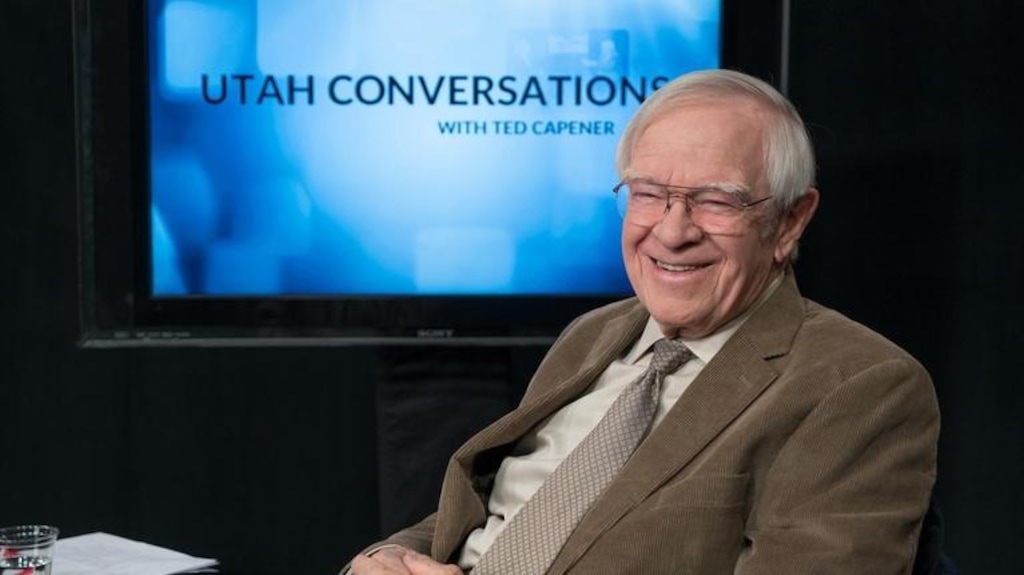
Ted Capener, a journalist and executive who was an unflappable interviewer on Utah public television and an influential builder of the University of Utah’s public image, has died.
Capener, who hosted interview programs on PBS Utah for 35 years and held executive positions at Bonneville International and the U., died Monday, the university announced Thursday afternoon. He was 94.
In 1985, Capener was hired away from Bonneville, the parent company of KSL, to be the U.’s vice president for university relations — a post he held until he retired in 1999.
Fred Esplin, a Salt Lake Tribune board member who worked under Capener and succeeded him as vice president, said Capener worked diligently to mold how people saw the U. The job then included overseeing the its athletic department, alumni association, marketing and communication, KUED and KUER, and such university-based institutions as Red Butte Garden and Pioneer Theatre Company.
Chris Nelson, the U.’s current vice president for university relations, said that “Ted would meet people where they were at in their relationship with the U. He would always ask for their stories, and he would ask about their connection to the U. … He was a storyteller, and he was just endlessly curious.”
One of Capener’s accomplishments, Esplin said, was establishing a relationship with the Ute Indian Tribe to get permission for the use of the school’s Utes team name. Part of that relationship, Esplin said, involved getting rid of the school’s old mascot, a Native American caricature, and replacing it in 1996 with Swoop, the red-tailed hawk figure that now works the sidelines at U. games.
Capener hired Mary Pat Matheson to run Red Butte Garden, Esplin said, and together they launched a small series of four concerts in 1987 to draw visitors to the garden.
“It began as a very modest affair,” Esplin said. “No buildings or anything — just a small stage.” This summer, 39 years later, the Red Butte Garden summer concert series staged more than 30 shows featuring internationally known headliners from Alabama Shakes to Ziggy Marley.
Capener also is credited with launching the school’s magazine, Continuum (now University of Utah Magazine), overseeing construction of the Dolores Dore Eccles Broadcast Center — home to KUER and PBS Utah — and creating the Crimson Line dance team and reinvigorating the U.’s marching band.
Capener, Esplin said, “was an ideal boss. He had keen insight, a real clear sense of the importance of people and morale and positive reinforcement.”
Capener “knew talent,” Esplin said, citing his 1987 hire of Chris Hill to be the U.’s athletic director. Hill held that job for 31 years, and is credited with negotiating the U.’s way into the Pac-12, and recruited Rick Majerus as basketball coach and Ron McBride, Urban Meyer and Kyle Whittingham to coach the football team.
35 years of interviews
Television viewers knew Capener as the host of two long-form interview programs on PBS Utah, “Civic Dialogue” and “Utah Conversations.” Capener’s presence on the university-based TV station started shortly after he took the vice president job at the U. and lasted through 2020.
From 1986 to 1990, Capener also served on PBS’ national board of directors.
On his interview shows, Capener “tried to really personally connect with the guest sitting across from him,” said James Davie, PBS Utah’s station manager.
“No matter what discipline they were in, no matter what the conversation was going to be about,” Davie said, Capener “was going to be prepared, and he was going to make that guest feel like they were the absolute focus of attention for 30 minutes.”
Capener interviewed more than 250 people on the PBS Utah shows. On the final show, Capener was the subject, interviewed by another station personality, producer Mary Dickson. That episode will be rebroadcast Sunday, 5:30 p.m. Mountain time, on PBS Utah, Davie said.
Davie’s first job at PBS Utah, long known by its call letters KUED, was as an intern on “Civic Dialogue” (later renamed “Utah Conversations”). “I was so green I didn’t understand quite how intimidated maybe I should have been,” Davie said. “And Ted was never the sort who would make you feel intimidated.”
Capener, Davie said, “was a very dedicated and serious-minded journalist, but he was also quick to laugh, so kind to everyone on the crew, so invested in the guests that he had in.”
Early days in journalism
Theodore Robert Capener graduated from the U. in 1953 and started his career in broadcast journalism as a farm reporter. He was hired at KSL Radio in 1958.
Esplin was a student at Southern Utah University when he met Capener, who was KSL’s news director at the time, and Esplin worked as a stringer for KSL and The Salt Lake Tribune.
Later, when Esplin was living in Washington, D.C., he met up again with Capener, who was Washington bureau chief for KSL’s parent organization, Bonneville International.
Capener, Esplin said, “was a rigorous journalist who took the profession very seriously, and he really raised the standards of KSL. … They were the gold standard in broadcast journalism for years.”
As Washington bureau chief, Capener was a correspondent for Bonneville’s 14 radio and TV stations, covering congressional delegations for eight states. One highlight of his Washington career was grilling President Richard Nixon during the Watergate scandal.
For much of his KSL career, from 1964 to 1972, Capener was Bonneville’s vice president for news and public affairs. In 1983, he was named Bonneville’s senior vice president for news, public affairs and research. Two years later, he left Bonneville for the U.
Capener’s wife, Judy, died in 2024. Their son Ted Jr. died in 2018. Capener is survived by a daughter, Amanda Rasmussen, and a son, Andy Capener; as well as 11 grandchildren, 11 great-grandchildren, his brother Danny and several in-laws, nieces and nephews.
A memorial service is scheduled for Saturday, Sept. 26, at 11 a.m., at The Church of Jesus Christ of Latter-day Saints meetinghouse at 2625 E. Milo Way, Holladay. Visitation will begin at 10 a.m. that day. In lieu of flowers, the family requests people donate to the Utah Food Bank or The Nature Conservancy.