The University of Utah has a new supercomputer that could super-charge how fast researchers and innovators can tackle some of the state’s biggest problems.
Called Redtail, the “AI factory” supercomputer came online just this summer as a statewide resource — meant for researchers, students, entrepreneurs and state agencies.
Already, Redtail ranks fifth among supercomputers at public universities in the U.S., behind only Texas A&M University, the University of Texas at Austin, the University of Illinois Urbana-Champaign and the University of Florida.
Internationally, Redtail debuted at No. 159 on a June list of the world’s fastest computers, according to a university news release. But U. President Taylor Randall said it’s more than its computing speed.
“It is the foundation of Utah’s AI future,” he said in a statement.
Not just a computer
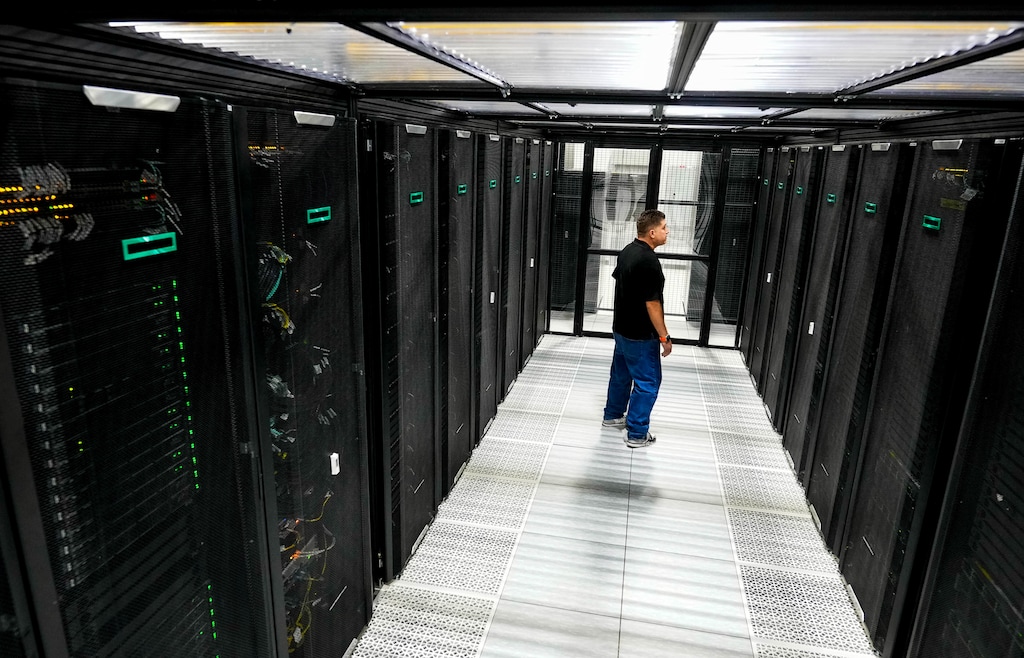
(Francisco Kjolseth | The Salt Lake Tribune) A cold isle containment cage houses what is ranked among the world’s fastest and greenest supercomputers, in a University of Utah data center facility in Bluffdale, pictured Tuesday, Aug. 18, 2026.
Manish Parashar, the U.’s chief AI officer and executive director of its Scientific Computing and Imaging Institute, described Redtail as an “AI ecosystem.”
“A supercomputer is a computer that allows you to solve problems, explore solutions that you wouldn’t be able to do otherwise,” Parashar told The Salt Lake Tribune. “It’s a collection of small computers that come together and bring their collective power towards solving big problems.”
What surrounds the hardware, he said, matters just as much: software stacks, data infrastructure, networking and — the piece he returned to repeatedly — the people.
Their expertise, he said, can help users “use it most effectively, but also responsibly, so that they’re using it in a way that aligns with Utah’s broader pro-human initiative.” The state initiative calls for AI development and usage in Utah to be both human-guided and human-enhancing.
At the U., Redtail is the product of a $50 million public-private partnership involving the state, the university and the Huntsman Family Foundation, spread across five years.
How could Redtail impact Utahns’ everyday life?
(Francisco Kjolseth | The Salt Lake Tribune) Anselmo Chapa Garza is pictured at the cold isle containment cage that houses Redtail.
“There are challenges with AI being technology-hungry,” Parashar acknowledged. “There are impacts around power and cooling that go with running a computer.”
The university’s answer, he said, was to avoid building anything new. Instead, Redtail was placed inside what Parashar called the most efficient data center in the state — the U.’s Center for High Performance Computing (CHPC), an air-cooled site already in operation.
“We’ve tried to right-size the size of this system, so there’s no direct, noticeable impact,” he said.
He described a three-part mitigation approach: technical research into cooling and application efficiency; operational choices; and an education effort, aimed at getting Redtail’s users to weigh whether each computation is worth its cost.
“We’re trying to make sure that we are making people aware that this is a tool — it has tremendous positive impacts to the state,” he said. “But there are possible negative aspects, and you have to address them and use it responsibly.”
In time, Redtail has the potential to help researchers solve issues related to water and energy — not just exacerbate them, Parshar said.
Call for proposals
(Francisco Kjolseth | The Salt Lake Tribune) A cold isle containment cage at the University of Utah's data center facility in Bluffdale.
Who could soon be able to use Redtail? That depends on who is selected through the U.’s current call for proposals.
The call invites “researchers, educators and innovators” throughout the Utah System of Higher Education to pitch why their project should receive early access.
These projects will help understand what the supercomputer’s workflow can look like and also help work out any interface kinks.
Researchers at Utah State University, Utah Valley University and Salt Lake Community College are among those expected to compete for access.
Eventually, Parashar said, researchers will submit jobs through a web portal much as they would with other national or commercial cloud resources.
He envisions Redtail’s computing power as a model for other states to emulate.
Every state, he said, is struggling with the same problem — how to give citizens, researchers and students access to computing — and Utah’s arrangement of state money and philanthropy with a public university is one answer.
“When we have collective problems, we can share resources to address them,” he said.