 Sean P. Means
When people hit a milestone birthday, they like to have a big celebration. The same goes for the country.
This July 4 marks the 250th anniversary of the signing of the Declaration of Independence, and Utah is organizing a raft of events to mark “America250” — including parades, town fairs and fireworks shows.
It’s not the first time Utah has thrown a big party for the country’s birthday. I looked through The Salt Lake Tribune’s archives to find out how Utahns marked the country’s centennial (in 1876), sesquicentennial (in 1926) and bicentennial (in 1976).
200th birthday (1976): A day at Lagoon
(Utah State Historical Society) A 1970s-era photo of a roller coaster at Lagoon amusement park in Farmington. A day of activities at Lagoon was one of the big Utah events on July 4, 1976, the nation's bicentennial.
Celebrations for America’s bicentennial started six months earlier, on Monday, Jan. 5, 1976, with an event at the Salt Lake Tabernacle to mark 80 years since Utah’s statehood.
The country was less than two years removed from the Watergate scandal and President Richard Nixon’s resignation.
Months of planning went into the state’s formal four-day commemoration, which involved a fair at Salt Lake City’s City Hall, a parade and a concert on Sunday, July 4, with a 500-person choir and an address from Norman Vincent Peale, the clergyman who wrote “The Power of Positive Thinking.”
The final day included an expanded version of the annual “Old Fashioned Fourth of July” at the Lagoon amusement park in Farmington, which drew 55,000 attendees to a classic car show, bicycle races, a watermelon-eating contest and more. The high hit 97 degrees, and about 10,000 kids there were given free sun visors.
The Lagoon event was free, except for parking and the gravity-defying rides, including the Jet Star 2, which was new to the park that year and lasted until 2025.
150th birthday (1926): Cars in the canyons
Most of America’s 150th birthday celebrations in Utah fell on Monday, July 5.
“Perhaps Liberty Park was the scene of the most concentrated activities,” The Tribune reported in its July 6, 1926, edition. “The great green lawns were dotted with picnicking groups and the playgrounds were thronged with boys and girls bent on having a strenuous good time.”
(Salt Lake Tribune) The float of the Independent Ducats Organization in the 4th of July parade in Eureka around 1900.
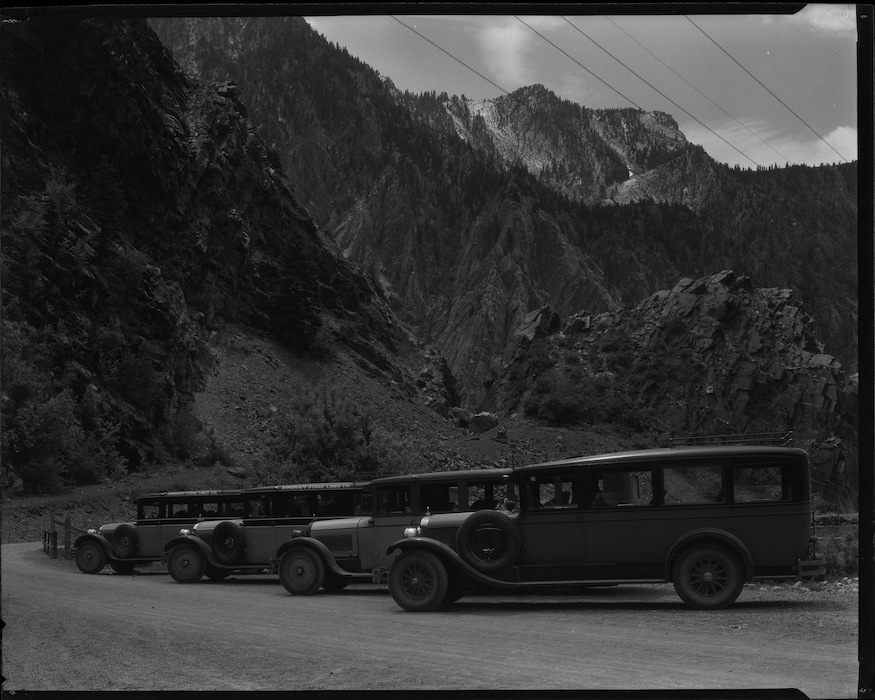
Many Salt Lakers also took advantage of a fairly recent invention — the automobile — and headed up into the canyons.
“Perhaps never in the history of the city have the canyons been as invaded,” The Tribune wrote, apparently not imagining the “the red snake” present-day Utahns have come to expect each ski season.
(Utah State Historical Society) A man stands next to his Oldsmobile at 11th Avenue and B Street near City Creek Canyon, 1919.
During the three-day weekend, the reporter added, “thousands of automobiles carrying thousands of passengers have propelled their way up mountainous slopes to icy streams, where trout lingered under shady shrub-edged streams and pines filled the air with a faint, fresh aroma.”
Meanwhile, in the city, The Tribune reported, those fleeing Salt Lakers were replaced temporarily by more rural residents.
“From the country, seeking the newness of other pleasures, came hundreds and even thousands of holiday visitors to the parks and resorts of Salt Lake City,” The Tribune reported.
100th birthday (1876): Oratory and baseball
(Utah State Historical Society) A drawing from 1887 of Fuller's Hill Pleasure Gardens west of the University of Utah, believed to be Utah's first amusement park — and a popular destination to celebrate the nation's centennial on July 4, 1876.
Many Salt Lakers marked the nation’s centennial the same way: by getting out of town.
“The Fourth in the city was observed by an almost total suspension of business, and the cars on the Utah Central and Utah Western carried away thousands of our citizens,” according to an article in The Salt Lake Daily Tribune on July 6, 1876.
One holiday venue, the article said, was Fuller’s Hill Pleasure Gardens, said to be the state’s first amusement park, on a hillside just west of the University of Utah. (The area today is filled with houses and apartment buildings between 900 East and the edge of the university.)
Under the “blazing hot sun,” Judge Joseph C. Hemingray — a leader in the “anti-Mormon” Liberal Party — gave a 30-minute speech on “the heroic sacrifices made by our forefathers in the achievement of their liberties, and then touched on the principal political topics of the present time,” though the article doesn’t detail what those topics were.
Other festivities at Fuller’s Hill included a “well attended” theater performance and a dance that “was kept up till past midnight,” the piece noted, adding that “the display of pyrotechnics at private houses was quite liberal.”
(Salt Lake Tribune) Groups of people take boats out on the lake at Salt Lake City's Calders Park, modernly known as Nibley Park, in 1887.
Ogden residents enjoyed similar festivities, with speeches and patriotic music. The city was also the site of a “hotly contested” baseball game between the Longstroke club of Willard City and Salt Lake City’s Deserets, The Tribune reported. The Deserets won, 31-13.
East of Salt Lake City, “small parties went up the several canyons and celebrated on their own hook,” The Tribune reported. “They were generally well provisioned, and enjoyed themselves hugely. … These parties, we believe, had the best time of any of the celebrations in Zion.”
(Salt Lake Tribune) Salt Lake City's 4th of July parade in 1896. The celebration, the first after Utah received statehood, lasted three days with parachute jumpers, bike races, athletic events and fireworks.
Sean P. Means has been reporting and editing for The Salt Lake Tribune since 1991 — including 25 years as movie critic. Since 2018, he has reported on arts and culture reporter, and breaking news — and was part of The Tribune’s COVID-19 reporting team. He reviews movies for MovieCricket.net and X96’s “Radio From Hell” program.