 Andrew Christiansen
Arches National Park recorded 180,978 recreation visits in April, marking its busiest April since 2021 during the first peak visitation season in several years without timed-entry reservations.
The total was up about 11.7% from last April, according to National Park Service data. Through the first four months of 2026, Arches has recorded 438,464 visits, nearly 10% more than during the same period last year.
Arches experienced a record year for visitation in 2021, capping a decade in which visitation increased roughly 74%. Growing concerns about congestion, crowding, parking shortages and visitor experience helped prompt NPS to launch a pilot timed-entry reservation system in 2022.
Visitation trends varied across Utah’s national parks in April. While Capitol Reef recorded a 45.4% increase compared to last April, visitation declined 2.1% at Zion, 4.6% at Bryce Canyon and 5.2% at Canyonlands, according to NPS data. The results contrasted with March, when all five of Utah’s national parks posted year-over-year visitation increases and several set monthly records.
Sam Wainer, executive director of the Canyonlands Natural History Association, cautioned against drawing a direct connection between Arches’ visitation increase and the absence of timed-entry reservations, saying a variety of factors may influence travel patterns from year to year. CNHA operates the Moab Information Center and visitor center stores at Arches and Canyonlands national parks.
NPS announced in February that visitors would not need timed-entry reservations to enter Arches in 2026. The system had previously been used during peak visitation months from 2022 through 2025, beginning each year in April, to spread visitation throughout the day and reduce congestion.
The National Park Service’s Intermountain Region told The Times-Independent national parks are taking a park-by-park, conditions-based approach to managing visitor access.
“In some locations, a comprehensive evaluation of traffic patterns, parking availability, and visitor use showed that a season-long reservation system was not the most effective tool,” NPS said in an email.
Instead, parks are using tools such as real-time traffic monitoring, active parking management and additional staffing to support safe access while protecting park resources, according to the agency.
NPS said operational strategies implemented at Arches this spring — including encouraging advance pass purchases, streamlining entrance booth interactions and using handheld tablets to check passes of vehicles waiting in line — have been effective at reducing entrance wait times and congestion.
Earlier this spring, NPS said new employees were still arriving and being trained while the park continued recruiting for additional seasonal and permanent positions. In its latest response, NPS said local recruitment for vacant positions remains ongoing but did not address whether staffing levels have improved since then or whether the agency considers the park adequately staffed heading into the summer season.
According to NPS, park staff have not needed to “flush” the entrance line since March, when the handheld tablets became operational. Earlier this spring, Sharon Kienzle of the Canyonlands Natural History Association said staff occasionally allowed vehicles to enter without stopping to check passes or collect fees during periods of heavy congestion to prevent backups from extending toward Highway 191. At the time, she warned that the practice could contribute to crowded conditions elsewhere in the park.
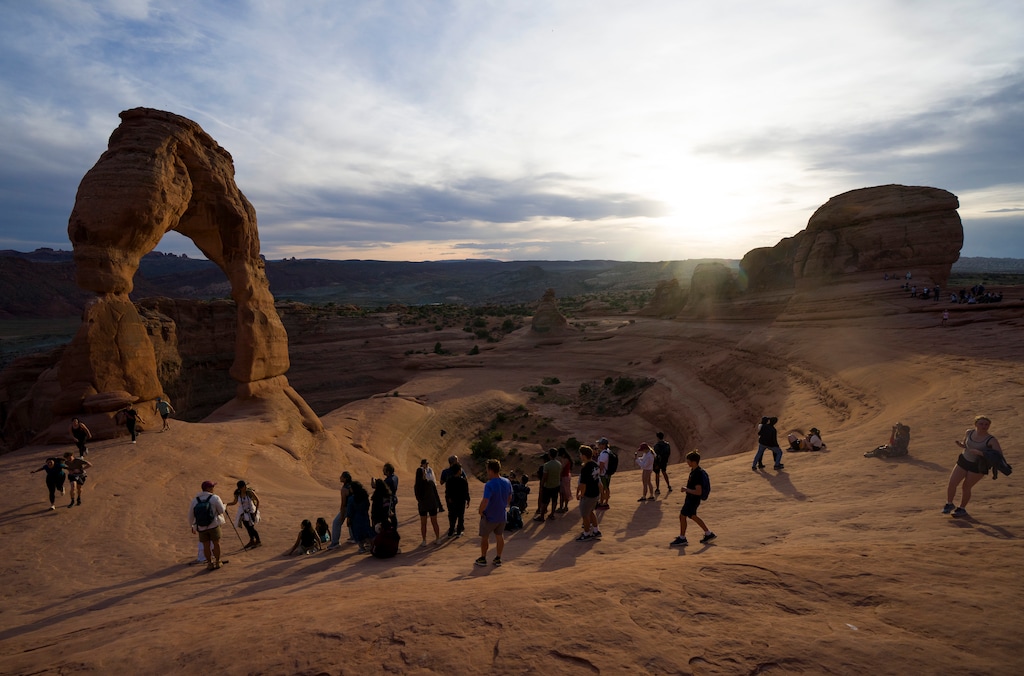
However, congestion remains a challenge at some of the park’s most popular destinations.
NPS said visitors encountered full parking lots during busy periods this spring and that staff implemented temporary 30-minute closures at Delicate Arch and The Windows over Memorial Day weekend until parking spaces became available.
(Bethany Baker | The Salt Lake Tribune) Visitors review trail information near Double Arch in Arches National Park near Moab on Thursday, April 9. Some visitors have continued reporting crowded trails and limited parking at popular destinations this spring.
To reduce wait times and congestion, NPS encourages visitors to purchase entrance passes online or at the Moab Information Center before arriving, check the Arches entrance station webcam for current conditions and consider visiting before 7 a.m. or after 2 p.m. The agency also encourages visitors to remain flexible and explore less-traveled areas when popular destinations are crowded.
Kienzle, who’s the retail sales manager for the CNHA, said visitors have continued reporting concerns about parking availability and crowding throughout April and May.
“We are hearing more and more comments about the lack of parking at the trailheads,” she said. “The trails are congested and visitors are trying to navigate the crowds while trying to enjoy the views.”
Wainer said the busiest period at the entrance station typically occurs between 9 a.m. and 11 a.m., before traffic tapers off during the afternoon and increases again later in the day.
Wainer said Memorial Day weekend traffic generally moved smoothly through the entrance station, but “things were not as smooth in the park at some of the parking lots.”
Sales at CNHA-operated park stores have generally tracked with visitation trends, Wainer said. While sales remained strong in May, year-over-year growth slowed compared to April.
This story was first published by The Times-Independent.