 Samantha Moilanen
Kathryn Macdonald-Poelman is tired.
The 35-year-old Sugar House mom has spent the past decade trying to balance a career in public health with raising three young boys alongside her husband.
But maintaining a career she is passionate about while building the family she loves, she said, has come at a cost. For several years, she only worked part-time because she couldn’t afford full-time childcare for her children.
Now, the rising cost of childcare has made the future she once envisioned feel increasingly out of reach.
“It’s a such a financial burden on its own, and it’s such a stress finding high-quality childcare solutions that feel safe for your kid,” Macdonald-Poelman said, “that it has impacted our family planning.”
More than 40 parents who responded to a Salt Lake Tribune survey described childcare as one of the largest expenses in their household budgets — a cost that, for many, rivals a monthly mortgage or rent payment and increasingly shapes decisions about work, finances and whether to grow their families.
On average, center-based infant care in Utah last year totaled about $14,533 annually, or $1,211 a month, while care for a toddler was about $11,626 a year, or $968 a month. That’s according to annual data collected by Child Care Aware of America, a national childcare advocacy and research organization.
That means childcare for just one infant can consume roughly 12% of a Utah married couple’s median income, far above the federal affordability benchmark of 7%, according to Child Care Aware’s report.
The gap between wages and childcare costs is forcing families like Macdonald-Poelman’s into tradeoffs: one parent scaling back work, planning for fewer children, or dedicating a full paycheck entirely to childcare, state and national analyses consistently show.
At times, Macdonald-Poelman said, childcare has cost about $500 more each month than her mortgage. Her entire paycheck went to those costs, while her husband’s income covered rent, groceries, gas and everything else.
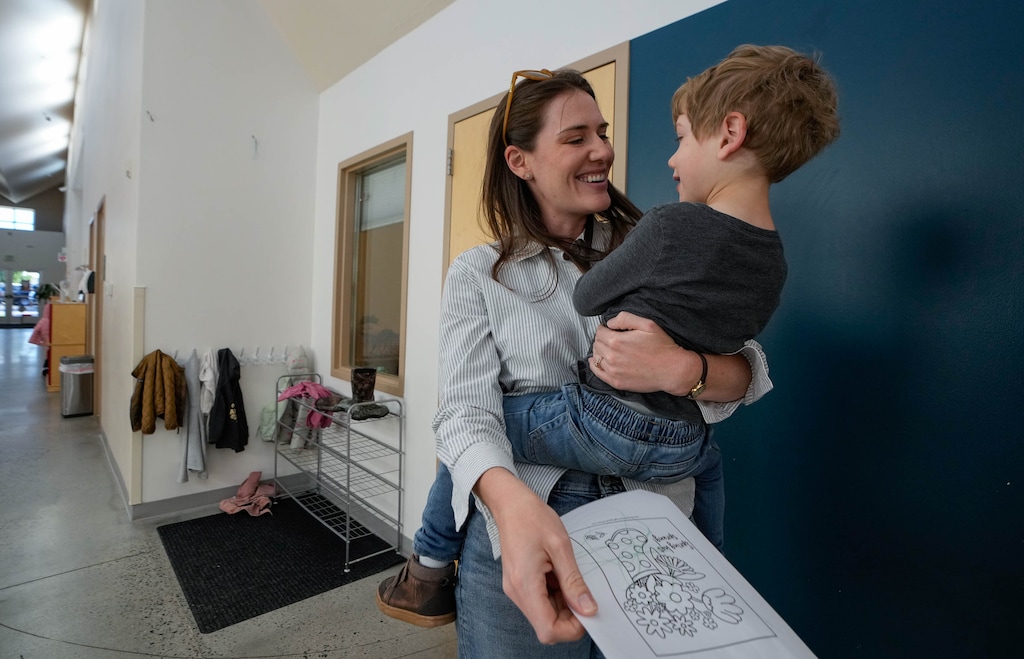
(Francisco Kjolseth | The Salt Lake Tribune) Kathryn Macdonald-Poelman, a mother of three, picks up her youngest son Ezra, 3, at the Dancing Moose Montessori School, a private child care center and preschool in West Valley City on Tuesday, May 19, 2026.
Now that her two oldest children are in school, she pays about 23% less to cover part-time care for her 3-year-old, Ezra. That amounts to about $700 a month.
Full-time care would be nearly double, or about $1,300, she said.
“We grew up being fed this lie that we could have it all as women,” she said. “You can have the family that you want, you can have the career that you want.”
Cutting back to afford care
To afford full-time care, Rachel Brewer said she has had to make tradeoffs, too.
The single mother pays about $2,680 a month to enroll her 1-year-old and 4-year-old in a childcare and preschool program in the Salt Lake Valley — a cost she said is necessary to keep working her full-time job.
But making the numbers work has meant cutting back elsewhere.
“I have paused putting money into my retirement account,” Brewer said. “I really limit any sort of activities that I’m able to do with the girls. … I’d love to have them be taking swimming lessons and sports and activities, but you just try and be very selective."
(Francisco Kjolseth | The Salt Lake Tribune) Rachel Brewer, a mom in West Jordan, picks up her daughters Rebecca, 4, and Sarah, 1, at Creative Learning Academy of Utah, a day care center in Murray on Tuesday, May 19, 2026.
For Draper resident Conner Leoncini, affording part-time care for his two kids while he and his wife, Cheyenne, work full-time has meant carefully splitting the day between schedules and drop-offs.
During part of the week, Cheyenne drops their youngest off on her way to work in the morning. Leoncini spends the first half of his day working from home. Then, he takes their older child to preschool, heads into the office for the afternoon and later picks up both kids before returning home to finish his workday.
His mother watches the kids two days each week, saving the couple about $700 a month, he said.
“I’m paying $2,000 a month — like there is not extra money to go on trips or vacations, or to be backed up to have fun with,” Leoncini said. “We are living very much within our means to make sure we don’t put ourselves in trouble.”
(Conner Leoncini) Cheyenne and Conner Leoncini at a restaurant with their kids Hudson and Holden.
Brewer said she considers herself “lucky” to have found care she trusts and can afford, but that sense of stability still feels “tenuous.” She worries about the center one day closing, or losing the job that gives her the ability to pay for it.
Her concerns come as some licensed childcare centers are shutting down, such as the four county-run daycare programs in Salt Lake County set to close at the end of May.
Utah has 513 licensed childcare centers, down from 523 the year before, according to the 2025 data from Child Care Aware.
‘We need a village’
Salt Lake City residents Brody Froelich and Natalie Bramwell opted not to enroll their now-5-year-old son in center-based care because of how expensive it is.
Instead, they have adjusted their work schedules over the past five years to make it work. But it has taken a village, they said.
Rather than hiring sitters, Bramwell said the couple often relies on other parents in a shared network who “trade” watching each another’s children. At times, she has also brought her son to work.
She said being open with other parents about the challenges of balancing work and care has helped make the arrangement possible.
“It’s just saying, ‘Hey, we need a village — can we team up?’ Bramwell said. “And then the other parents are like, ‘Yes, please.’”
(Brody Froelich) Brody Froelich and Natalie Bramwell with their 6-year-old son, Luka Froelich.
While Macdonald-Poelman said she feels “privileged” compared to parents facing fewer options, she said childcare has still shaped what her family can afford — and can’t.
For a moment, she said, the 2021 debate over former President Joe Biden’s Build Back Better plan, which included major childcare subsidies, made another child feel possible while pursuing her career.
“I could actually have a piece of myself and have the family that I’ve always wanted,” she said.
But when it failed to pass Congress, she said, that possibility faded with it.