 Mark Eddington
St. George • Since great horned owls are commonly found throughout North America, some might question who, if anyone, would give a hoot about seeing one.
Well, Red Hills Desert Garden is not just anywhere. This Edenic oasis is so good, TripAdvisor tabs it as one of St. George’s top tourist attractions, sporting more than 5,000 drought-resistant flora for visitors to fawn over.
And now, some newfound fauna is adding to the flora’s already considerable allure, bringing scores of visitors to the garden that is owned and operated by the Washington County Water Conservancy District.
A mother great horned owl and three owlets have taken up residence on a patch of Red Cliff Desert Reserve Land bordering the garden on the north. District officials learned about the nearby owls two weeks ago from a birder at the garden.
(Elizabeth Bennett) A great horned owl and her owlet appearing from a cliffside nest at Red Hills Desert Garden in St. George.
Doug Bennett, the district’s water conservation manager, initially thought to keep news of the owls nestled high up in a cliffside cavity on the down-low. That was before pictures of the mother and her brood began popping up on social media, prompting swarms of people to flock to see them.
Now, the district has posted its own videos on social media.
“Some people have asked, ‘Why did you put this on Facebook if you are trying to protect them?’” Bennett said. “But we thought it would be better to educate people about the owls and set up a controlled environment where they could see them rather than let everyone run among the birds unsupervised.”
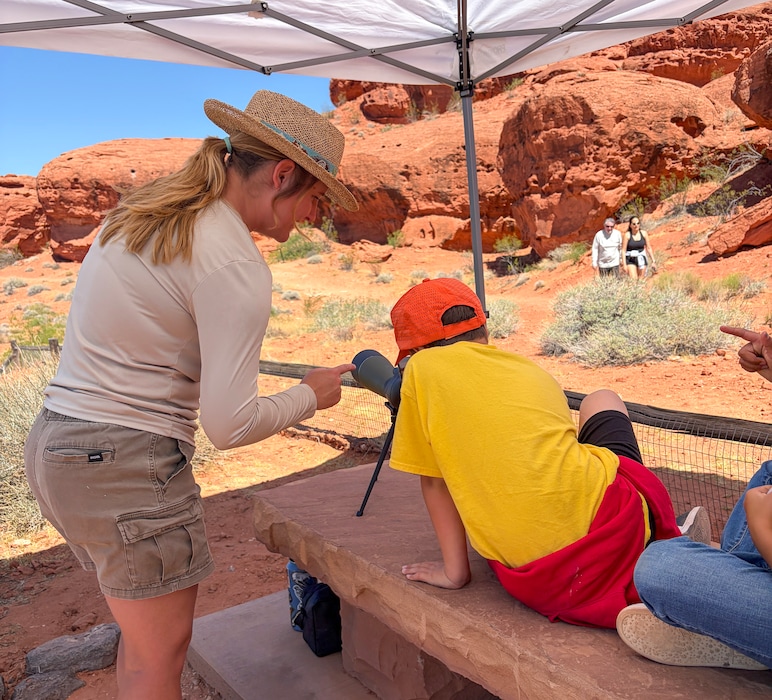
To that end, Bennett said, the district and reserve officials teamed up to erect a defensive perimeter to keep over-exuberant visitors from getting too close. In addition, Bennett and garden staff monitor the site, simultaneously protecting the family and educating sightseers about the birds.
That dual mission, the conservation manager added, has become more challenging recently due to two factors: a surging number of visitors and the fact that two of the owlets have recently fledged. Having leaped 25 feet from their cliffside home to the ground, the young birds are now sheltering among the rocks, monitored by their mother and sibling from above.
DoorDash for owls
(Mark Eddington | The Salt Lake Tribune) A great horned owlet is seen appearing from a cliffside nest near Red Hills Desert Garden in St. George.
Bennett, who majored in wildlife biology at New Mexico State University, said the fledglings are vulnerable at this stage because they are weeks away from being able to fly and won’t be able to hunt until fall.
Still, the fledglings, which he estimates to be between eight to 10 weeks old, are not on their own. Even though the owlets’ father has vacated the nest site to make room for the mother and her owlets, Bennett said he is still roosting in the area.
“He still does DoorDash at night and delivers food to the whole family,” he said, adding that the mother also helps out with nocturnal hunting and feeding chores. “It’s important for one of the parents to stick close by because ravens, bobcats, foxes and coyotes will try to eat their fledglings that are on the ground.”
As devoted as great horned owl parents are, most owlets don’t survive to adulthood.
“Everything owls do during that first year is learned,” said Martin Tyner, founder and CEO of Enoch Wildlife Rescue. “They don’t know what a car is until it nearly kills them. They don’t know what a window is until they run into it, and they don’t know what a power pole is until they possibly get shocked. So the mortality rate with most birds of prey during that first year is about 80%.”
All eyes and ears
(Elizabeth Bennett) A great horned owl and her owlets appearing from a cliffside nest at Red Hills Desert Garden in St. George.
So if great horned owls are so common, what makes them special and so fascinating to “bird nerds,” the self-deprecating nickname members of the bird watching community apply to themselves?
According to the Cornell Lab of Ornithology, North America’s largest owl by weight is a powerful predator. From backyard bug-catcher to apex avian, this owl is a formidable and versatile predator, capable of tackling anything from a tiny scorpion to prey twice its size.
For some, Tyner said, it is the raptors’ powerful eyes. Even on a moonless night, under heavy cloud cover and 200 miles from the nearest town, he explained, the great horned owls can see as well as humans in bright sunlight.
While their eyes are permanently affixed to their skull, he continued, the owls have twice as many neck bones as humans, which enable them to move their heads twice as far and really lock their vision in on their targets.
Others are all ears about the predator’s aural acuity.
“Their hearing is so precise … they can hear a mouse or a vole crawling under a foot of snow,” Tyner said. “That enables them to glide silently overhead, dive down and stick their feet through the snow to grab the rodent.”
According to experts, great horned owls are also one of few species able to eat skunks. While the odiferous mammal does not pass most predators’ smell test, the owls are unfazed due to their poor sense of smell.
No one had to sell bird enthusiast James Meyer on the virtues of the owls during his brief visit to Red Hills Desert Garden on Friday. Enraptured by the mother and its owlets, which he said reminded him of robotic Furby toys, the Chicago resident said he was ducking out to fetch his girlfriend from the hotel so she could see the birds.
“Owl be back,” he quipped, doing a dead-on Schwarzenegger.