 Jordan Miller
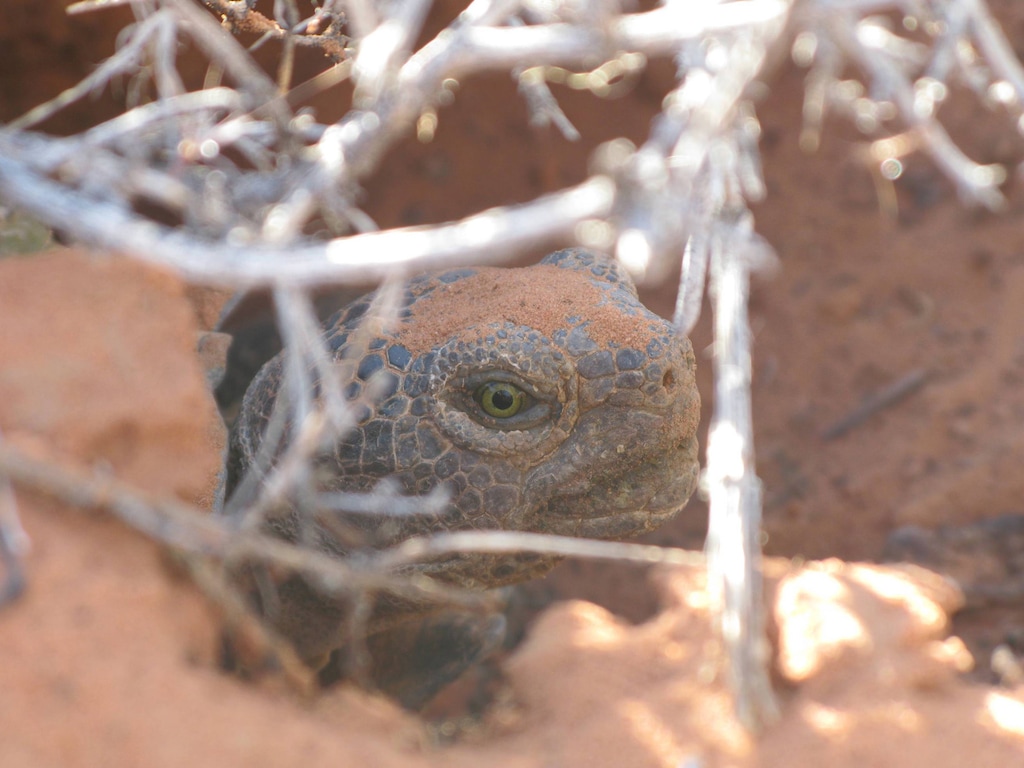
Need a companion for the next half-century? The Utah Division of Wildlife Resources has just the solution: a Mojave desert tortoise.
Utah’s Desert Tortoise Adoption Program is looking to place 15 of the reptiles in new homes. DWR contracts with a Utah County reptile facility to house tortoises that need to be rehomed, and they are often animals that have illegally removed from their native habitat: the deserts of southern Utah.
The reptiles make perfect lifetime companions: they are relatively low-maintenance, don’t talk back and can be full of personality, said DWR contractor Joey Mugleston, who owns Great Basin Serpentarium in Lindon and previously worked as a biology professor at Utah Valley University.
A pet with a purpose
In addition to getting a pet, adopters will also be doing a service for the state, Mugleston said. Mojave desert tortoises are native to Arizona, Utah, Nevada and California, but are listed as threatened under the Endangered Species Act.
Despite conservation efforts in Washington County — home to Utah’s highest population of Mojave desert tortoises — there are still a number of threats to the reptiles that need to be addressed before researchers can feel good about their population levels, Division of Wildlife Resources native reptile coordinator Alyssa Hoekstra said.
Captive tortoises are more likely to contract a pneumonia-like disease that could harm Utah’s wild population, so it can be risky to return the animals to their native habitat if the tortoise has been a pet for a long time or if the state can’t determine the tortoise’s exact origin, Hoekstra added.
“You’re helping out a problem we have in the state; some of these tortoises can’t be released back in the wild,” Mugleston said. “They need somewhere to go, so this actually gives them a comfortable place to live for the remainder of their life.”
A low-maintenance companion
Although they are a threatened species, the animals don’t need much to live a comfortable life, Mugleston said, and often require less upkeep than a cat or dog. The Utah Division of Wildlife Resources has a handbook on the animals for prospective adopters, but tortoises only need access to sunlight, water, and a secure pen with native vegetation for grazing, Mugleston said.
The animals also hibernate during the winter months, so prospective adopters in northern Utah will likely need to bring them inside for about five months out of the year, or at night when temperatures drop in early spring, Hoekstra added.
The tortoises the state has available won’t be massive animals — on average, the reptiles weigh between 5 and 15 pounds and are about the size of a laptop, Hoekstra said.
The biggest requirement to bring a tortoise home is that adopters can’t live in Washington County, since if they were to escape they could be harmful to the wild population, Hoekstra added.
“If you have a nice, fenced-in area in your backyard, you have grass and plants for them to eat, it’s a very low maintenance pet,” Mugleston said. “… They don’t need the constant attention that some of your mammal pets do. So a nice low-maintenance pet that actually can be quite personable after they’ve lived with you for a bit.”
One of the funniest tortoises Mugleston cared for was a female his staff nicknamed “Muscles.” Although the animals are pretty calm, they can be escape artists — and Muscles always tested the limits of the containers she was transported in, often shoving the lid off to try and “bust out,” Mugleston said.
Another tortoise was particularly grumpy, and loved to tuck his head inside his shell and ram against ankles when people walked by him, Mugleston said. When a prospective adopter came by to meet some of the tortoises Mugleston was rehoming at the time, the person “absolutely fell in love with that” and took the animal home because of it.
“[My] favorite memory so far is just seeing how excited people are,” Mugleston said. “This is a long-term commitment, and so people will put a lot of thought into which one they want to take home.”
To adopt a tortoise, submit an application — found on the wildlife agency’s website — to tortoise@utah.gov. Adopters will need to pay a $10 handling fee, get their tortoise’s environment inspected by the adoption program and pay a $75 registration fee once they are approved for adoption.