 Andy Larsen
 Paighten Harkins
Did you fly from July through October last year?
If so, there’s a 40% chance we have your airline ticket in our database. And, according to our research, there’s a good chance your flight was expensive.
In the last year, the federal government greatly expanded the amount of airfare information it reports. The new dataset contains 40 percent of all tickets sold for domestic airline travel in the U.S. In particular, if your ticket number ended in a 0, 2, 7, or 9, it’s likely your anonymized itinerary is included in these files, over 50 million rows deep.
This data provides a greater understanding of the airfare market. For example, we can tell you that Salt Lake City International Airport had the fifth-most expensive fares of any major airport in the country.
SLC tends to have longer flights than airports in other parts of the country — we’re in the middle of the Intermountain West. But even adjusting for that, Salt Lake City’s airfares rank eighth-highest in the nation.
Why is that? We broke down the data every which way — and then talked to Bill Wyatt, executive director at the Salt Lake airport, about the reasons for the high costs.
The result is, we think, the single deepest dive into the public data on Salt Lake City airfares. We found it all fascinating, and hope you do too.
(Trent Nelson | The Salt Lake Tribune) Salt Lake City International Airport was the country's fifth-most expensive major airport, according to a Tribune analysis of recent airfare data.
Salt Lake’s expensive airfare
First of all, it is true: Salt Lake City’s airfare is higher than most. We looked at eight peer airports in the West (Denver, Las Vegas, Los Angeles, Phoenix, Portland, San Diego, San Francisco, and Seattle) and the cost differences were clear:
Round-trip flights from Salt Lake City had a median price of $458.97 — the most expensive in the West.
So what’s going on here? Well, to investigate, we sorted all of our Salt Lake City departing flights by airline.
Hawaiian has a pretty good excuse for high airfares: It’s only flying to Hawaii. But Delta is significantly more expensive than major competitors like Alaska, American, and United.
Delta is more than double, and sometimes more than triple, the cost of ultra-low-cost airlines like Spirit and Frontier.
We should note that the smaller airlines’ costs are a bit of an underestimate, though: The U.S. Department of Transportation doesn’t require airlines to report baggage fees, seat location fees, and any other ancillary fees for this dataset.
The airlines do, however, report those fees to investors. In 2024, Frontier, Spirit, Sun Country, and Allegiant all estimated their total ancillary fees to come out to between $66 and $76 per passenger. In comparison, the higher-service airlines made an estimated $9 to $25 per passenger on ancillary fees.
But Delta is also the carrier for roughly two-thirds of round-trip tickets booked out of Salt Lake City. Some of that, certainly, is because the airline flies direct routes no other carrier does: Delta flies direct to Anchorage, Little Rock and Tulsa — expensive flights that wouldn’t make sense for other carriers.
Does the route map explain the high fares?
To investigate, we decided to look at only competitive routes. In order to qualify for the analysis, routes had to be competed among at least two different airlines, with at least 500 tickets in our sample on that route. We looked at round-trips only, and flights booked with money, not points. And here were the results:
Even taking into account Delta’s sprawling route map, it’s simply more expensive than the competition.
Curious to dig even deeper? With this interactive chart, you can even go into the routes you’re most interested in, and compare Delta’s median flight cost to other airlines.
So how did we end up here?
This is where Salt Lake City International Airport Executive Director Bill Wyatt’s perspective can be of service.
“Salt Lake is really the key that unlocks the West for what was an eastern airline,” Wyatt said of SLC’s early days as a Delta hub in the 1980s. “And so for years and years, that’s what we did: We connected people here.”
Wyatt said connections were 70% of SLC’s Delta traffic back then and 30% was local.
“Today, as a result of what’s happened in the economy of this region, it’s now 60% local and 40% connecting,” Wyatt said.
Despite that change, Wyatt said Delta’s connection with the city still means the airport has more direct routes than it would have otherwise.
“If we did not have a connecting carrier here, based on the population of the region and rough equivalents that you see around the country, that number would probably be 50, maybe 60, non-stop (destinations),” Wyatt said. “In exchange for that concentration, we get access to 100 non-stop destinations for an extra 25 bucks.
“Is it worth it? Depends who you are.”
The other part of the picture is that Delta tends to be an expensive airline everywhere it flies, not just out of Salt Lake City. Wyatt said Delta and fellow full-service airline United have found more financial success by targeting high-end consumers.
“If you walk onto these planes and you haven’t been flying for a while, you’re going to note that the first class cabin is bigger than it used to be. They’re knocking people off the back of the bus in order to expand for fewer people paying at the front of the bus,” Wyatt said.
In other words, the high airfares from Salt Lake City are the result of a combination of factors. One airline has market dominance in a location with exploding demand — and that airline is looking to cater to its highest-paying customers.
“I do, honestly, worry a little bit about who’s going to fly that family with six kids to Disneyland, right? Which is a lot of our local business in a lot of markets, it’s a really important thing,” Wyatt said.
That’s where the non-Delta airlines come in, especially the low-cost carriers. When they choose to fly to a new city from Salt Lake City, fares overall drop on that route. Wyatt cited Spirit’s entrance into the Salt Lake City to Orlando market as one such example.
“If you look at markets where you have competing carriers, fares are pretty normal. If you look at markets where we don’t have competing carriers, there’s a premium,” Wyatt said.
“Even if you never fly Frontier, be happy they’re here.”
What the airport can do about its airfares
The obvious question is, then: Can the airport attract more competition to Salt Lake City?
It’s a delicate, wooing dance. First, Salt Lake City has to compete with other airports for new business.
(Trent Nelson | The Salt Lake Tribune) A traveler walks through Salt Lake City International Airport.
This typically happens at conferences (there’s Routes World, Routes Americas, the Airport Council’s JumpStart, to name three). At these annual events, airlines and airports undergo a “matchmaking” process that can work similarly to medical school placements. Airlines list routes they’d like to consider, airports list airlines they’d like to talk to, and the conferences pair up potential compatible partners to hold meetings about making their mutual dreams become reality.
“They want to see what it’s going to be like to operate at a facility like this, what the costs are, and if we can do anything for them,” Wyatt said of the airlines in those conversations. It’s a process that can take as little as six months or as long as five years.
But the Salt Lake airport’s relationship with Delta makes the courting even more convoluted.
“It’s a tricky business when you’re a hub airport, because we have a really good relationship with Delta,” Wyatt said. “It’s in our interest, and it’s in the community’s interest, to keep it that way. So I’m not going to go challenge their core business model.
“When we do recruiting, we’re not looking for someone to come in and fly two more segments to Atlanta,” Wyatt continued. “A, that would be considered pretty offensive to our hub carrier and B, nobody’s stupid enough to do that. You know, there are stupid airlines out there, I’ll just say that, but nobody that’s quite that stupid, because Delta is very successful.”
Though the airport is somewhat limited in how it can chase lower airfares via market competition, it has done a generally good job of being more competitive with other costs. Landing fees and other fees charged to airlines are generally similar to those at other airports — about $19 per passenger at SLC, compared to $22 out of San Francisco or $36 from JFK in New York City.
The airport’s new configuration, with two parallel rows of gates, also allows airlines to be more efficient with their airplanes’ movements, meaning they waste less time on the ground.
Finally, there’s the airport’s street pricing policy, which dictates shops and restaurants inside the airport can’t charge more than what they do outside the airport. It means Salt Lake City’s airport has the lowest prices of any airport in the nation, with prices sometimes less than half of what you’d find elsewhere.
“We created a facility where we’re dragging all these bodies past your front door, so we’re going to have a say over what you do,” Wyatt said he told the businesses. “It’s been successful.” It also drives overall passenger costs down.
New developments
It’s a changing field, though. For one, Provo Airport now flies to 10-15 destinations through discount airlines Allegiant and Breeze, and full-service American Airlines began service to the airport in 2024.
“You can talk to a lot of airport directors who’d be snippy about a Provo or whatever. Not me,” Wyatt said about his airport’s growing competitor. “As far as I’m concerned, any community that wants air service and has the wherewithal to get it and make it work, more power to them.”
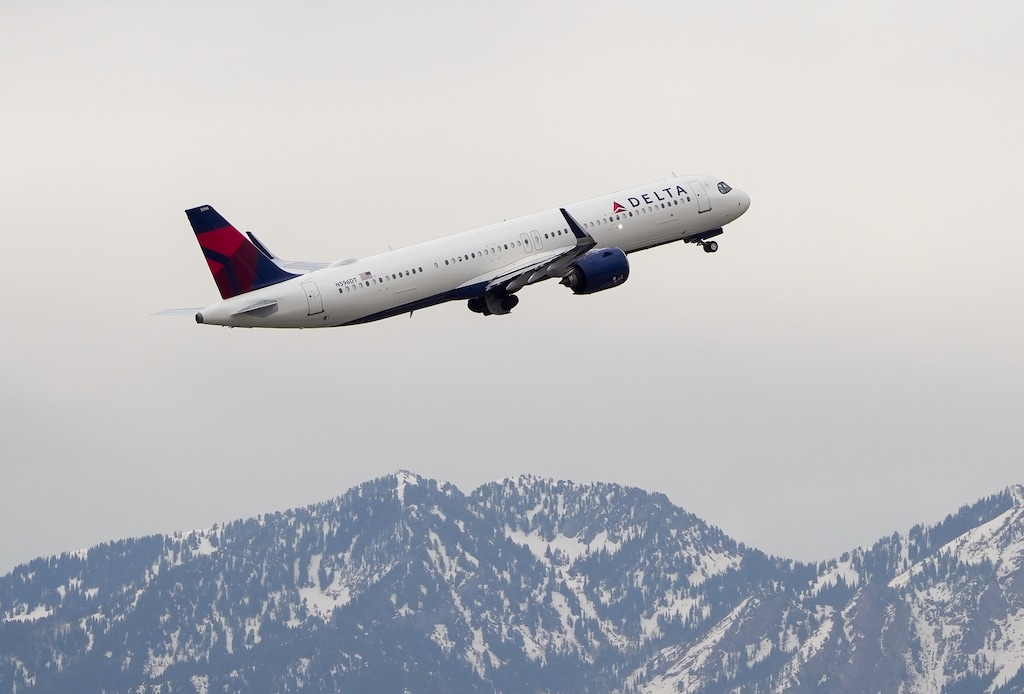
(Trent Nelson | The Salt Lake Tribune) Delta Air Lines flights are among the most expensive on average for passengers flying out of Salt Lake City International Airport.
And rapidly increasing oil prices are putting pressure on fares, too. The price of U.S. Gulf Coast jet fuel has risen from about $1.88 per gallon on spot markets on Jan. 1 to $4.23 per gallon as of April 1, as a result of the Iran War.
What does that mean for ticket prices? We can do some back-of-the-napkin-style math. In 2024, Delta used about 4,114 million jet fuel gallons while flying 246,145 million revenue passenger miles. That means about 60 passenger miles per gallon — a number approximating other estimates for the figure.
At that rate, the increase in jet fuel prices should push prices on short round-trip flights up by roughly $50, and longer ones from $90 to $150.
Now, what actually happens is far more complicated than that — airlines can negotiate deals on fuel, respond to supply and demand across routes differently, and so on. But that gives you some idea of the pressure on airfares, with an uncertain end.
Wyatt has faith in his partner airlines seeing the chaos through. “The big airlines, particularly Delta, have gotten so much more skilled at revenue management and cost control,” Wyatt said.
We’ll see if the everyday Salt Lake City flyer can keep up.