 Brock Marchant
Logan • Brittany Cascio was nervous to leave a pile of undeveloped film outside a stranger’s home.
When the professional photographer had learned that someone in Logan was offering to process film, she jumped at the chance to bring her family’s undeveloped pictures to life.
Because her bag of film rolls was too bulky to fit in the door’s mail slot, she left it on Jason Haywood’s doorstep for him to find when he got home.
“I just left it. And I was like, I don’t think anybody is going to be like, ‘Oh, a bag of film. I’m going to take this,’” she said.
Days later, he returned the images. Among them were years-old photos taken by her grandparents, Grace and Will Rose. Though her grandparents died in 2022, the pictures brought a new memory of them to life — there they stood sometime around 2001, embracing one another and smiling for the camera.
(Via Brittany Cascio) Brittany Cascio's grandparents, Will and Grace Rose, hold each other and smile sometime around 2001 in Vancouver, Washington. The photograph went undeveloped for years, until Cascio learned Jason Haywood was developing film in Logan.
Haywood, a professional photographer originally from Richfield, runs Logan Mini Lab — Cache Valley’s only dedicated film development business. As he’s steadily grown his venture, he’s unlocked snapshots of the past.
“There’s something about getting pictures of people that are already gone that you’ve never seen before,” Cascio said. “It’s like getting a little piece of them back and getting to see … what was important to them to take photos of.”
(Brock Marchant | The Salt Lake Tribune) Jason Haywood's Logan Mini Lab drop box, where people can leave their film for Haywood to develop, hangs near the entry of Caffe Ibis Gallery Caffé in Logan.
(Almost) lost memories
Haywood, now 25, has shot on film since he first took up photography as a teenager, but he wasn’t fully exposed to the aged medium’s significance until last year.
As he helped his grandparents Duane and Viola Buchanan into a retirement home, he found undeveloped film rolls in the couple’s basement, along with damaged black-and-white photos that had never been digitized. Some had never even been printed.
Haywood digitized and restored the developed images, though he didn’t know if the undeveloped film would be salvageable. Still, he gave it a shot, putting the strips through a series of chemical baths.
He was glad he did.
(Via Jason Haywood) Duane Buchanan, left, sits atop a tank in Germany just after WWII. Buchanan's grandson, Jason Haywood, found and restored this image.
In the images, he found his grandfather posing amid tanks in post-WWII Germany, the bright lights of old Las Vegas from a trip his grandparents took decades ago, and the couple giddily dangling from a rope swing by a lake.
“I open it up, and all the film — it’s scratched up. It’s old. But other than that, it’s in perfect condition,” Haywood said. “I didn’t understand the impact of it just yet.”
He showed the photos to his grandfather, who was able to recognize his younger self even as he was suffering from dementia. Weeks later, Duane died, and Viola followed shortly after.
(Via Jason Haywood) Duane Buchanan hangs upside down on still rings next to a lake. His grandson, Jason Haywood, found and developed this photo decades later.
Revival of film
Haywood started his business — a venture first reported by The Utah Statesman — last year after a friend noticed he developed his own photographs. That friend asked if he would develop others’ work as well.
At the time, Haywood said, no one else in Cache Valley developed film.
“I started advertising it,” he said. “It kind of exploded from there.”
(Via Jason Haywood) A photo of Las Vegas, taken by Duane Buchanan and Viola Buchanan during a trip to the city. Their grandson, Jason Haywood, found and developed the photo decades later.
A film renaissance was already sweeping through the valley’s photography scene when Haywood opened his business. Since then, he said, the medium has only gotten more popular because artists no longer need to send their film away to be developed.
Don Penman, a geosciences professor at Utah State University who gets his film developed by Haywood, said he took up a photography hobby after his wife, Norah Saarman, found her old camera in their basement. After making sure it would work, he bought raw film online and began experimenting.
“I liked the challenge. It’s all mechanical, and you have to think about the exposure and aperture,” he said. “The process of it is kind of refreshing compared to using your phone. … There’s a delayed gratification aspect to it.”
(Via Jason Haywood) Viola Buchanan swings from a still ring next to a lake. Her grandson, Jason Haywood, found and developed this photo decades later.
Cascio, who runs a photography studio in River Heights with her husband, Bryan, said that while she normally opts for the convenience of digital photography, film pushes her to be intentional about the shots she chooses to take.
“You know you’re going to be paying more money,” she said. “You slow down, you think about things a little bit more, and you might be a little bit more creative.”
Kitchen table chemical bath
Haywood, whose images of global travels with his wife, Elora Miriam Haywood, have been published in photography magazines, started shooting on film at 16 years old.
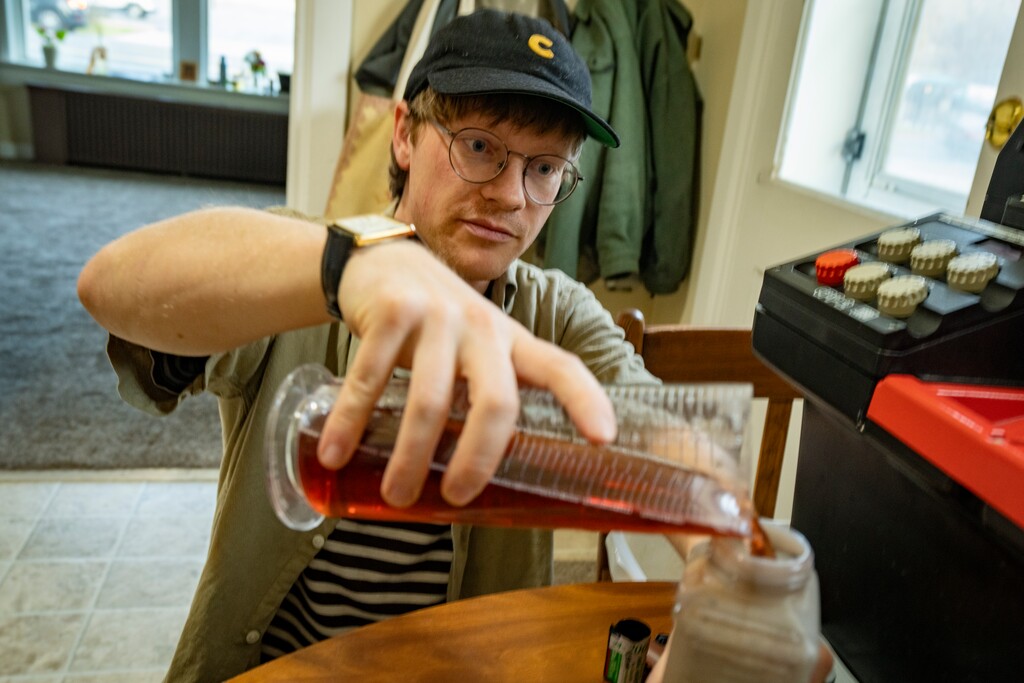
As he strung film onto development reels and prepared the images for a chemical bath atop his kitchen table this month, he explained what draws him to stay loyal to the out-of-date, relatively inconvenient technology.
(Rick Egan | The Salt Lake Tribune) Jason Haywood edits photos in his living room at his home in Logan on Wednesday, March 4, 2026.
“You can literally pick up a digital camera and shoot anything and do anything with it in post(-production),” he said. “There’s something cool about limiting yourself.”
To bring images to life, he rinses them with filtered water, film developer fluid and bleach — all in a particular order and with expert timing — before hanging the straight lines of film to dry on bathroom shower hooks.
(Rick Egan | The Salt Lake Tribune) Jason Haywood checks out the negatives as he hangs them to dry in his bathroom at his home in Logan on Wednesday, March 4, 2026.
He later digitizes them with scanners in his living room — his way of making moments live forever.
“Pulling the film off of the developing reel for the first time … it doesn’t get old,” he said.
 I’m Brock Marchant, The Salt Lake Tribune’s Cache Valley reporter in partnership with Utah Public Radio. As a valley native, I’ve seen firsthand the issues that people face everywhere from Richmond to Avon — unaffordable housing, dwindling open space and a rapidly increasing population that has cities struggling to keep up. I want to explore local problems by reporting on the ground, not just quote elected officials and news releases. As residents work diligently to overcome challenges, I want to tell their stories and share their solutions. Smart, hard-working people have built the valley’s history, and I’m certain they will frame its future.
As a nonprofit newsroom we rely on donations from readers like you to make this work possible. Donate today to support this reporting.