 Brooke Larsen
Rick Atkin rarely visited downtown St. George as a kid in the 1980s and ’90s, even though he lived just a few miles away. When his family ate out, they usually headed to strip malls full of chain restaurants along the I-15 corridor on the outskirts of town.
In the mid-1970s, a few years before Atkin was born, his parents ditched the old adobe brick buildings of St. George and joined other young families flocking to fresh homes in Bloomington, one of many new suburbs popping up throughout southwest Utah.
Before that, though, Atkin’s family lived in the historic city center for generations. His ancestors were part of the first two Mormon handcart companies that colonized the area in the 1860s, and his family remained there for a century.
“With my dad’s generation — he’s 82 — downtown was everything,” Atkin said. “It was where everybody lived.”
(Washington County Historical Society) St. George Boulevard in the 1950s.
It wasn’t until he was an adult that Atkin began forming a fondness for downtown. About 17 years ago, a new cupcake and sandwich shop called TwentyFive Main lured him to the city’s historic Main Street. “That was probably … the first business that opened up downtown that everyone was like, ‘Whoa, downtown is really cool,’” he said.
Atkin moved away from southwest Utah for school and work, but returned in 2020, this time opting to live in a historic home in the downtown area his parents once left. He’s now the chair of the St. George Historic Preservation Commission and thinks celebrating the city’s history can help enliven its future.
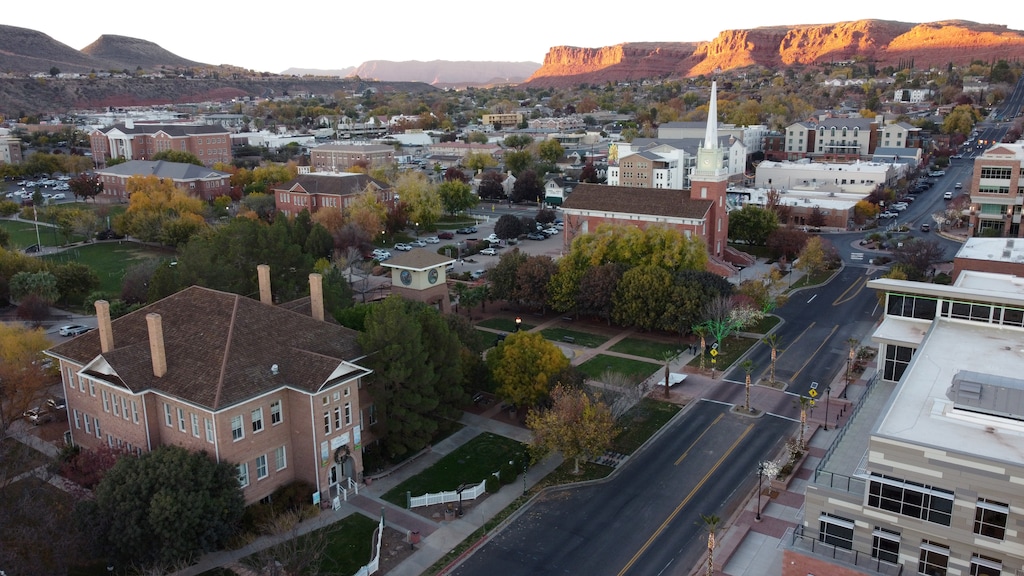
The commission recently completed a proposal to list the city center under the National Register of Historic Places. Such a designation would bring tax incentives for property owners who rehabilitate and preserve historic buildings, as well as opportunities to attract tourists who otherwise may just drive past downtown on their way to nearby destinations like Zion National Park.
“We really see this as a way for communities to revitalize and to encourage preservation,” said Cory Jensen, the national register coordinator for the Utah State Historic Preservation Office.
The designation only incentivizes preservation; it doesn’t require it. Property owners who are included in the district can still change their home or business however they want. “It’s more of an honorary designation than anything,” Jensen said. “There are no restrictions or regulations that come with listing the properties of the historic district in the national register.”
However, Jensen, Atkin and others on the preservation commission hope property owners will opt to restore their homes and commercial buildings in ways that preserve the historic integrity. If they do so, property owners may receive an income tax credit for 20% of qualified rehabilitation costs. Business owners apply for the credit via the federal government, and homeowners apply for the credit with the state.
(Christopher Cherrington | The Salt Lake Tribune) A map of the proposed St. George Central City Historic District. Contributing properties were built within the historic period and retain their historic integrity. Non-contributing properties were built in the historic period but have had major alterations. Properties that are out of period were built after 1975.
“There’s a lot of people that have lived in their homes, you know, 30 years or multiple generations, right?” Atkin said. “So now it creates a cool opportunity for them to invest in their homes.”
St. George was the fastest growing metropolitan area in the country in 2021, according to the U.S. Census Bureau. Washington County is expected to jump from just over 209,000 residents this year to nearly 385,000 in the next 40 years, according to the Kem C. Gardner Policy Institute. The national register designation may serve as a way to protect some of St. George’s history as southwest Utah continues to boom.
“It truly does need to be certified or designated historically in order for it to be preserved,” said Jeanine Vander Bruggen, a member of the Washington County Historical Society who used to run the Pioneer Courthouse museum. “Otherwise the growth will just suck it up.”
Historic St. George
Throughout downtown St. George, historic plaques rise in front of old homes and public and commercial buildings. In Ancestor Square, near the corner of Main Street and 200 North, one sign brings attention to an adobe home built in the early twentieth century for Dr. Pike, a former pharmacist.
Further north up Main Street, another plaque describes the home of Julia Graff, who had the bungalow-style house built during World War I in honor of her husband who died at the age of 34. It was the first home in St. George to have closets, according to the Washington County Historical Society.
(Jud Burkett | Special to The Tribune) Susan Crook, a member of the St. George Historic Preservation Commission, describes the history behind some of the oldest buildings found in downtown St. George as she stands outside the Orson Pratt home in the Historic Green Gate Village, Tuesday, Nov. 25, 2025.
“Buildings tell stories, and the stories embodied in those buildings help to give that sense of community,” said Susan Crook, member of the historic preservation commission and a historical landscape architect.
The proposed historic district includes homes built from 1862-1975, according to the city’s historic district nomination form. The time period starts with the oldest remaining building in downtown St. George, the Orson Pratt House, and extends to 50 years ago, the limit to qualify as historic under the national register.
This Orson Pratt House is among a dozen structures in the historic city center, including Brigham Young’s winter home, that are already listed under the National Register of Historic Places. But there are over 640 buildings — 51% of all structures downtown — that have maintained their historic integrity, according to the nomination form. Most of those are residential buildings.
(Washington County Historical Society) Brigham Young's winter home in St. George.
Many of the old historic homes, including Atkin’s, are made of adobe. “It’s kind of expensive to fix and repair, so this [historic district designation] does create an opportunity to protect some of those early pioneer homes, which I think is really exciting,” Atkin said.
The number of adobe buildings in St. George sets it apart from other communities across Utah, said Kirk Huffaker, an architectural historian who completed the survey and national register nomination form for the city.
“Adobe, of course, was a very common building material in lots of early Mormon communities because it was easy to make, it was cheap, you could make it right out of the material that was around you,” Huffaker said. “The problem was that it didn’t last long … especially like in Salt Lake, we don’t see very many adobe buildings anymore because the weather, snow and water would erode the adobe. But in St. George, where it’s more of a desert climate, you don’t have that weathering process, and so the adobe lasts a lot longer, and it’s in good condition.”
In the early twentieth century, builders continued using nearby materials in construction as the town began its transition to a tourism economy. The Electric Theater was built in 1911 out of adobe and sandstone, according to the city’s historic district nomination form, and it still serves as a hub for the arts. Thomas Judd’s Store was also built during this period, and even though it has changed owners over the years, it continues to sell soup, candy and ice cream.
(Washington County Historical Society) Thomas Judd's Store with an old gas pump around 1940.
After the designation of Zion National Park in 1919 and the expansion of highways and automobile use, more and more tourists visited the area, sparking an increase in commercial buildings in St. George. Some of those still stand today, such as the J.C. Penney Building where Urban Renewal, a vintage store, now operates on St. George Boulevard.
Even the more recently constructed buildings tell stories about St. George’s past. One of Atkin’s and Crook’s favorite buildings in the district is an old county administration building and courthouse that was built in the mid-century modern style in 1966. During the Cold War, it served as a bomb shelter, and a yellow and black fallout shelter sign still hangs on the facade. It currently houses the federal court and justice court.
Atkin and Crook fear the county will eventually demolish the building, but they both see potential to revitalize it with the historic district designation.
“This would make a fabulous downwinders interpretive center to talk about the Cold War and what that was like and to maybe pay some respect to all those downwinders who have died from the various cancers that they got from being exposed,” said Crook.
Atkin also sees potential for the building to turn into a hub for startups and restaurants to bring more activity to downtown.
Appreciation for downtown growing
Whether downtown St. George is designated as a historic district or not, the area continues to show signs of revival. “[I’m] starting to see more young families move in and kids riding their bikes and going to the elementary school,” said Atkin.
(Jud Burkett | Special to The Tribune) Carolyn and James Spencer enjoy ice cream with their children, Sam, William, Jane, and Eleanor, left to right, on the bench outside the historic Judd's General Store, Tuesday, Nov. 25, 2025 in St. George.
Atkin sees the draw himself. He can walk to local restaurants and shops, or venture up Main Street to the Red Cliffs Desert Reserve and hike Owen’s Loop with his dogs.
“A lot of people will drive through St. George on the way to the national parks but not really stop and spend time downtown and go to the shops and restaurants,” Atkin said. He hopes the historic district designation will change that.
Jensen, the national register coordinator for the state, will present the proposal at the state’s national register review committee on Jan. 15 during a public meeting. If the committee votes to move the St. George historic district proposal forward, Jensen will submit a final draft to the national register in Washington, D.C.
The national register office then has 45 days to review a nomination and make a decision, but the process may be delayed because of a backlog from the federal government shutdown, Jensen said. If it is listed, notification will be sent to all property owners with additional information, including details on the tax credits and how to order a historic plaque.
“We’re really pleased that St. George is finally moving forward with this and offering this opportunity for property owners to be listed and to be honored for the history of these buildings,” Jensen said.
(Jud Burkett | Special to The Tribune) Historic buildings including the St. George Tabernacle, at left, and a number of Main Street storefronts stand in downtown St. George, Monday, Dec. 1, 2025 in St. George.