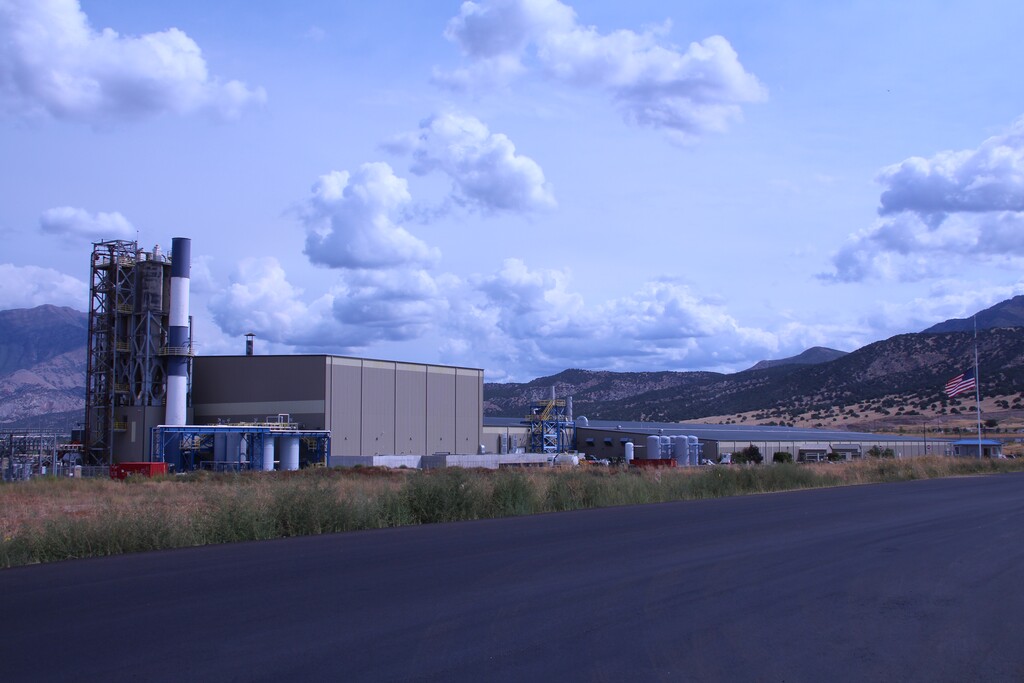
Four years after securing state tax breaks with the promise of bringing new jobs to Nephi, a building materials maker has announced it is cutting most of the workforce there — perhaps permanently.
Owens Corning announced Friday that it would be giving furloughs to 67 employees in its insulation plant in Nephi. The notice was posted on the Utah Department of Workforce Services’ website.
In a notice sent to Justin Seely, Nephi’s mayor, on Aug. 28, the company said it could not guarantee the furloughed employees won’t be out of work permanently. The furloughs will begin Oct. 27, the company said.
The furloughs are part of a “strategic decision to curtail operations” at the Nephi plant, Owens Corning said Friday in a statement to The Salt Lake Tribune. The company will “retain a group of employees to support facility needs,” but did not say how many employees would be kept on.
The company said the “curtailment” would likely “continue through the end of this year.”
Seely said “it’s not a straight-out closure. … I think it’s a short-term issue, not a long-term issue.”
In its notice to the mayor, Owens Corning said it aims to restart production at its Nephi facility by the third quarter of 2026 — though production could restart sooner, depending on the market for building materials like insulation.
In 2021, Owens Corning entered a tax-incentive agreement with the state of Utah. Under the agreement, the company said it would bring 70 high-paying jobs to Nephi over the next 10 years, in exchange for a break on 50% of new state taxes — a deal that could eventually be worth more than $2.5 million.
In the first four years of that deal, the company added some jobs and has received between 25% and 50% of those tax breaks by meeting yearly growth totals, said Lindsey LeBaron with the Governor’s Office of Economic Opportunity. Even as Owens Corning begins reducing its workforce now, LeBaron said, the company doesn’t have to pay any of that money back.
“Owens Corning is still eligible to rehire and grow its business here in Utah, and that’s our goal in creating these durable partnerships, especially in rural Utah,” LeBaron said in an email.
Brent Boswell, economic director for the city of Nephi and Juab County, said several factories are slated to open soon in the area, which will provide jobs and fill the manufacturing hole left by the Owens Corning furloughs. Still, he said he is concerned about the employees losing their jobs, and the families affected by those cuts.
Boswell said the city is working with the company to bring in the Utah Department of Workforce Services’ “rapid response team,” to mitigate the furloughs’ effect on workers and their families. The state agency can help workers enroll in government programs, find jobs or seek education for different careers, he said.
The company, Boswell said, also is organizing social events with furloughed employees, looking for potential service projects they could engage in, and coordinating with other factories around the country who might be able to hire them temporarily.
Nephi is not the only place Owens Corning is laying off workers this quarter. In June, the company announced it was shutting down a door-manufacturing facility in Prineville, Oregon — and laying off 184 workers there. The layoffs were scheduled to start in Oregon in late August and be completed in November.
Leaders in Nephi also have reached out to Utah’s congressional delegation and Gov. Spencer Cox, Boswell said, to ask them to help.
One request, Boswell said, is for state and congressional leaders to do what they can to bring down interest rates. That would help the housing market, he said, and encourage the manufacturing of construction materials — like Owens Corning’s insulation.
“I think it really will depend on interest rates,” he said. “That seems to be what’s driving the slowing of housing right now.”
Boswell said city and county leaders remain optimistic that the furloughs will be temporary. He said he believes they won’t affect Nephi’s economy significantly — but he noted that the job cuts can be a crisis for the families directly involved.
“We don’t want to downplay it,” he said.