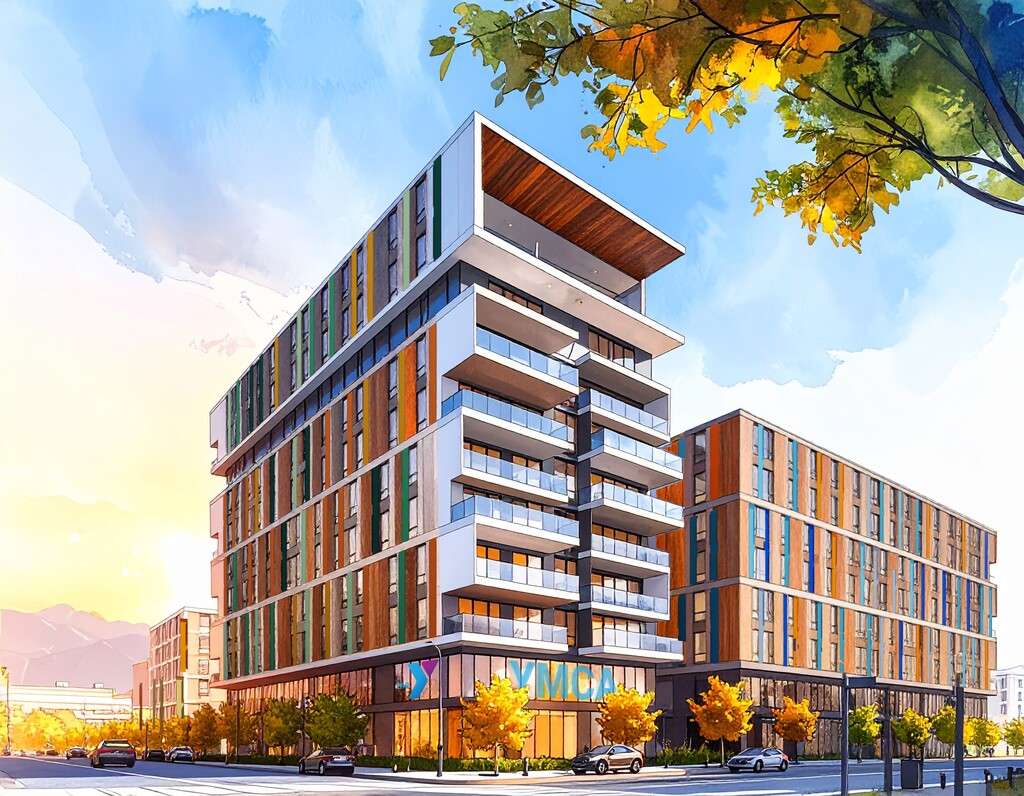
Along with visions of remembrance and resilience, there will be housing — some of it affordable — at Salt Lake City’s old Fleet Block.
Officials announced plans Thursday for the city to partner with two well-known affordable housing developers to build homes on a portion of that open block southwest of downtown: Mercy Housing, a national nonprofit based in Colorado, and an Illinois company called Brinshore Development.
The two firms now have dibs to build what are likely to be multistory mixed-use housing and retail complexes on the northern parcels of the city-owned block, located between 800 South and 900 South from 300 West to 400 West, on the east edge of the city’s Granary District.
(Brinshore, via Salt Lake City) Conceptual renderings of the ground-floor presence of what Illinois-based Brinshore Development could being in its partnership with Salt Lake City to develop the northwest corner of city-owned Fleet Block.
Their selection from a raft of applicants was unveiled as part of a concurrent effort by the city to gather community input that will help shape the Fleet Block’s future, including the contours of a 3-acre public space.
Many know that decayed block and former city fleet-management facility for a series of large street murals depicting those killed by police. The portraits were painted on its exterior walls and drew makeshift shrines along the sidewalks as places of remembrance.
Those have since been demolished and now housing, green spaces, walkways and community amenities are coming in their place.
“Right now, this lot is a barrier between beautiful neighborhoods, but soon it’s going to be a bridge,” Mayor Erin Mendehall said at an event Thursday announcing the developers. “It’s going to be alive with affordable homes, welcoming green space and public art that honors its history as a space where social justice matters.”
Focus on housing — and healing
(Rick Egan | The Salt Lake Tribune) The Fleet Block on Wednesday, August 20, 2025.
Logan Hunt, director of real estate services, said officials now will hammer out what community benefits the city will require of the developers in exchange for any financial concessions they receive in building the dwellings.
What are likely to be scores of apartments in both housing projects, Hunt said, will be accessible to residents with a range of mixed incomes. The city might also seek commercial spaces set aside for locally owned businesses or other community amenities.
“We wanted to select the right partners based on their qualifications and their commitment to the community,” Hunt said, “and then to collaborate on more of a blockwide approach to achieve the best results.”
(Salt Lake City) A map of the Fleet Block, where Salt Lake City now wants to build housing, open spaces, walkways and other community amenities.
Founded nearly 40 years ago, Mercy Housing is one of the nation’s largest nonprofits focused on affordable housing and builds shelters and permanent housing, with a focus on helping those experiencing homelessness and housing insecurity.
Brinshore has been a robust development partner to Salt Lake City’s Community Reinvestment Agency for several years, including on such affordable housing projects as the high-rise Aster Apartments, 265 S. State; and SPARK, a 200-apartment complex on North Temple that also offers residents subsidized child care.
(Leah Hogsten and Rick Egan | The Salt Lake Tribune) The Aster and SPARK apartments, both by Brinshore Development, used Olene Walker Housing Loan Fund monies to fill financing gaps.
The firms are said to be readying a series upcoming presentations for community councils and others in the Fleet Block’s immediate neighborhood.
Official with Brinshore and Mercy Housing said Thursday their developments would unfold slowly from here, with at least a year to take plenty of public input as part of final design.
Added Mendenhall: “The people who live and work here will be in the driver’s seat, deciding what future features and amenities they want to see in these developments.”
The site’s legacy
(Francisco Kjolseth | The Salt Lake Tribune) Demolition crews began leveling the Fleet Block last spring.
Long abandoned as an active city facility, the area is considered a prime location for housing and green space, with its proximity to a spate of new housing and businesses in the Granary and the rising Central Ninth neighborhood.
Council member Darin Mano, whose District 5 spans the Fleet Block, said that in the more than 13 years that Fleet Block has been considered for redevelopment, neighborhoods have sprouted rapidly around it.
“Central Ninth has blossomed. The Granary District is blossoming, and we have quite a few really fantastic developments around here” Mano said. “So this no longer is the catalyst that’s going to start redevelopment in this part of our city. ... I’m really excited that we’re here today to be able to do more on this publicly owned asset.”
The two-toned murals started appearing in 2020 and a total of 26 faces were ultimately memorialized on the outer walls. They soon carried potent meaning in ongoing social justice protests.
Recognizing their meaning to some residents, city officials delayed Fleet Block development to conduct outreach with those affected, including family members of those depicted. While conducting that “ongoing community dialogue,” as city officials put it, environmental assessments determined the series of abandoned and asbestos-contaminated structures on the site’s perimeter could not be salvaged.
(Francisco Kjolseth | The Salt Lake Tribune) Rae Duckworth of the Black Lives Matter Utah Chapter embraces a friend as she hosts a vigil to honor the lives of those depicted on the Fleet Block's murals.
City crews ultimately demolished the mural walls in March — after a Feb. 8 vigil held there by friends, family members and community activists.
Along with new housing, ground-floor retail outlets and public open spaces, the city wants to spend around $3.9 million to create midblock streets transecting the Fleet Block for better pedestrian access.
The city also is asking residents to weigh in with visions “for a space that celebrates social justice, community resilience and a more inclusive future.”
In a recent statement soliciting that input, Mendenhall called the Fleet Block “an opportunity to respond — with care and intention — to what residents have long asked for. As we move forward, I want this space to honor and embody the values of healing, justice and community that we all share.”