If a few thousand people see a gallery show in New York City, it’s considered a tremendous success. The Venice Biennale, which typically runs from May to November every other year and features work by hundreds of artists from all over the world, attracts more than 800,000 attendees. There’s an enormous amount of art on view all over Venice, but the proceedings revolve around more than 70 national pavilions organized and partly funded by the governments of their respective countries.
In the art world, which genuinely takes pride in (or at least isn’t hugely concerned with) its ability to alienate people, the Biennale is the most sincere populist ritual, a family-friendly exercise for the masses and a feat of diplomatic grandstanding unmatched by anything in our culture besides the Olympics. And like the Games, or any other collective show of nationalism, everything about it is intensely choreographed, self-important and at times a little corny.
Still, there are few higher honors bestowed upon a living American artist than being asked to show in the U.S. Pavilion. This prestige has generally overshadowed the fact that the commission is, at least partly, the purview of the federal government. Whatever awkwardness this created in the past was tempered by the fact that the executive branch’s involvement was, at best, symbolic. But the second Trump administration’s State Department is different and — like all things in the president’s universe — has a way of calling attention to itself.
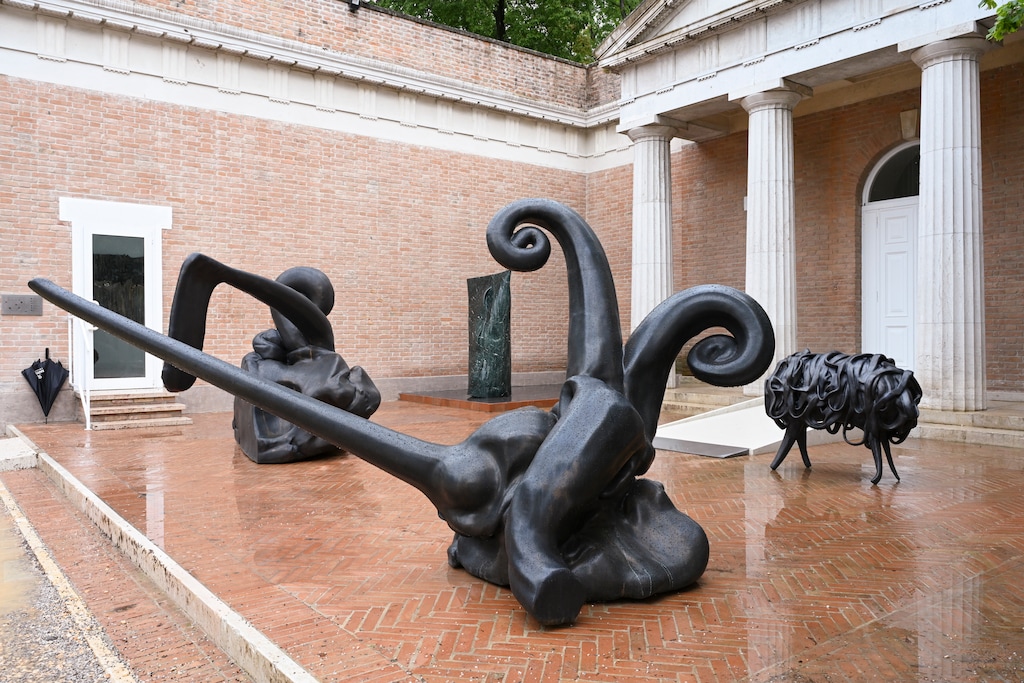
(Casey Kelbaugh | The New York Times) Sculptures in Mexican onyx and bronze, 2022-2026, part of American sculptor Alma Allen’s “Call Me the Breeze” presentation in the Giardini of the Venice Biennale in Venice, Italy, May 6, 2026.
There’s no exact science to this, but in previous years, the State Department’s Bureau of Educational and Cultural Affairs would make the Venice application available at least 18 months in advance of the Biennale. By last spring, approaching just 12 months before the opening, the art press — a hyperbolic and superstitious lot — began to notice that the department hadn’t released the application. “Fear started rippling through the museum world,” Vanity Fair put it at the time; would there be a pavilion at all? Finally, in May, the application was released. A selection was made in September and then fell through before it was officially announced. Then in October a government shutdown began, lasting a record 43 days.
At the end of November, with about six months to go, the State Department announced that Alma Allen, a Utah-born sculptor based in Mexico, would represent the United States with an exhibition curated by Jeffrey Uslip. The two would be supported by a nonprofit partner called the American Arts Conservancy, which was founded last year in Tampa, Fla., by someone named Jenni Parido. She had little experience in the art business and until a few years ago ran Feed Pet Purveyor, a “lifestyle market for pets and their people.”
This made everyone more anxious. Allen was hardly a marquee name on a level with his predecessors (“the work has nothing to say about the state of our country at the moment,” in the words of the trade publication ARTnews). And simultaneously with the announcement, it was revealed that both galleries that Allen worked with — Mendes Wood in São Paulo, Brazil, and Olney Gleason in New York — stopped representing him after he accepted the commission. This was a surprising turn of events, given that Venice is usually a commercial and reputational boon not only for artists but also for the galleries they show with.
(Jake Naughton | The New York Times) The sculptor Alma Allen at home in Mexico City, Nov. 17, 2025. Allen, a relatively unknown artist chosen last November to represent the United States at the 2026 Venice Biennale, announced Tuesday, March 10, that he was joining the roster of Perrotin, a French art gallery with nine locations around the world.
Uslip raised some eyebrows as well. With the exception of curating the Malta Pavilion in Venice in 2022, he had virtually disappeared from institutional programming for the past decade. In 2016, he was part of a very public split with the Contemporary Art Museum St. Louis, where he served as chief curator, over an incident in which he was accused of racism. For years, he had been living in a self-imposed exile in Bellport, N.Y., a village on Long Island, where he ran a small exhibition space.
Controversy is nothing new in the context of Venice. It’s not as if the State Department has ever been particularly popular with art critics. Given President Trump’s executive order meddling in the displays at various Washington-based museums, it was fair enough for arts journalists to be wary of anything he had even peripheral involvement in. “When Trump calls for art that promotes ‘American exceptionalism’ and censors exhibitions that confront this country’s violent legacy,” a writer declared on the website Hyperallergic, “it says something about Allen’s work that it was deemed acceptable — namely that it is antiseptic and probably politically vacant.”
But there’s no evidence the president has ever heard of Uslip, Allen or the Venice Biennale. And in pre-emptively dismissing this iteration of the pavilion as some sycophantic display of Republican-approved art, the art world seemed to be communicating that the basic idea of Venice itself — an art show that embraced cultural exchange and at least indirectly celebrated America’s international standing — was now a kind of taboo.
Regardless, in the past, all this drama would have played out at the opening, once people had actually seen the art and judged it. This year, the criticism has been largely reflexive. No other pavilion in the Biennale’s history has ever received such a brutal reception as America’s in 2026 — and that was before anything had even been installed.
(Casey Kelbaugh | The New York Times) At left, “Not Yet Titled,” Mexican marble, 2019; inside left, a childlike figure in bronze; at right, a bronze sculpture, 2022, part of American sculptor Alma Allen’s “Call Me the Breeze” presentation in the Giardini of the Venice Biennale in Venice, Italy, May 6, 2026.
———
Every couple of weeks this winter, Uslip would drive in from Bellport to meet me at a restaurant near my apartment in Brooklyn. He insisted on doing it this way so he could visit his parents in the city. I found him erudite and knowledgeable about art and up-to-date on all the gossip. “What people think of me is of no interest to me,” he told me at one point. But he also seemed to have an acute suspicion of the press, which he knew would be paying attention to him over the next couple of months.
Unlike Allen, who is still relatively unheralded, Uslip was for most of his career a well-regarded art-world insider. He has held high-level curatorial jobs at PS1 (part of the Museum of Modern Art) and the Santa Monica Museum of Art (now known as the Institute of Contemporary Art, Los Angeles). In 2005, at Artists Space, a beloved venue in Lower Manhattan, he put together a group show that examined “the impact of neo-conservatism on queer representations in America” — in other words, he was perfectly in step with the progressive politics of the art world.
He became the chief curator at the Contemporary Art Museum St. Louis in 2014. In September 2016, he opened a show at CAM by Kelley Walker, a white Southerner whose art explores racism and violence. Walker’s work appropriated images of social unrest, which he would then rotate and blur, turning them into what looked like abstract paintings. The show came just after the second anniversary of the killing of Michael Brown by a police officer in nearby Ferguson, Mo., and amid the nationwide protest movement it inspired.
Walker’s work was difficult and confrontational, at a time when people seemed to be looking for something else from the arts. “There were many people who thought I should not open that show,” Uslip said. But “we thought that it was really a very good opportunity to create dialogue, debate, and have the conversation.” Walker gave a talk at the museum the day after the opening, which had been a lively party. He arrived exhausted. Uslip recalled preparing Walker, telling him that he would inevitably be asked about his investment as a white artist in Black bodies and police brutality. “And the answer was actually quite easy and true,” Uslip said, “which is that he’s a civil rights activist from desegregated Georgia.”
(Casey Kelbaugh | The New York Times) “Not Yet Titled,” 2025, bronze, part of American sculptor Alma Allen’s “Call Me the Breeze” presentation in the Giardini of the Venice Biennale in Venice, Italy, May 6, 2026.
When questioned about his positions on race, mostly by local Black artists, Walker appeared defensive and overwhelmed, declining to answer and saying that he shouldn’t have to justify his work. The response from the audience “was very aggressive,” Uslip recalled. His attempts to defuse the situation effectively put an abrupt end to the talk, which didn’t help matters. Attendees took to social media, calling for a boycott of the show, and the story spiraled out from there.
Several weeks later, CAM announced that Uslip had “unexpectedly accepted a new position at another institution.” It was a job at the Bass Museum of Art in Miami Beach. But that job never materialized. By this point, the media had crafted its own narrative about what happened. “St. Louis Curator Quits Amid Charges of Racism, Debate Over Who Controls the ‘Black Body’ Narrative,” an article in Forbes said. Uslip now denies that the Walker incident had anything to do with his departure, but at the time he declined to correct the record. Until speaking with me, he said, he hadn’t talked to a journalist in 10 years.
That an ostensible victim of cancel culture, or something like it, would wind up working with a reinvigorated Trump administration on the pavilion drew a lot of attention. But both he and Parido described the reality of his hiring as more mundane. Parido told me she discovered Uslip from watching a video about the 2022 Malta Pavilion on the culture website Nowness. Seeing him talk about the show, Parido thought “that’s someone I could really get along with.” Uslip said ultimately Parido was interested in his work because “I’m not afraid of difficult situations.”
In any other year, accepting this commission is a prestigious job. Typically the pavilion is funded by well-established cultural institutions. Past partners have included MoMA, the Solomon R. Guggenheim Foundation, the Whitney Museum of American Art and the Smithsonian Institution. Only up to $350,000 of the total budget comes from the State Department. The same is true this year, but the institutions are gone.
And so, into one of the most credentialed of all art-world traditions comes the American Arts Conservancy, which is a truly unknown entity — and one whose recent inception reveals much about Trump’s interest in the American arts. Erin Scavino (née Elmore), who this year married Dan Scavino, head of the White House presidential personnel office, was named the director of Art in Embassies in the early days of Trump’s second term. A longstanding State Department initiative that dates to the Kennedy administration, Art in Embassies places art in diplomatic offices around the globe. Scavino needed a nonprofit partner to help raise funds for the program, so she reached out to Parido, whom Scavino knew from various philanthropic endeavors in Florida. Shortly after, Parido, who studied graphic design at the University of Tampa, founded the American Arts Conservancy.
(Casey Kelbaugh | The New York Times) “Not Yet Titled,” 2026, of Guatemalan green quartzite, part of American sculptor Alma Allen’s “Call Me the Breeze” presentation in the Giardini of the Venice Biennale in Venice, Italy, May 6, 2026.
Art in Embassies is an idealistic project of the Cold War years, and notionally about cultural diplomacy. So it was surprising when, during an appearance in January on “The Katie Miller Podcast,” hosted by the wife of Stephen Miller, Trump’s deputy chief of staff for policy, Scavino described her role at the State Department this way: Like Trump had “done with performing arts at the Kennedy Center, he wanted to make sure that I was here to make sure that our visual arts were not woke, were not dominated by people who had a leftist ideology.” Asked by Miller if she was hired at her current job before she started dating a top Trump adviser, she responded, “Ish.”
The makeup of the A.A.C. is quite different from past institutional sponsors. It’s safe to say that never before have so many people from South Florida had a hand in raising funds for the Venice Biennale. The A.A.C.’s board includes President Frank Bardonaro, chief executive of the Brock Group, a Houston-based contractor for the oil refinery business; Vice President Janet Steinger, who is married to Michael Steinger, a personal injury lawyer based in Palm Beach, Fla.; Treasurer Ryan Coyne, the founder and chief executive of Starboard, a digital marketing agency that includes clients like We the People, “an American wine brand dedicated to American values”; and Secretary John Mocker, a partner at LB Industries, “a leading distributor of carbon steel pipe products.”
The show’s additional sponsors include some familiar names — Dee and Tommy Hilfiger; the owner of the Dallas Cowboys, Jerry Jones; John and Amy Phelan, well-known art collectors and Trump supporters; as well as the Palm Beach socialite Nicola Verses, the daughter of the administration official Leandro Rizzuto Jr. On some level, this list is unremarkable. There has long been a tension between the fundamentally progressive politics of fine art and the extreme wealth that keeps the art business running. But Trump’s second term has made this tension all the more explicit. Indeed, it was widely reported that the State Department application contained new language, indicating that art in the pavilion should “promote American values.” (Uslip says this was “absolutely not in our minds when we applied with Alma.”)
Nevertheless, it’s hard to imagine the same group of sponsors throwing support behind the previous two iterations of the U.S. Pavilion — Simone Leigh in 2022 and Jeffrey Gibson in 2024, artists who are engaged in the kind of explorations of race, gender and identity that Trump is trying to remove from museums and higher education.
Of course, it could just be a coincidence that Allen isn’t that kind of artist. The art business in general is less engaged with identity politics than it was just a few years ago. If this pavilion represents a true departure from years past, it has had less to do with the administration’s taste in art than with its attitude toward money. The total cost was, according to Uslip, less than $2.5 million, which Parido described as “one of the least expensive shows in the history of the Biennale.” (That number includes a $10,000 stipend each for Uslip and Parido.) All told, that’s less than half what the pavilion cost in 2024. “That we’ve been able to work incredibly efficiently has been helpful,” Parido said.
(Casey Kelbaugh | The New York Times) From left, “Not Yet Titled” (2020), bronze, and “Not Yet Titled” (2014), yule marble, part of American sculptor Alma Allen’s “Call Me the Breeze” presentation in the Giardini of the Venice Biennale in Venice, Italy, May 6, 2026.
———
Throughout four months of conversations, Uslip evaded any and all questions that might place him or Allen within a particular political camp in Trump’s America. At one point, we were discussing how nonfigurative sculpture, which is what Allen makes, could still send a powerful political message. Uslip described how the minimalist artist Donald Judd was making simple plywood boxes that, during the Vietnam War, resonated with an American public that was watching footage of plywood caskets every night on the evening news. “You just have to know how to look at it,” he said.
How to look at Allen’s show has been made all the more difficult by everything that surrounds it. It’s titled “Call Me the Breeze,” and the works, images of which Uslip shared with me as they were being installed, had a potentially wide range of interpretations. There wasn’t an obvious point of view and, unlike Walker or other artists Uslip had championed, the art felt deliberately inoffensive and neutral. (Only adding to the ambiguity is Allen’s practice of not naming any of his works; every piece in the pavilion is called “Not Yet Titled.”) The centerpiece, at the pavilion’s forecourt, is a bronze sculpture that looks like an overgrown unsheared sheep. In front of it are two elongated sculptures that look like splintered tree trunks — or, perhaps, tank turrets. There are bronze wall reliefs, some of which look like snakes, while others are flat and look like flags.
Maybe representatives of Trump’s administration, if they see the show at all, will see these works as a simple celebration of American patriotism — the serpentlike objects a stand-in for the coiled rattlesnake of the Gadsden flag. And likewise, maybe the elite class of collectors and curators that usually populate the opening of the Venice show will register a more pronounced ambivalence about the state of the country, a cautionary tale of the false idol, or a sheep separated from its flock, taking heavy fire. Whether such a malleable reading is still possible in 2026 remains to be seen.
According to the State Department’s initial news release, and every writing since then, Allen is “self-taught,” which in the art world’s upper echelons marks him as an outsider. He grew up in a Mormon family in Utah, where his mother was a schoolteacher and his father was a janitor at the same school. He left home at 16 for San Francisco, where he spent periods of time homeless, and finally made his way to New York, where he worked as a stonemason. After an injury, he was unable to work and, out of desperation, started selling small sculptures on the street in front of what’s now an Apple Store in SoHo. “What was amazing,” Allen said, “is I met people that became supporters and collectors and helped me find work doing other things.”
(Casey Kelbaugh | The New York Times) A 14-foot totem of polished bronze, 2026, part of American sculptor Alma Allen’s “Call Me the Breeze” presentation in the Giardini of the Venice Biennale in Venice, Italy, May 6, 2026.
Allen is far from some fringe character, but his pedigree is less institutionally tested than Uslip’s. He had a museum show in Mexico City in 2024 and has participated in the Whitney Biennial, as well as several prominent public commissions in New York, but he has never had a major solo museum survey in America. Uslip sees all this as a positive — “He was really courageous to say: I’m not interested in your gatekeeping,” Uslip told me — but it’s unclear how this, by far the biggest show of his career, will affect him afterward. “I’ve had a curator contact me that I’ve known for years,” Allen said, “who told me that if I did this, I’d be blacklisted for the rest of my life and my legacy would be ruined.”
So far, things have worked out fine: After being dropped by his galleries, he joined an even larger one, Perrotin, which has 10 locations around the world, including in New York, Paris, Tokyo and Dubai, and where Allen will join a roster of artists who have been embraced by popular culture, like Takashi Murakami and Daniel Arsham. “I feel like I would regret my whole life if I turned down this opportunity,” he said. “If we decide to be artists, we should try to do our thing and be artists. It’s a little bit much to criticize the artist for doing the thing they’ve worked their whole life for.”
In a best-case scenario, the U.S. Pavilion telegraphs the mood of the country. One result of all the fatalism this year is that before the show had even opened, before images had even been released to the public, Uslip and Allen had indeed held a mirror up to the country: What we saw was a vision of American culture under the control of an inept and petulant right that fails to understand the basic premise of fine art and is therefore despised by an easily scandalized left that wouldn’t be pleased unless this showing at the Venice Biennale somehow managed to topple the Trump presidency.
As was the case with Walker in St. Louis, Uslip has once again made a show that isn’t what the art viewing public seems to want right now. It might have preferred some unambiguous attack on the authoritarian impulses of this president. What it got instead was firmly in the tradition of most art shown at the national pavilions in Venice: polite, digestible, ultimately a celebration of a collective experiment in global harmony.
Perhaps our country’s current identity crisis has made this tradition passé. Whether the show has merit is, by now, almost beside the point, at least for members of the art press, which, like so much in American life, has become only more cloistered and reactive in the last decade. Many of them had clearly made up their minds about Allen, and they didn’t have to look at his art at all to do so. “That’s the real controversy,” Uslip told me.
I’m not sure that Allen’s show had, in Uslip’s words, handled “the existential issues of our time,” but I did find one of his works to be especially telling: a four-foot-tall bronze statue from 2022 that has an almost childlike shape and posture. It stands off to the side of the forecourt. It has limbs that are outstretched, as if it has just been cornered by some unseen malevolent force and is unsure in which direction to move toward safety. There’s nowhere to go, and it looks scared about what will happen next.
Note to readers • This article originally appeared in The New York Times.