 Palak Jayswal
Two decades ago, actor Jay Perry played a role at Salt Lake City’s Plan-B Theatre that has stayed with him since.
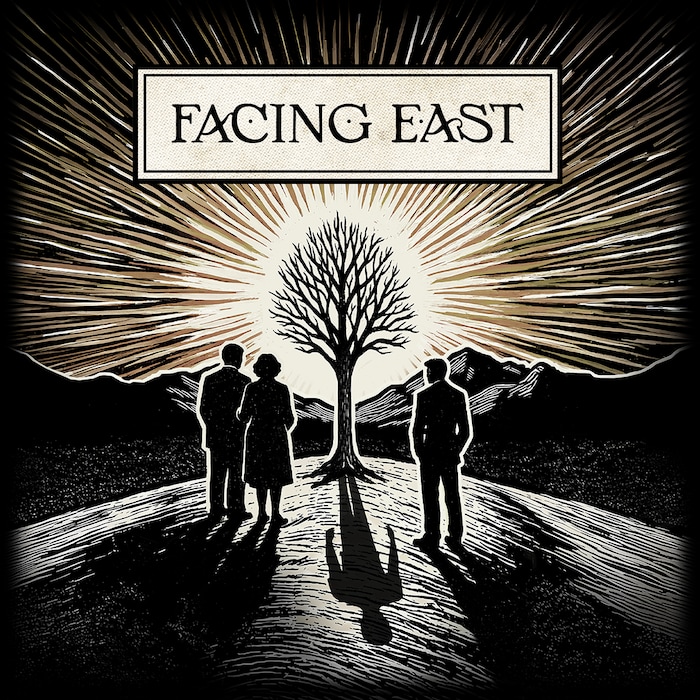
“Facing East” follows a couple named Ruth and Alex as they grieve their son Andrew, who died by suicide at the age of 24 after being excommunicated from The Church of Jesus Christ of Latter-day Saints for being gay. At Andrew’s gravesite, the devout couple meets their son’s partner Marcus for the first time.
Perry played Marcus in 2006, and he recalls seeing families in the lobby, sitting down at a table, talking, crying and holding each other after performances.
(Jennifer Zornow) Jay Perry plays the character of Marcus in the 2006 world premiere of "Facing East."
“Sometimes a play is more than a play, and a piece of art kind of transcends and starts to create a conversation that is bigger than the play itself,” Perry said.
Twenty years later, Perry will be back on the stage for the anniversary run of “Facing East” from Plan-B this month — this time as Alex, Andrew’s father.
His role has changed, but many people say the production is as relevant as ever.
A playwright’s intuition
When playwright Carol Lynn Pearson wrote “Facing East,” she knew it was the right thing to do.
“I had this long history with being with our Mormon young people who were experiencing a lot of difficulty over the way they were feeling about themselves and about others because of their own sexuality,” Pearson told The Salt Lake Tribune in an interview earlier this year, a month before her death.
During their engagement, Pearson’s then-fiance told her he had been attracted to men but that he wanted to “do things the ‘right’ way.” They married and eventually divorced but remained close. He was later diagnosed with AIDS and she took care of him until his death.
When she premiered her play at Plan-B in November 2006, Pearson heard firsthand accounts from LGBTQ+ friends about how much it resonated with them, some saying that it saved their lives.
(File Photo) Author Carol Lynn Pearson, shown in 2002, has died at age 86.
“One told me that he had placed a date on the calendar [when] he was going to take his life,” Pearson said. “One of the things that saved him was reading what I had written about ‘Facing East.’”
Twenty years later, Pearson was adamant: Her play is still relevant, even if the exact circumstances have changed.
“It’s not a done deal. We were not at a place where everybody understands and everybody accepts, and nobody will ever think about destroying themselves,” she said. “So, I’m thrilled to see this [play] have a new life.”
“Facing East” will have its sold-out anniversary run from Oct. 22-Nov. 6 at the Rose Wagner Performing Arts Center.
Audience weighs in
Elbert Peck, once the editor of Sunstone magazine, remembers seeing the first run of “Facing East” in Utah during a time of uncertainty for LGBTQ+ people.
Two years later, in 2008, the Latter-day Saint church would back California’s Proposition 8, a measure that defined marriage there strictly as a union between a man and woman. Gay marriage in Utah would not be allowed until 2013.
Reviving the play brings up those cultural and political factors and looks at how they have changed.
“Mormonism is in a very different place now. It has moderated a lot, if not doctrinally, certainly culturally,” Peck said. “[The play] doesn’t resonate as vividly, because there are a lot more Mormons who believe gays should have love in their lives and should not be denied that.”
Yet, he added, a certain degree of tension remains and cannot be ignored.
“Gays are still second-class citizens in Mormonism,” Peck said.
(Plan-B Theatre) Bruce Bastian, Jerry Rapier and Carol Lynn Pearson at the off-Broadway opening night of "Facing East."
In 20 years, the production has created a history of its own. During its first run, the late Utah philanthropist Bruce Bastian was “instantly devoted” to the project, according to Pearson.
Michael Marriott, the executive director of the B. W. Bastian Foundation, said Bastian’s involvement in the production was personal.
“He was driven by his desire to bring attention to the struggles faced by the LGBTQ+ community, especially those within the Mormon community,” Marriott said.
Bastian grew up in a Latter-day Saint family, came out as gay, and dealt with the aftermath, much like Andrew, the main character in “Facing East.”
“He saw that there was a real need to tell that story, so that you could have some conversation around change, and how people could live together,” Marriott said. “[The play’s] story really resonated with him, because it navigated things of faith, love, and acceptance, and with a Mormon family dealing with the grief of losing their son to suicide.”
Marriott predicted that if Bastian were still alive, he would be “a champion” of seeing the show return.
“The play’s message of love and understanding and compassion in the face of tragedy is kind of a timeless story,” Marriott said. “Dealing with the issues of faith and identity, all those things are still relevant. He would say, ‘The fight continues.’”
(File Photo) From left, actors Jayne Luke, Charles Lynn Frost and Jay Perry pose for a portrait in the City Cemetery on Nov. 4, 2006, ahead of a world premiere of a play by Carol Lynn Pearson that tells the story of Mormon parents after the funeral of their gay son, who committed suicide. The play is significant, due to its topical themes about how religious institutions treat homosexual members, as well as the unreported -- thought to be significant -- numbers of gay and lesbian youth from conservative cultures thought to commit suicide.
That’s something former Salt Lake City mayor Jackie Biskupski agrees with.
“Things definitely were different. We didn’t have marriage equality. We were fighting to be able to create families through adoption,” she said. “The reality of the [play] is still very much alive in this state of ours, and likely in other states, but because the predominant religion is what it is, it is heavier here.”
And, for Perry, who returns to “Facing East” playing a new character, he can’t help but reflect on the last 20 years and the return to a production that means so much to so many.
“It’s going to be a wonderful, wonderful challenge,” Perry said. “It is just as important now, if not more so, because we don’t seem to be learning from our past.”
(Sharah Meservy) The set for the anniversary run of "Facing East" designed by Janice Chan with lighting by Emma Belnap.