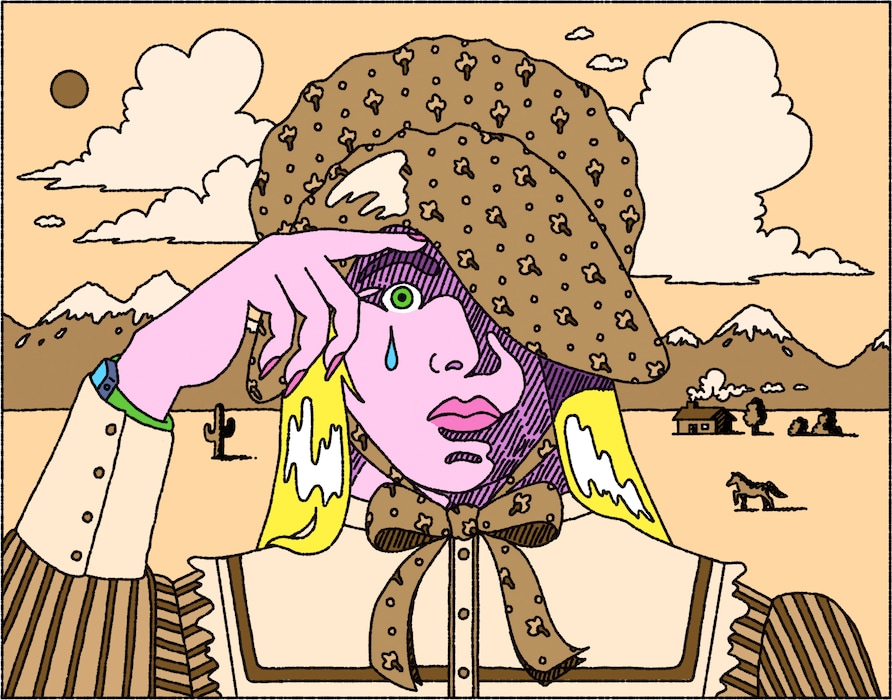
The book “Yesteryear” has a fantastic, pithy pitch: A tradwife influencer named Natalie wakes up in the world she was cosplaying online, in the year 1855. It’s a thriller and a scathing critique of how women perform for the internet. It’s also a book all about religion, belief — and delusion.
It was at the top of The New York Times bestseller list this month. Before it even came out, Anne Hathaway decided she’d adapt it into a movie.
I loved every page. So I called the author, Caro Claire Burke, to talk to her about it.
This interview was edited for clarity and brevity.
Q: Your understanding of the psychology of religious experience is evident in this book. Did you have a religious upbringing?
A: I was raised Catholic, and not just cultural. I was confirmed. My parents never pushed God on me, but you go to Catholic church and that’s where you learn about sin. That’s where you learn about good and evil.
I’ve been surprised at how many people ask if Natalie is Catholic. More people assume evangelical or Mormon, but a not insignificant number of people have said Catholic.
Q: You say Natalie is a “fundamentalist Christian.” Talk to me about why you decided to keep her denomination vague.
A: There are two decisions I made. Number one is that she doesn’t have a specific type of Christianity. And number two, her relationship to her religion kind of moves in and out. She is not someone who is attached to the doctrine. She doesn’t understand Scripture. Her relationship is very transactional.
I feel like I’ve spent the last decade watching people in power try on and then take off elements of religious strategy to see what works best. I became obsessed with the idea that fundamentalism is pretty consistent for women across not just every thread of Christianity, but every religion. There is so much more in common between fundamentalists than there is separating them. A specific thread of Christianity would really just be more distracting. And it would imply more of an intelligence than Natalie has about her own religion.
Q: In preparation for this book, you spoke to many Mormon, or Latter-day Saint, and evangelical women. What did you learn from them?
A: I was really seeking out women who had one foot in these high-control religious settings and one foot out. Because if you’ve never been in it, it’s hard to understand. And if you’re still in it, I don’t think you have the distance to be able to help someone like me with the project I was working on.
Reddit was an incredible resource — ex-Mormon Reddit, ex-evangelical Reddit, ex-Jehovah’s Witness. These women who leave these communities are more aware of gender than probably any other women I know. They’re so aware of what that performance is.
Q: I kept feeling both a critique of religion in the book, but there’s also a longing for faith. In the 1855 scenes in particular, you articulate a really comprehensive bliss Natalie was able to find only when she gave herself fully over to her beliefs.
A: What’s so funny is that before writing this book, I considered myself pretty ambivalent about religion. But writing this has made me so much more interested in my own Christianity. I became really obsessed with the idea of anyone being redeemable.
This book is really a critique of America, and America as a Christian nationalist country right now. I had no interest in either condemning or defending any specific religion. But it was important to me to show that there are people who can find their way out of a regressive ideology and stay in church.
Q: You’re framing Natalie as transactional, but there are certain scenes, especially when she is young, where her faith feels really sincere.
A: Yes. There’s a moment where she’s about to be baptized and she has this terrifying dread, and then this comfort — a sense that, no, we’re not alone, this isn’t pointless.
In the college scenes, Natalie looks at the other girls and thinks, you’re held up by nothing, you’re completely aimless and you’re never going to know wonder — I do feel that. That’s a paranoia I have as someone who doesn’t have a consistent spiritual faith. That I’m missing that drug. I’m missing that feeling of true comfort and wonder.
Q: So much of this book is about surveillance. Tell me about when and how that idea emerged for you, and why you decided to make it such a dominant theme.
A: It started with the most obvious thread, which is social media — the performance and the surveillance. And then when I was reading it again, I started to become aware of the ways that the performance begins so much earlier than social media. Natalie is taught from the earliest age that she will be watched, and if she behaves a certain way, she will be rewarded. Her only understanding of bodily pleasure comes from this idea of performing in the correct way.
Q: You’re also making a broader social critique that we all operate under this kind of surveillance.
A: You think about these social media platforms — their founders might not call themselves religious, but they are acting as religious authorities in some way. They are creating these panopticons where we’re surveilling one other.
Q: I want to talk about prayer in this book — the seeming compulsion of it, and how it changes for her. Initially it’s apologetic, an explicit acknowledgment she’s being watched and needs to be accountable for wrongdoing. And then it shifts to become more theologically grounded.
A: I wanted the camera to be on her at first, where she’s apologizing. I kind of wanted her God to feel more legitimate — she’s the fraudulent one here. But as time goes on, I wanted that camera to shift: What is this authority that she is praying to? How legitimate is it?
And by the end, it’s really her just knocking on a door again and again, and no one’s answering. And it’s like, who even was that? Was that just an amalgamation of voices who have told her how to respond to authority her whole life?
Q: To me, the ending feels like a love letter to reality. What statement were you trying to make?
A: I started to ask myself: Can I love the world while it’s broken right now?
And that’s a very religious question. Finding love for people who behave in deeply irredeemable ways is half of the Ten Commandments. Different religions find different ways for people to cope with that.
I’m pregnant right now, and so many of my friends say: Why would you have kids right now? For me, this is my way of developing a faith. Maybe it’ll get worse in our lifetime. That happens all the time. But that’s why people have faith. For me, it’s not about developing a belief in the afterlife — it’s like, how do you find love in the world?
This article originally appeared in The New York Times.