Olivia Book is a dancer who draws the eye. During a run of “Swan Lake” in 2024, the specificity of her pointe work made it possible to pick out her feet under the dense forest of tutus; the delicate opposition of her shoulders and head allowed her form to emerge from the sea of swans.
But technical prowess isn’t the only thing that makes Book stand out. She has a congenital limb difference — her right arm is smaller than her left. In February, Book was promoted to the corps de ballet of Ballet West, in Salt Lake City, making her one of the first professional ballerinas with a limb difference.
A photo provided by Beau Pearson shows Olivia Book with Pieter Gunning in Ballet West IIÕs ÒAnalog 13.Ó Book is one of the first professional ballet dancers to have a limb difference. (Beau Pearson via The New York Times) Ñ NO SALES; FOR EDITORIAL USE ONLY WITH NYT STORY SLUGGED DANCER LIMB DIFFERENCE BY SOPHIE BRESS FOR MAY 29, 2026. ALL OTHER USE PROHIBITED. Ñ
“In past interviews I would be like, ‘My dream is to become a professional dancer,’” Book, 23, said during a video interview from her hometown, Grimsby, Ontario. “Part of my ballet journey is that I always felt sort of behind, or like I wasn’t the specific ballet dancer that is expected.”
Ballet has a reputation for upholding rigid body standards. In recent years, though, the art form has been rethinking its relationship to diversity in areas like race and body type. Bradford Chin, an assistant professor of dance at the University of Wisconsin-Madison whose work examines dance and disability, said Book’s promotion could add a new layer to these conversations.
“It allows us to question how we conceptualize what a healthy body looks like,” Chin said, “and how we’re approaching the idea of what makes a qualified dancer.”
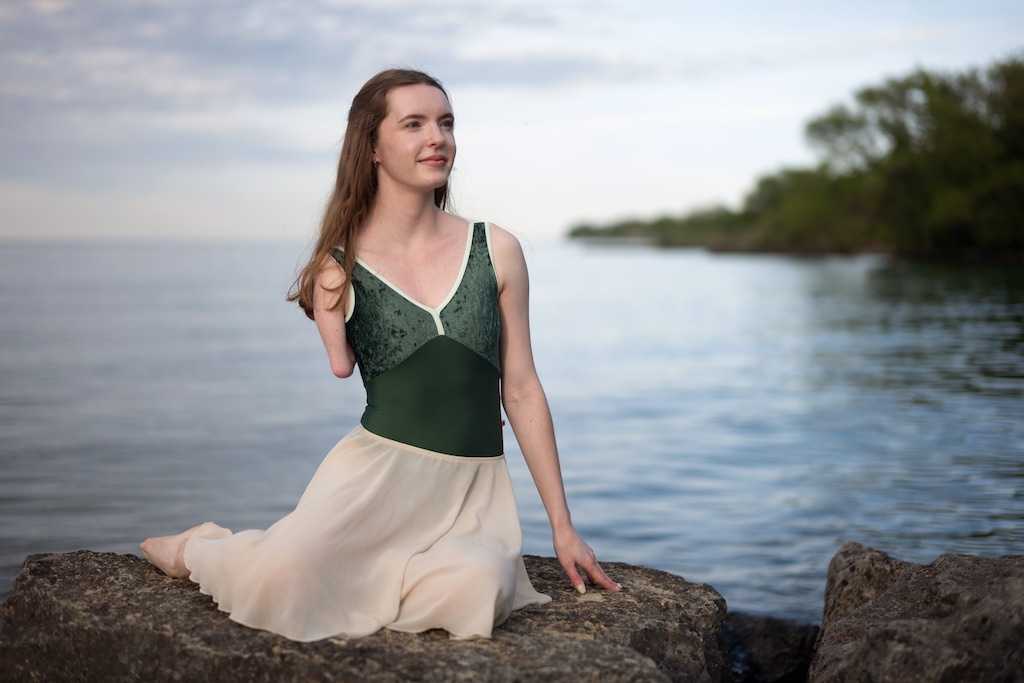
Olivia Book, a member of the corps de ballet of Ballet West, in Salt Lake City, on the shore of Lake Ontario in her hometown of Grimsby, Canada, on May 21, 2026. ÒPart of my ballet journey is that I always felt sort of behind, or like I wasnÕt the specific ballet dancer that is expected,Ó Book says. (Ian Willms/The New York Time)
Book started dance lessons at 3 and became serious about ballet when she got pointe shoes at 12. “There was always that little voice in my head that didn’t know if it would ever be possible to be a professional,” she said, “but I loved continuing to work at ballet.”
She was spotted by Ballet West’s artistic director, Adam Sklute, when he was judging the 2018 Youth America Grand Prix semifinals. Shortly after seeing her dance, he offered her a spot in the company’s school.
“I remember a conversation where a couple of the judges were saying, ‘We should give her a special award,’” Sklute said, “and I said, ‘Well, I’m not sure we need to give her a special award. Let’s see how she does in the competition.’ And when the scores came out, she scored quite high.”
Olivia Book, a member of the corps de ballet of Ballet West, in Salt Lake City, dances on the shore of Lake Ontario in her hometown of Grimsby, Canada, on May 21, 2026. ÒPart of my ballet journey is that I always felt sort of behind, or like I wasnÕt the specific ballet dancer that is expected,Ó Book says. (Ian Willms/The New York Time)
He added that Book “is hardworking, she’s smart, and she has a positive attitude. You can’t ask for anything more in a company member.”
Book, who started training at the Ballet West Academy in 2019, spent two years as a student, two as a company trainee and three in the second company, Ballet West II. Though this is a slightly longer runway than is typical for company dancers, Book said her story was not primarily one of hardship or deficit.
“I’ve been really fortunate not to have had a lot of barriers,” she said. “For the most part, I feel like it was in my own head growing up, and not coming from the people around me.”
Many of the challenges she has encountered as a dancer, she said, have to do with making ballet technique work for her body. She has mastered the art of balancing with one smaller arm, and she has learned to dance pas de deux with only one hand as a connection point with her partner.
Olivia Book, a member of the corps de ballet of Ballet West, in Salt Lake City, on the shore of Lake Ontario in her hometown of Grimsby, Canada, on May 21, 2026. ÒPart of my ballet journey is that I always felt sort of behind, or like I wasnÕt the specific ballet dancer that is expected,Ó Book says. (Ian Willms/The New York Time)
During the company’s recent run of “The Nutcracker,” Book, then a member of Ballet West II, was cast in the Arabian divertissement. At one point, she needed to hold the fabric of a prop tapestry with her right hand. She came up with a simple solution: She reached her left arm overhead to hold the fabric.
“I never want to have to change the choreography too much,” she said. “I always want to find that balance where I can honor the choreography and still be a part of it.”
In the corps de ballet, the dancers’ main task is to blend in. But, with this promotion, Book has been placed in the spotlight in a new way. An accompanying weight has been placed on her shoulders.
Chin said the risk for Book is becoming known for her difference, rather than being seen as an artist whose work is informed by the entirety of her identity.
But being a beacon for others is not new. “I’ve met so many other dancers who have limb differences, and when they say they look up to me or I inspire them to keep going or chase their dreams, it means so much to me,” she said.
Although Book dreams of dancing the ballet canon’s big soloist and principal roles, she said that at this point in her career, the joy she finds onstage is in camaraderie. She recalls that 2024 run of “Swan Lake,” during her first year in the second company.
“That was really a highlight for me, like ‘Wow, I’m onstage being a ballerina,’” she said. “Everyone’s dancing the same and very much in unison, so for me to be a part of that group was just really special.”
This article originally appeared in The New York Times.