This story is jointly published by nonprofits Amplify Utah and The Salt Lake Tribune to elevate perspectives in local media through student journalism.
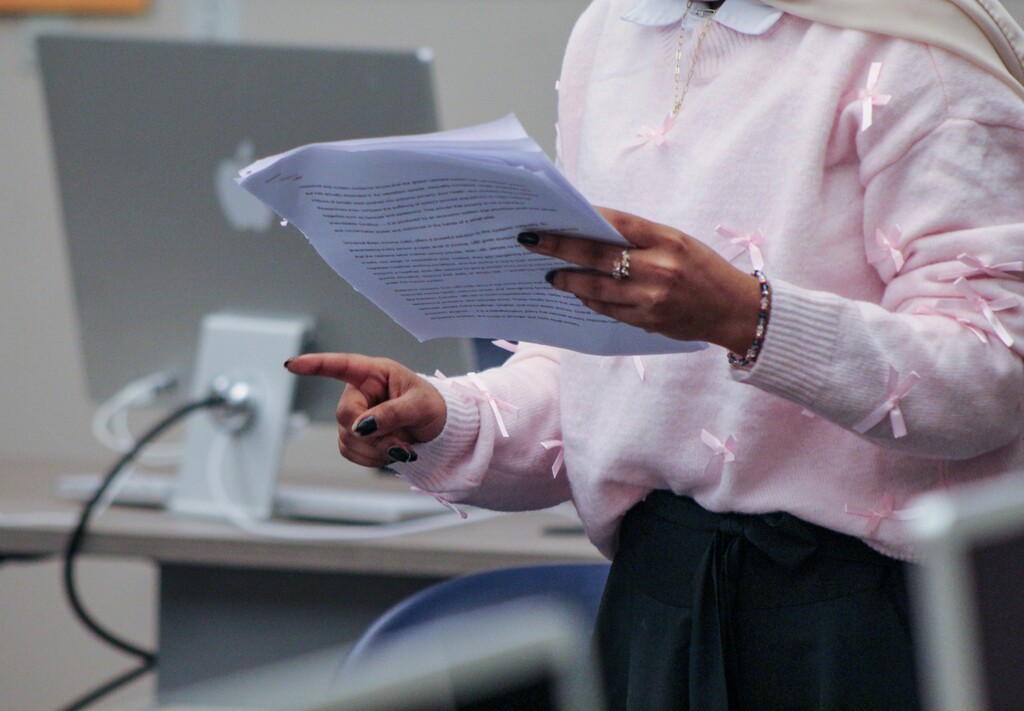
Bom and Anna took their seats in front of a judges’ panel in an auditorium, adjusted their handwritten notes, and watched as the clock was about to start.
After hours of debates, and besting 13 other competitors, Bom, 17, from North Korea, and Anna, 15, from Ukraine, had made it to the final round of a debate competition for refugee teens, held at the University of Utah. (Organizers asked student debaters only to be identified by first name and that their faces not be shown in photographs, due to privacy concerns.)
The debate topic in the final round: Establishing a carbon tax in the United States.
“Here’s the biggest point,” Bom said, arguing in favor of the tax. “No companies or anyone will try to take the responsibility or volunteer to stop the emissions without any policy or government interactions.”
Anna pushed back, arguing such a tax would create global tariffs and destabilize the economy.
It was a moment the students had been working toward for the last 10 weeks. So had Khadija Kele, youth coordinator of the Department of Workforce Service’s Refugee Services Office, who has seen students, many of whom arrived in Utah as refugees, “come alive” as they’ve discovered the power of their voice.
“They’re the ones that are wanting to have these challenging conversations,” Kele said. “They’re pushing others to have these conversations.”
Those voices filled classrooms and auditoriums at the U. on Dec. 4, during the fall tournament of the Refugee Community Debate League, a program that teaches debate and argumentation to middle and high schoolers who are refugees in Utah.
The University of Utah Department of Communication and John R. Park Debate Society, in partnership with the state’s Refugee Services Office, established the program in 2022. Averie Vockel, assistant director of forensics at the U. and the debate society’s outreach coordinator, said it was created to expand the department’s community outreach.
“We wanted something that was offering debate in a new space,” Vockel said.
(Leo LeBohec | Amplify Utah) Jeremy Curry-Young, a panel judge, listens to a student present an argument about how lower-income populations may be affected by a carbon tax, at a debate organized by the Refugee Community Debate League at the University of Utah on Dec. 4, 2025. A panel judge, Jeremy Curry-Young, listens to a student speech about how the lower class could be impacted by a carbon emissions tax. (Leo LeBohec)
More than 21,500 refugees have resettled in Utah over the past 27 years, according to data from the Health Resources and Services Administration. Since 2015, more than half have been children.
Vockel oversees the league, which has run in both the spring and fall semesters. She works with students for more than two months, building from debate basics to research skills, case building and presentation.
Each new group of students chooses a topic area for policy-oriented debate, Vockel said. In past semesters, they have tackled education, health care and gun control. This year’s debates centered around capitalism, with participants making arguments for and against universal basic income and a carbon tax.
“They never [try] to avoid anything controversial,” Vockel said. “Debate is a space where you have those hard conversations, and it’s structured in a way that’s meant to be productive.”
Research supports the effects Vockel has seen the program make. A 2019 study in the journal Educational Research and Reviews found high schoolers who participated in debate were 28% more likely to enroll in a four-year university than those who did not. In 2021, research from the University of Michigan found debate students had an .66 point higher average GPA, as well as higher math, reading and writing scores on the SAT.
Alya Al Mashhadani’s 14-year-old daughter, Basma, took part in the debate league this fall. The program strengthened her communication skills and self-esteem, Al Mashhadani said.
Al Mashhadani’s family moved to the United States from Iraq in 2013, which she said makes opportunities like these even more significant.
“People see refugees like they don’t have enough knowledge or underestimate them,” Al Mashhadani added. “Maybe because of the language barrier, but that doesn’t mean we are not capable.”
Kele said the students’ experiences as refugees help them see more perspectives in their debates. She noticed many of the kids struggled with self-doubt at first. But as the weeks went on, she said she watched them recognize their abilities and potential.
“A lot of times, people only see [refugee kids] as, ‘Oh, the poor refugees,’ but this gives them an opportunity to just put themselves out there and leave the label to the side,” she said. “It’s given them an opportunity to show themselves in a different light.”
Vockel added that building arguments helps students look at the world through a critical lens and form their own opinions, fostering a sense of political efficacy, advocacy and belonging.
The program also works to bridge higher education gaps by offering free college credit to students in ninth grade and higher, Vockel said. Making education more accessible is important, she added, since a refugee family’s immediate needs can overshadow college.
“Higher education resources should be put in places where they’re needed,” Vockel said. “Education is good, access to spaces is good, and having more voices, I think, makes policy better always.”
Students who make it to the final round get $1,500 scholarships to the University of Utah, Vockel said, and the winner gets a new laptop.
The tournament brought together students from countries like North Korea, Ukraine, Somalia and Afghanistan.
Bom, from North Korea, ultimately bested her Ukrainian opponent, Anna, with her argument in favor of a carbon tax, and left the U. as champion.
For Bom, Anna and the other participants Kele watched that day, the tournament was more than a competition. It was a marker of the group’s hard work and growth.
“A lot of these kids … entered in shy,” Kele said, “and they’re coming out empowered.”
Elle Crossley, a recent journalism graduate from the University of Utah, wrote this article as part of a collaborative including nonprofits Amplify Utah and The Salt Lake Tribune.
Donate to the newsroom now. The Salt Lake Tribune, Inc. is a 501(c)(3) public charity and contributions are tax deductible