 Andy Larsen
Boston • There’s a disagreement about the putter.
You see, Brad Stevens, the Boston Celtics’ president of basketball operations, has the flatstick in his office. He seems to practice with it often. When a reporter called him on a Tuesday afternoon last week, Stevens admitted he’d been passing the time by hitting a few golf balls with it just minutes before.
Without a doubt, the putter used to belong to Austin Ainge and he believes his former boss made an effort to keep it in the Celtics’ front offices when Ainge left Boston last summer. Stevens, however, claims it was a gift left behind when his former employee took the job as the Utah Jazz’s president of basketball operations.
“When you talk about his legacy, at the very least, he left the putter,” Stevens jokes.
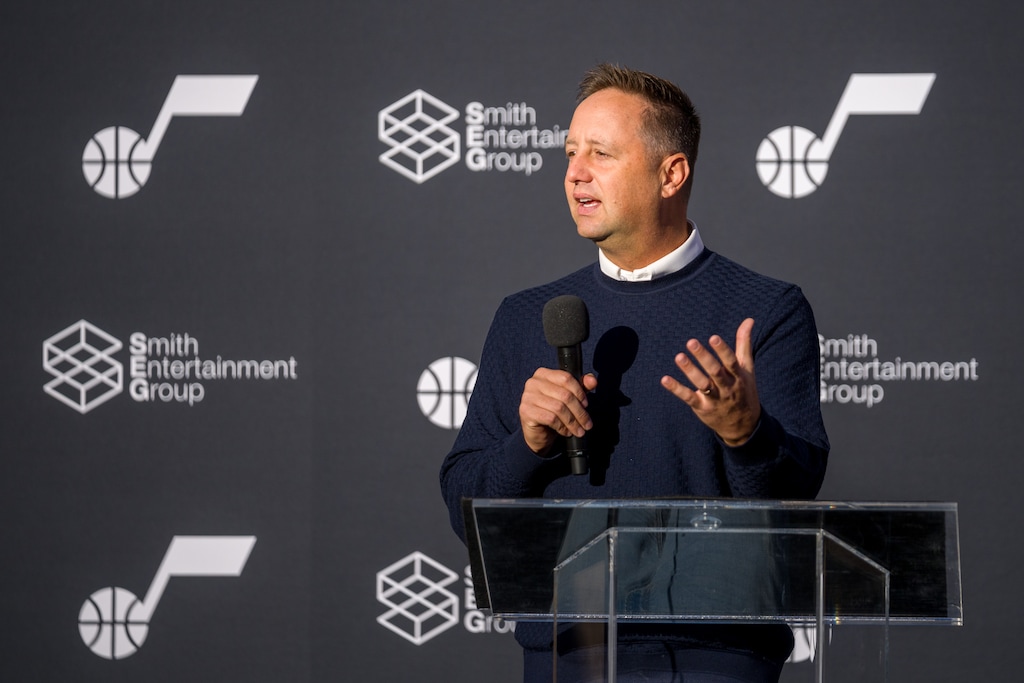
(Chris Samuels | The Salt Lake Tribune) Utah Jazz governor Ryan Smith, right, and president of basketball operations Austin Ainge speak to reporters during Jazz media day in Salt Lake City, Monday, Sept. 29, 2025.
At any rate, giving up the putter was worth it for the experience and lessons Ainge gained from Stevens and others in Boston.
Now, Ainge seeks to impart the lessons he’s gained from a career in basketball onto the Jazz, who might need quality decision-making from their front offices now more than ever after finishing last in the NBA last season.
What will Ainge bring to the role? Here’s what the men who knew Ainge well in Boston say.
Becoming a head coach before 30
Ainge went into coaching nearly immediately upon ending his collegiate career at BYU, where he averaged 7.9 points per game during his senior season. He spent one season (2007-08) as an assistant coach at Southern Utah University.
In 2008, the Celtics hired him to be one of the team’s scouts, but he returned to coaching after just one year in the role.
(John Raoux | AP) Then-Boston Celtics director of player personnel Austin Ainge, left, talks with head coach Brad Stevens during an NBA summer league basketball game between the Celtics and the Detroit Pistons, Monday, July 8, 2013, in Orlando, Fla.
Boston had a new D-League team, the Maine Red Claws, and Danny Ainge, the Celtics’ president of basketball operations at that time, named his son as the developmental squad’s first head coach.
“I wanted somebody I could trust [who] would do things the way we wanted them done,” Danny Ainge told ESPN then. “And I knew Austin was capable and it would be a great experience for him. Again, I wouldn’t do that if my son couldn’t do it. He was ready for it.”
In Maine, Austin Ainge learned the ins and outs of the professional coaching business from D-League coaching consultant Gordon Chiesa, once one of Jerry Sloan’s assistants with the Jazz.
“He was a very intelligent guy. Instinctually, he knew the game,” Chiesa said about Ainge’s first years as a coach. “To be that poised at age 27 was really remarkable.”
What Ainge needed help with was his approach to teaching. Chiesa helped Ainge understand “when to criticize and when to let it flow,” he said. “Especially young coaches, they want to correct and critique every mistake, and then internally, the players rebel,” Chiesa explained. Ainge, over his two years as a coach, learned to pick his spots — especially as the Red Claws brought in 48 rostered players in that limited time.
Chiesa believes Ainge’s experience as a coach was formative in how he’d approach a front office job later on.
“The best talent evaluators are usually former coaches that see the game differently,” Chiesa said. “It’s not just based on pure talent, it’s based on how the talent fits into a team system.”
Growing with the Celtics
Ainge began his NBA career with the Celtics under the tutelage of his father, but he worked his way up the ranks even after the elder Ainge departed Boston.
After two years as a D-League coach, Ainge rejoined the front office as the Celtics’ director of player personnel — in practice, generally a team’s top talent evaluator. As such, Ainge scouted both collegiate and international players, looking for the best prospects to add to the rebuilding Celtics.
“He’s an excellent scout,“ Stevens told The Salt Lake Tribune. ”He has a great eye for it. He won’t leave any stone unturned.”
The level of detail he was seeking took Ainge to courts all over the world.
(Charles Krupa | AP) In this file photo, Boston Celtics forward Jayson Tatum (0) is congratulated by Celtics Assistant General Manager Austin Ainge, center, after scoring a basket during the first half of an NBA basketball game against the New Orleans Pelicans, Monday, March 29, 2021, in Boston. At left is Celtics President of Basketball Operations Danny Ainge, Austin's father.
“He would always tell me, ‘Hey, I’m heading to Australia tomorrow, or ‘Hey, I’m heading to Belgrade tomorrow.’ He really made sure, as a talent evaluator, that he covered every base. He was willing to really put in the work and do that at a high level,” Stevens said.
“Everybody talks about Danny and the guts Danny has in this role and everything else, but I think it’s the work ethic, how measured he really was that I was so impressed by,” Stevens continued. “You see a lot of that in Austin.”
That level of research took Ainge to watch the Iona Gaels of the Metro Atlantic Athletic Conference, where he first saw Jazz draft pick Walter Clayton, Jr. play in 2022-23, before Clayton was generating draft buzz. Clayton, a three-star high school recruit who had garnered attention as a football player in high school, caught Ainge’s eye, well before he was playing in brighter lights and national championship stages at Florida.
It meant that Stevens wasn’t surprised when it was his former employee who called Clayton’s name on draft night. “I could’ve told you two years ago he was going to trade up to get Clayton‚” Stevens told Boston’s media in a news conference then.
Overall, Ainge impressed Stevens with his approach to the job — including on Boston’s developmental path to becoming an NBA championship-winning team.
“He’s always been a guy that I think has a good sense for putting a team together and what wins, both in the regular season and then certainly in the playoffs,” Stevens said.
Adding a new element for the Jazz
In the wake of former Jazz general manager Dennis Lindsey’s removal from the job, there was a sense that the team could use more scouting expertise in the front office.
Danny Ainge was the team’s CEO, but that role didn’t mean much room for day-to-day scouting rigor. General manager Justin Zanik knows the league’s collective bargaining agreement in and out, has relationships around the league, and has experience on negotiating contracts as both a front office executive and as an agent — but may not have had the scouting background the Jazz needed. Team owner Ryan Smith said the resulting Jazz organization was “as lean as any team in the NBA” over the past few seasons.
Smith felt Austin Ainge was the answer. As Ainge attended a two-hour planning session for the Celtics’ offseason with Stevens and company, he received a text from the Jazz’s owner, asking for a meeting. It quickly led to a job offer.
The resulting title gives the younger Ainge wide-reaching control of the organization. While he listens to others who give him advice — including one of his former players in Maine, Utah Jazz Vice President of Player Development Avery Bradley, as well as former Jazz player and current scout Carlos Boozer — Ainge is the one who has final say over all of the Jazz’s moves.
(Tyler Tate | AP) Utah Jazz drafted players,left to right, Ace Bailey, Walter Clayton Jr., John Tonje and Austin Ainge, President of Basketball Operations for the Utah Jazz, pose during the Utah Jazz player introduction press conference Sunday, June 29, 2025, in Salt Lake City.
Hiring someone over the top of those who were in the front office before could have been destabilizing. Head coach Will Hardy, though, said that Ainge has been easy to work with in his months in Utah.
“I haven’t felt a shock from him coming in the building, just because of how he carries himself,” Hardy said.
Why is that?
“He’s a very level-headed, competitive, forward-thinking person,” Hardy continued. “He’s an easygoing person. He’s got a good sense of humor. I think he’s an easy person to connect with.”
It’s why Stevens thinks that Ainge will be a success in his new role, saying that “Austin is more than ready for this task in Utah.”
However, not everything will be as easy as it was in Boston — especially without his favorite putter.
“Here, he was one of the better golfers left on staff,” Stevens said. “Now he’s probably found himself in some tougher games. So probably that’ll be his biggest challenge.”
Note to readers • This story is available to Salt Lake Tribune subscribers only. Thank you for supporting local journalism.