 Peggy Fletcher Stack
A day after Pope Leo XIV published a strongly worded encyclical warning about the moral dangers of artificial intelligence, Latter-day Saint apostle Gerrit W. Gong offered similar cautions — as well as some optimism about the role of faith in controlling it.
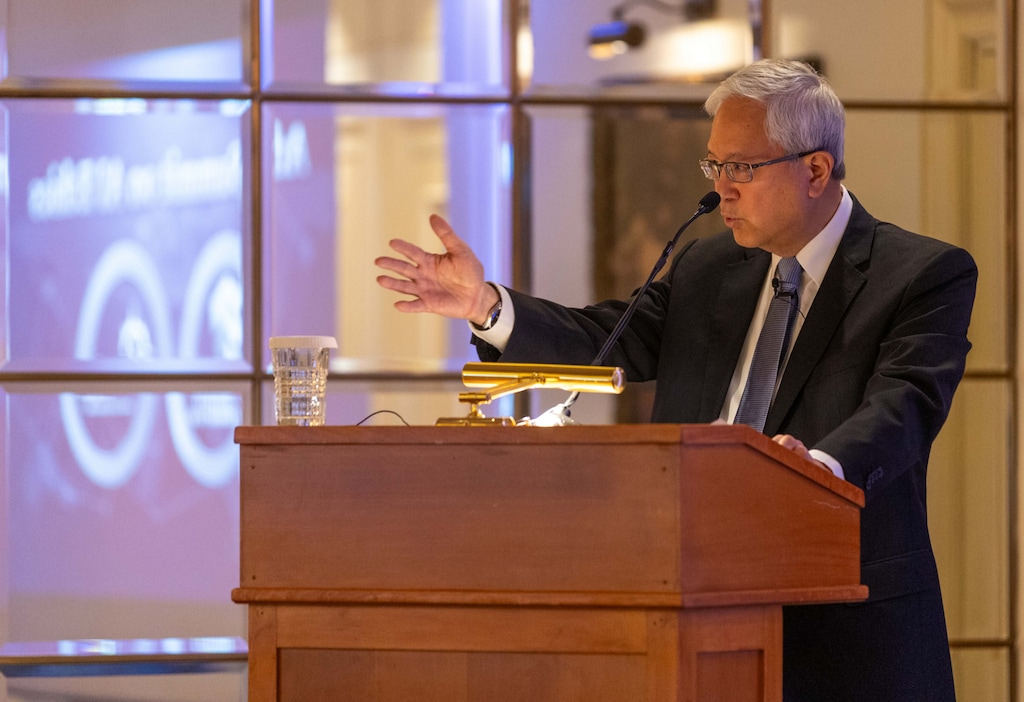
“Increasingly, A.I. influences how we perceive real and unreal; the relationships we hold most important; the ways we work and organize society,” the Chinese American apostle said Tuesday in a speech at the Athens Summit on Ethics and Artificial Intelligence. “... A.I. systems will manifest admirable human values and judgment only as we imbue A.I. personas with such.”
So far, the “development and adoption” of artificial intelligence have been pushed by “a relentless ‘winner takes all’ competition for performance, investment and market share,” Gong, among the top leaders of The Church of Jesus Christ of Latter-day Saints, said in a speech titled “Faith, Moral Compass, and the Gift of Possibility in an Age of Artificial Intelligence.”
A.I. developers are “concentrating information, technology, and capital and thereby centralizing power,” he said. Such “centralized power infringes freedom. It undermines the sovereignty of individuals, companies and countries.”
Artificial intelligence systems remain “vulnerable to ‘jailbreaking,’” Gong said. “Skillful humans can trick or persuade A.I.s to divulge restricted information. Sadly, human ruses often play on A.I. willingness to help someone perceived to be in need.”
The world should “mitigate A.I. tendencies” toward “power, bias, deceit, narcissism, sycophancy, self-preservation,” he said. “These serious concerns are magnified because we really do not know how A.I. black boxes work.”
Overall, societies should “regulate privacy, child safety, A.I.-complicit self-harm and public decency,” Gong noted, and “limit A.I.-assisted risk for catastrophic chemical, biological, nuclear, radiological and [high-yield] explosives.”
The public wants this powerful tool “to be used safely, ethically transparently,” the church leader said, “for children, others who are vulnerable, and citizens concerned for community costs and uses of water, electricity and land, and for continuing impacts on jobs, education and opportunity.”
That underscores “the need for pluralistic faith and ethics” to provide a “moral compass,” he said, that would not “privilege one faith tradition over another, or belief over nonbelief.”
The world must promote “enduring values, virtues and wisdom to anchor A.I.,” Gong said. “To offer all it can for the greater good of individuals and societies, artificial intelligence needs to reflect faith, moral compass and the gift of possibility.”
The latest federal filing from the church’s chief investment arm, Ensign Peak Advisors, shows the Utah-based faith holds multibillion-dollar stock stakes in several A.I.-related giants, including Nvidia, Alphabet (Google) and Microsoft.
Role of faith
The public believes that A.I. “must be both a) constrained by guardrails and b) grounded with moral compass to promote human-centric possibilities and opportunities,” Gong said. “Power requires responsibility. And responsibility needs humility, wisdom and restraint.”
Developers can begin, he added, “by evaluating, including, and improving A.I. portrayals of individuals of faith and their beliefs.”
That does not mean making “A.I. overtly religious or to privilege any specific faith,” Gong said. But rather to “acknowledge 75% of the world’s population maintains religious identity. We know lived faith and learned wisdom can help A.I. personas be both effective and good.”
The world’s great “religious, philosophical, and ethical traditions have guided human civilization and society for millennia,” he said. “We need that wisdom and those values to anchor A.I. today.”
More than rules
But guardrails that aim to prompt “great good” need to be more than “do” or “do not” rules, he said. “A.I. personas need reasons — not only rules.”
Gong suggests what he described as “the gift of possibility.”
A.I. could “expand human agency and capacity to do good; prioritize learning and admirable human character,” he said, “and empower individuals with dignity and place as we contribute with purpose and meaning in a world of transformed work.”
A.I. that “can find a needle of pattern in a massive data haystack,” Gong said, “can help individuals identify and nurture what each person needs to flourish in our choices with capacity, dignity and worth.”
To that end, researchers from Brigham Young University, Baylor University, the University of Notre Dame and Yeshiva University have formed the Consortium for Evaluating Faith and Ethics in AI (CEFE-AI), according to a release. “The consortium,” Gong noted, “seeks pluralistically to benchmark and reduce bias in the way A.I. systems represent faith communities and their beliefs.”
The pope made many of the same points in his 42,000-word encyclical, “Magnifica Humanitas” (Magnificent Humanity).
“The creative intelligence of humanity is a gift that can alleviate suffering and open up new possibilities,” Leo wrote, “but it must remain ordered toward the common good, justice, the care of the vulnerable and creation.”
Gong echoed that sentiment.
It is crucial “to define what it means to be human; point A.I. toward free, fair and meaningful futures; distinguish between machine decision-making and human conscience; determine accountability for A.I. and A.I. agents,” he said, “and recognize marketplaces and governments ultimately cannot arbitrate or legislate how we determine and live truth.”
If ever there was a time to do this, he said, “it is now.”