facebook-pixel

Commentary: Trump’s war on Iran robs U.S. of its moral authority

America’s power in the world comes not from its military might alone but from its moral authority.
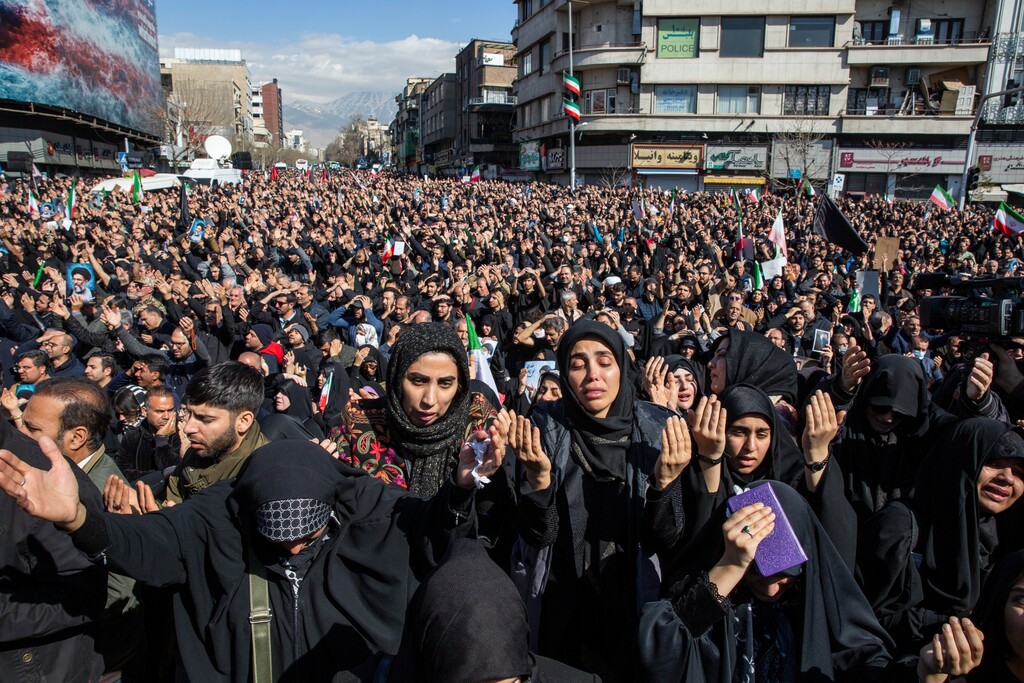
(Arash Khamooshi | The New York Times) People mourn the killing of Iran’s Supreme Leader Ayatollah Ali Khamenei at a rally in Tehran, Iran, on Sunday, March 1, 2026, a day after he was killed in coordinated U.S. and Israeli airstrikes.

The most famous quote about war has it that the first casualty of war is the truth, but for Muslims and other people of faith in the Middle East, the most important casualty of Operation Epic Fury may be the last wisp of America’s moral standing. What led Washington to this unprovoked war with negotiations underway?

The only answer that anyone in the Middle East can come up with is that Israel, which actually launched the main attack, pulled the U.S. administration into war. Israel and its supporters in Congress, bolstered by the powerful pro-Israel American Israel Public Affairs Committee lobbying group, were also behind President Donald Trump’s tearing up the 2015 nuclear deal between Iran and the five permanent U.N. Security Council members, plus Germany — known as the Joint Comprehensive Plan of Action.

That agreement aimed to limit Iran’s nuclear program in exchange for sanctions relief, but Trump wanted a deal of his own, not one negotiated under President Barack Obama, and Israel wanted one that restricted not only Iran’s nuclear capability but also ballistic missiles that could threaten its people.

Certainly, it is not the American public whom Trump is appeasing. A poll taken in early February by the University of Maryland showed that 21% of Americans overall and only 40% of Republicans favored attacking Iran. Because he didn’t bother getting approval from Congress, that body’s inclination is not known, but in going to war Trump has ignored the advice of his own party leaders as well as, reportedly, his top military adviser.

The attack took place while the United States was holding indirect talks with Iran, which, the latest indicators seemed to say, were moving in the right direction. Oman’s foreign minister, who communicated proposals to both sides and who was therefore privy to the discussions, had gone on U.S. television Friday to appeal to the American people to help prevent the war now at full steam.

We may not know for years what drove Trump to bypass his own campaign promise to be a no-war president, and the few immediate conjectures are not satisfying. Israel’s current prime minister, whom Trump admires, is fighting for his political life as well as against accusations of criminal behavior. A war is Benjamin Netanyahu’s only hope to convince Israelis in the next election that he must stay at the helm of the country.

But Trump is not one to risk his own political skin for another leader’s future. The Epstein files are a possible motivator: However redacted the files, their revelations keep getting closer to Trump, and a war is a handy distraction. He may be listening to the Christian Zionists who make up a chunk of his political base. Perhaps he dreams that if he turns Iran into a democratic anchor in the mostly autocratic Middle East, he will finally get a Nobel Peace Prize of his own.

But Trump should heed the lessons of George W. Bush’s Iraq War, whose ripple effects are still being felt. Bush followed the illusion put forth by Netanyahu that getting rid of a Middle Eastern dictator — two decades ago it was Saddam Hussein — would bring about peace. Instead, we have an Iraq that is closer to an Iranian client.

Ideological regimes like Iran’s are even less liable to surrender. Attacks from air aren’t likely to change facts on the ground, and conquering a huge and powerful country like Iran with boots on the ground will be no “cakewalk,” in the term used by Donald Rumsfeld before Iraq became a quagmire.

Meanwhile, the remote killing of its top leaders, even a total collapse of the regime, risks the possibility that a much more radical leadership will emerge. The assassination over the years of leaders of the Islamic Hamas movement has, by and large, brought more radical leaders.

Some might argue that after the initial hits and after both sides recuperate, there is a strong possibility that an agreement will be reached. But Saturday’s attacks will inflict immeasurable damage on the United States in the Muslim world. While most governments around the Persian Gulf denounced Iran’s attack against U.S. bases on their soil, the peoples of the region, the Muslims of Iran as well as their fellow Shiites in Iraq and Lebanon, Houthis in Yemen and young Arabs and Muslims everywhere are even now feeling more sympathy with the Iranian people than their own leaders.

The United States is finding out in concrete terms what has long been known abroad: Its power in the world comes not from its military might alone but from its moral authority. The saying “Fool me once, shame on you, fool me twice, shame on me” applies here. America has been fooled into an unnecessary war that will further put Americans and American policy in danger. What caused this foolish decision is anyone’s guess, but eventually history will look back on this as an act of folly.

Note to readers Daoud Kuttab is the publisher of Milhilard.org, a news site focused on Christians in Palestine, Israel and Jordan. The views expressed in this commentary do not necessarily reflect those of Religion News Service.

Help The Tribune report the stories others can’t—or won’t.

For over 150 years, The Salt Lake Tribune has been Utah’s independent news source. Our reporters work tirelessly to uncover the stories that matter most to Utahns, from unraveling the complexities of court rulings to allowing tax payers to see where and how their hard earned dollars are being spent. This critical work wouldn’t be possible without people like you—individuals who understand the importance of local, independent journalism.  As a nonprofit newsroom, every subscription and every donation fuels our mission, supporting the in-depth reporting that shines a light on the is sues shaping Utah today.

You can help power this work.