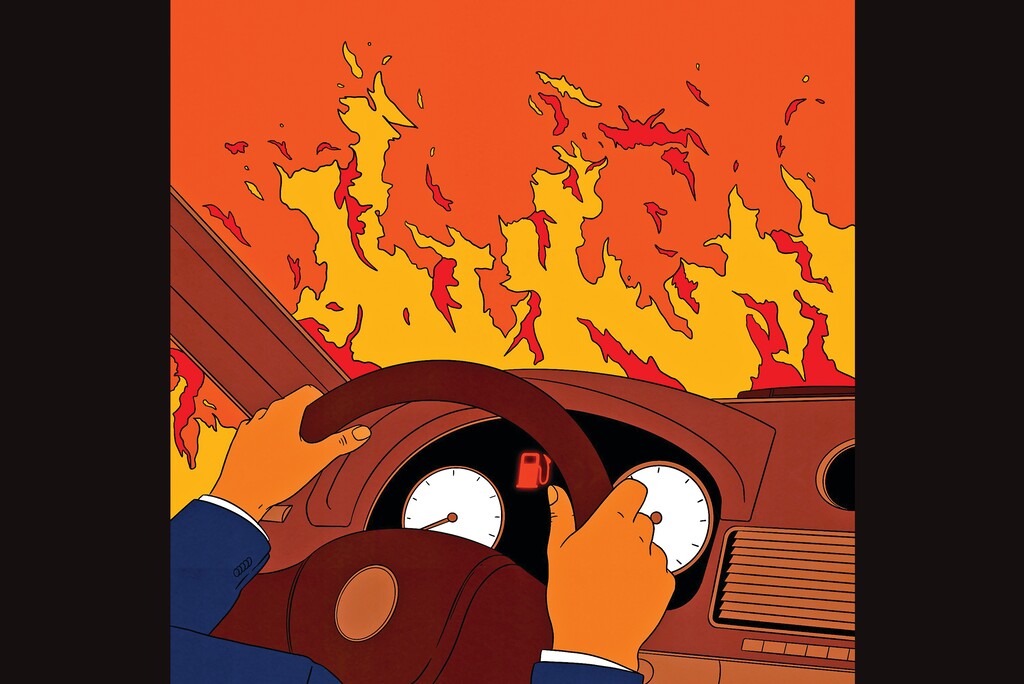
War in the Middle East is once again exposing the downsides of our addiction to oil and gas. Transportation and electricity costs are soaring for ordinary families, while multinational oil giants and Vladimir Putin reap windfalls. Then add in the usual planet-heating greenhouse gas emissions.
Understandably, $5-a-gallon gasoline and other fallouts from the energy crisis are inspiring calls for America to reduce its dependence on fossil fuels. And though it’s become unfashionable to say so, individual Americans can also change our expensive and destructive gas-guzzling ways. Yes, President Trump’s attacks on electric vehicles, renewable power and fuel-efficiency rules are awful. But nobody’s really stopping you from buying electric vehicles, installing solar panels or using less fuel.
It’s not a bad idea. You can save real money while doing a small part to help stabilize the climate, defund Big Oil and even reduce the risk of future conflicts in fossil-fueled nations like Iran and Venezuela. It’s true that your contribution to a better world will only be a drop in the bucket, but lots of individual drops, after all, are what fill buckets.
Our government used to recognize this. It called on patriots to join car pools to save gas during World War II, with posters declaring that “When you ride ALONE you ride with Hitler!” During the oil shocks of the 1970s, President Ford urged Americans to drive less in his “Whip Inflation Now” speech, before President Carter donned a cardigan for his infamous fireside chat asking them to lower their thermostats to 55 degrees Fahrenheit at night. President George H.W. Bush’s administration ran ads during the Persian Gulf War of 1991 suggesting that drivers should conserve fuel by slowing down and keeping their tires properly inflated.
President Trump, unsurprisingly, doesn’t talk like that. He recently claimed that high oil prices are good for America, by which he presumably meant good for his donors in the American oil industry. What’s surprising is that environmentalists don’t usually talk like that anymore, either, when they used to preach the importance of conservation, recycling and other eco-friendly behaviors all the time. The cartoon possum Pogo summed up the movement’s original Earth Day message in an anti-littering poster: “We have met the enemy and he is us.”
Over the past decade, green activists, tired of being caricatured as guilt-tripping scolds, have recast the enemy as fossil-fueled politicians like Mr. Trump and fossil-fuel extractors like Exxon. They’ve mostly stopped lecturing us about our individual carbon footprints and other environmental sins, focusing instead on political and systemic change, while urging us not to obsess about our personal behaviors. Climate hawks routinely point out that BP invented the carbon-footprint calculator, portraying the entire concept of personal eco-responsibility as Big Oil propaganda designed to make you feel ashamed about a problem created by corporate greed and political corruption.
It’s true that political change will be vital to weaning the world off energy sources subject to price spikes when there’s unrest around the Strait of Hormuz. Around the globe, supportive government policies have already helped drive down the prices of solar, wind, batteries and electric vehicles, spurring a clean-energy revolution that has allowed other countries and citizens to reduce their costs and exposure to oil shocks, as well as emissions. Mr. Trump’s assaults on green subsidies, mass transit and pollution regulations have been an infuriating drag on that progress in the United States. He’s making it harder to go green.
But he isn’t forcing you to drive a massive S.U.V. to the mall, and neither is Exxon. The good news is that going green no longer necessarily involves financial sacrifice. The five best-selling electric vehicles in the United States all cost less than the national average for a new car. Even before prices at the pump started soaring above $4 a gallon, Consumer Reports found that the typical E.V. owner saves $6,000 to $12,000 on maintenance and fuel over the car’s lifetime. As the owner of an all-electric Chevy Bolt, I can report that it’s nice not to have to think about gas prices. My Bolt is powered by solar panels on my roof that paid for themselves in seven years. And it’s nice not to pay big electric bills, too.
I don’t want to be a guilt-tripping scold, either, especially since I still fly way too much. The point isn’t that people should be perfect; it’s that better is better than worse. Even if you’re still reliant on fossil energy, even if you don’t believe that driving alone means driving with Putin and you don’t feel like adjusting your thermostat, occasional car pooling or biking can still be enjoyable and profitable. Inflating your tires, as mundane as it sounds, can save you a few hundred dollars a year on fuel. Maybe more if the bottlenecks persist at the Strait of Hormuz.
As the United Nations secretary general, António Guterres, pointed out two weeks ago in an appeal for an accelerated global transition to renewable energy, sunshine and wind can’t get blockaded, embargoed or weaponized — even though solar and wind components can run into supply-chain disruptions of their own. We now have cost-competitive and much less volatile alternatives to fossil energy that didn’t exist during World War II or even the war in Iraq. We now know that burning oil and natural gas in our cars and homes is turbocharging heat waves, droughts, floods and other climate-driven chaos. What we don’t seem to have is a sense that we’re all in this together, that we should all try to do our part for energy security, national security and the health of the planet. In a way, we’re all still driving alone.
That’s another political problem. But it’s worth keeping in mind that America’s greatest political victories for the environment — the Clean Air Act, the Clean Water Act, the Endangered Species Act — happened in the early days of the Earth Day era, when Pogo’s message that the enemy was us helped create an environmental ethic that made littering uncool and political change possible.
Fossil-fuel combustion is a form of atmospheric litter, but for most Americans, it’s not yet uncool to create carbon pollution. And it’s hard to imagine how to guilt or shame or even educate enough of them into going green without political change. But it’s also hard to imagine how the modern green movement can persuade enough people to support political action to fight the climate crisis, while simultaneously assuring them that their personal contributions to the crisis don’t really matter.
In reality, all emissions matter. They accumulate in the atmosphere, so every tank of gasoline, cross-country flight and fossil-fueled load of laundry makes the earth a little warmer. And anything you can do to reduce your emissions makes the problem a little easier to solve, once we collectively decide we want to solve it. Maybe if $5 gas can inspire more individual Americans to change, our leaders will eventually follow.
Michael Grunwald, a contributing New York Times Opinion writer, is the author of “We Are Eating the Earth: The Race to Fix Our Food System and Save Our Climate.” This article originally appeared in The New York Times.