For the past few years, a familiar refrain has echoed through conversations about the Great Salt Lake: If things don’t change, people will leave. Businesses will relocate. Families will move. Young people will take their futures elsewhere.
I’ve gotten tired of hearing that despair. I am choosing to stay.
And so are countless young people who have committed themselves to this lake. Not because it’s easy, or guaranteed or politically convenient, but because it is home. Even when our voices are discounted. Even when our ideas are dismissed.
I’ve advocated on Great Salt Lake issues for the past five years. In that time, I’ve watched something rare take shape. I’ve seen people with histories and values that barely resemble mine align their goals. Artists, business owners, policy makers, high schoolers — we all believe the lake matters. And that belief is what brings us together.
Last September, when Gov. Spencer Cox announced $200 million in private funding and a commitment to reaching healthy lake levels by the 2034 Winter Olympic and Paralympic Games, it felt like a promise: to the lake, to Utahns and to the young people who are fighting for their right to a healthy future here at home.
But when college and high school students like myself crunched the numbers to see what it would actually entail for the state to keep its promise to us, we realized just how much work we have ahead of us.
In order to restore the lake by 2034, our decision makers would need to dedicate more than one million additional acre feet of water to the lake each year. Reports show that this could cost between $2 billion and $5 billion, which means that Utah needs around $450 million every year for the next eight years to get enough water by 2034.
Even though the lake has secured half of that in private, non-profit, and federal dollars, we were shocked to see that we are still $200 million short this year alone.
Young people are often told our generation will “inherit a mess,” one that will be our responsibility to solve. I take that responsibility very seriously. That’s why I stepped up to help and wrote SB250: Great Salt Lake Amendments with Sen. Nate Blouin and other concerned youth.
Our bill closes the funding gap by redirecting $200 million away from the proposed Bear River Development — a project that would further drain the Great Salt Lake — and using it instead to purchase or lease water for the lake. By matching the recent $200 million private pledge with existing state funds, it will put Utah financially on track to achieve our “Great Salt Lake 2034” commitments without costing taxpayers a dime.
We brought SB250 forward because it is a common sense solution. We have hundreds of millions of taxpayer dollars sitting idle in an account intended to fund the Bear River Development. But the Bear River Development would divert an additional quarter million acre feet of water from Great Salt Lake. So, naturally, we asked: why continue funding it? It is impossible to develop the Bear River and save the Great Salt Lake. Those two things don’t align, and Utah leaders know this. S.B. 250 resolves that contradiction.
Last Monday, in a packed Senate hearing, high school students, mothers, west-side residents, and other community members testified in unanimous support of the bill. Dozens of people took time off of school and work to give public comments. In a five-to-one vote, the committee decided to hold the bill “for further discussion.” They handed it off to Thursday’s Water Development Commission meeting, where, once again, despite overwhelming constituent support, members of the commission refused to put the bill to a vote.
As teens and twenty-somethings, our formative years have been shaped by fighting for our future. We’ve stepped into leadership because we don’t have another option. We can’t wait until we “inherit” the mess to start fixing it, because we don’t have the luxury of waiting.
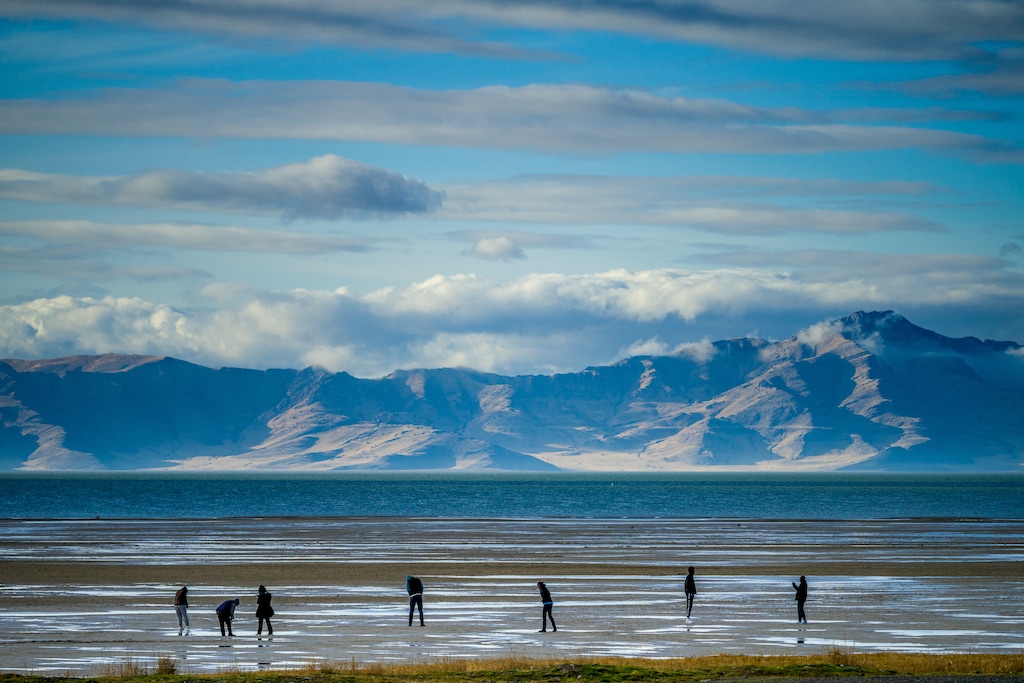
We are doing our part. Now, we are simply asking the adults entrusted with protecting us to do theirs. SB250 offers legislators the chance to listen to youth. To remember their promises. To work with us in good faith. And to give the solutions we’re bringing forward the sincere consideration they deserve.
We’ve chosen to stay and fight for this place, and we’re asking you to stay and fight with us.
(Harriet Richardson) Muskan Walia is a youth organizer.
Muskan Walia is a youth organizer. She has led campaigns around water, energy and environmental education.
(Nate Blouin) Nate Blouin serves in the Utah Senate, representing District 13.
Nate Blouin serves in the Utah Senate, representing District 13 including the cities of Millcreek, Salt Lake City, Murray, South Salt Lake and West Valley City. He focuses on accountability and climate issues including Great Salt Lake and clean energy.
The Salt Lake Tribune is committed to creating a space where Utahns can share ideas, perspectives and solutions that move our state forward. We rely on your insight to do this. Find out how to share your opinion here, and email us at voices@sltrib.com.
Donate to the newsroom now. The Salt Lake Tribune, Inc. is a 501(c)(3) public charity and contributions are tax deductible