 Emily Anderson Stern
Despite some candidates delivering concession and victory speeches in Tuesday night’s primary contests, Utah election workers continue to process ballots — and it will be weeks before all results are finalized.
All ballots, whether they were cast in person or through the mail, had to be received by 8 p.m. Tuesday. Election workers began counting ballots received through the mail, in drop boxes and at polling locations earlier that day, and will continue tallying them throughout the next couple weeks.
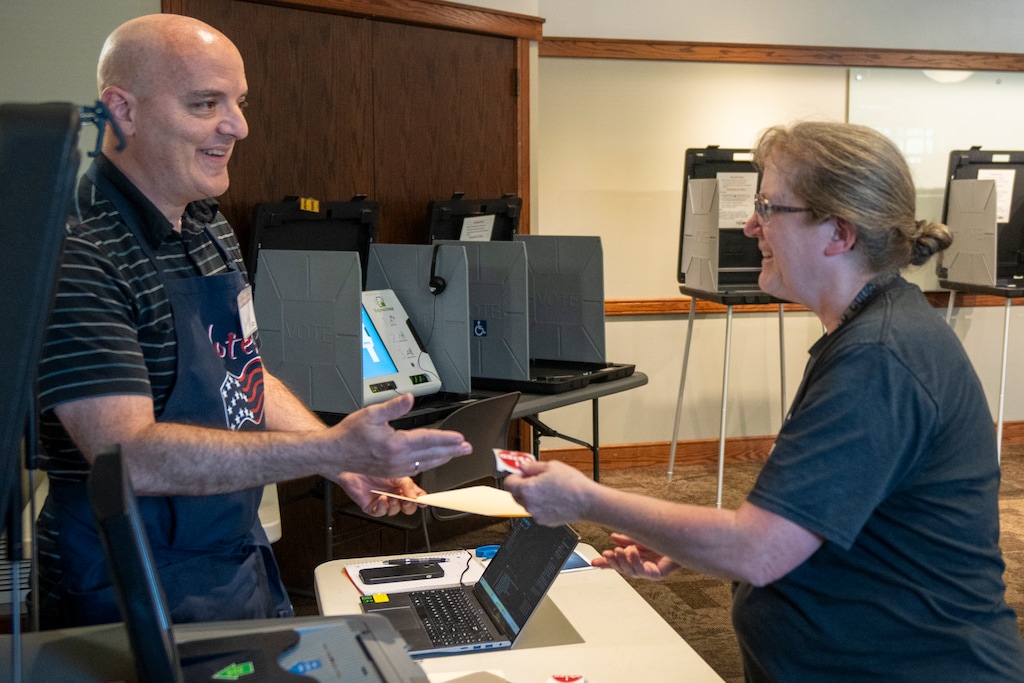
While Utahns who voted at a polling location on primary election day used a machine, paper ballots voters received in the mail are counted differently.
Each paper ballot includes a barcode that helps election workers verify that voters have only cast one ballot. Then, workers check the signature on the ballot against signatures in a state database to ensure they match.
After election workers confirm a voter’s identity, they remove personal information from the ballot — to keep it secret — and send it to be counted. Paper ballots cast through the mail or in drop boxes are counted by machines that were tested for accuracy in the weeks prior to the election.
If an election worker determines a signature does not match, or that there is some other issue with a ballot, county election officials will send a cure letter to that voter with instructions on how to resolve the issue. The deadline for taking action can range from six to 13 days after the letter was sent.
Voters can sign up to track their ballot at https://vote.utah.gov/track-my-ballot/.
The lieutenant governor’s office will certify the results of multi-county races, including most congressional races, on July 20 — “the fourth Monday after the regular primary election,” under Utah code. But in races that only take place in one county, like the Democratic contest for Utah’s new 1st Congressional District in Salt Lake County, state law says county officials can begin certifying results as early as next Tuesday, and must sign off on them by July 7.
In both cases, a board of canvassers votes to approve a certified summary of election results and officially declare who won each election.
Utah Auditor Tina Cannon, Treasurer Marlo Oaks and Attorney General Derek Brown comprise the state board of canvassers. On the county level, county commissions and councils also act as a board of canvassers.
Their role is to ensure every valid vote is counted, checking whether the number of votes tallied matches the number of ballots cast, and reviewing explanations as to why certain ballots may not have been counted.
But, Utah law says, “The state board of canvassers may not withhold the declaration of the result or any certificate of election because of any defect or informality in the returns of any election if the board can determine from the returns, with reasonable certainty, what office is intended and who is elected to it.”
The votes taken by boards of canvassers establish who will appear on ballots in the Nov. 3 general election.
Emily is a statewatch reporter at The Salt Lake Tribune, where she has worked since 2022. She received her master's degree in journalism from Northwestern University. There, she worked on investigative projects for The Washington Post and ProPublica. While writing, she's probably spinning something from her ever-expanding shelf of punk records.