Note to readers • The Salt Lake Tribune is making this story about the Utah Legislature free to all. Donate to support our nonprofit newsroom.
Herriman is one of the state’s fastest-growing cities, and it has approved thousands of permits for new houses. But developers can’t build them because there isn’t enough water capacity.
“We do not have the funding to add more water infrastructure as far as tanks right now,” Mayor Lorin Palmer told lawmakers last week while testifying in favor of HB492, a bill intended to route $100 million in state funds for infrastructure projects. “This absolutely will unlock thousands of units in our community.”
The bill would repurpose money from the Transportation Investment Fund to provide low-interest loans for local governments seeking to fund such projects as sewer lift stations, water tanks, treatment plants, and regional roads.
A board would consider the applications, with the preference toward supporting developments with single-family, detached homes.
“That’s the type of housing we’re missing,” said Rep. Cal Roberts, a Draper Republican who’s sponsoring the bill.
Palmer told The Salt Lake Tribune that cities have been “preaching for years” that funding infrastructure is the right role for the state to play in housing.
“That’s where they should put their thumb on the scale,” he said.
Not enough infrastructure, not enough houses
Utah has for years faced a massive housing shortage compounded by high interest rates and a lag in construction.
As of January, according to the Federal Reserve Bank of St. Louis, the median listing price for a home in Utah was $590,000 — the sixth-costliest market in the nation.
A recent report estimates the state will be more than 200,000 homes short of demand in 30 years, unless policymakers and lawmakers make changes.
Experts say those supply-side issues have led to Utah’s high housing costs – and that’s at least partly due to infrastructure.
Until now, Utah hasn’t had a great way to fund regional infrastructure projects, said Steve Waldrip, who serves as Gov. Spencer Cox’s senior advisor for housing strategy.
“This is something that is desperately needed across the state,” he said.
The fight in recent years, Roberts said, has been over how local governments don’t want the state to preempt their land-use authority.
He tried to think differently when proposing this bill, he said, to get at the supply issues by addressing one of the biggest choke points – infrastructure. A “significant amount of homes” are approved but not built, Roberts said, with infrastructure as the holdup.
And moving the $100 million from a transportation fund shouldn’t delay planned projects, he said.
More than 100,000 units waiting
According to testimony on a different bill meant to free up more private money for projects, there are more than 100,000 units across the state that are approved for development but held up by infrastructure needs.
That includes 13,000 in Herriman, a city of about 60,000. About 7,500 of those units are in three developments that are stalled while the city increases its water capacity.
In the Panorama and South Hills developments in eastern Herriman, two water tanks and a pump station should be completed this summer, allowing for up to 1,716 units in Panorama and up to 1,441 in South Hills, according to development agreements.
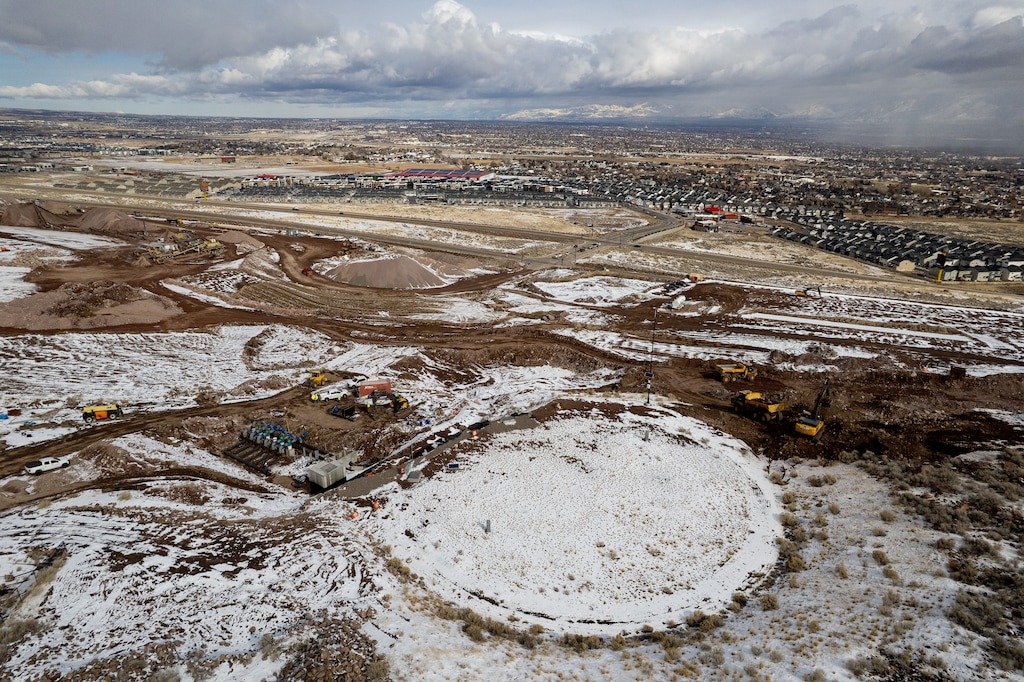
(Trent Nelson | The Salt Lake Tribune) The Olympia development near Oak Leaf Elementary School in Herriman is waiting for the completion of a water tank that's still in the design phase. It will eventually hold up to 6,330 housing units.
In the Olympia development in northwestern Herriman, a water tank and related infrastructure are still in the design phase, but would allow for up to 6,330 units once completed, according to the development agreement. At least 30% of those will be detached, single-family homes.
Other cities face similar issues, Palmer told lawmakers, citing Harrisville, a city of about 7,000 people in Weber County, where 1,200 approved units also are locked up because there isn’t supporting infrastructure.
Cities ‘just can’t ever afford to unlock all these units’
Many cities have maxed out on issuing bonds to finance projects, so they “just can’t ever afford to unlock all these units.”
And, Palmer said, infrastructure is “a lot more expensive than it used to be.”
Highway construction costs have surged 336 percent since 2003, with a 68% increase since 2021, according to the National Highway Construction Cost Index.
Herriman, for example, is spending $4.2 million on a project to redo a third of a mile of roadway, Palmer said.
HB492, if passed, would offer cities and other local governments a low-interest option to borrow money and fund projects that developers won’t, Roberts said.
They then would have flexibility on how to pay that money back, he said, suggesting that developers’ impact fees could be a source.
Lawmakers on the House Economic Development and Workforce Services Committee said the bill would give communities tools they don’t have now. They voted 7-1 to pass it to the full House of Representatives.
“While not perfect, I think it’s a good plan,” said Rep. Paul Cutler, a Cutlerville Republican who once served as that city’s mayor.