Note to readers •The Salt Lake Tribune is making this story free to all.
Though results were still filtering in late Tuesday in races for the Salt Lake City Council, those election numbers were enough for two candidates to declare victory.
Erika Carlsen, running in District 5, and current council chair and District 3 incumbent Chris Wharton both issued statements calling their races early in the evening, based on clear majorities that emerged in the first wave of ranked choice ballots.
District 1 incumbent Victoria Petro, meanwhile, held a slimmer lead, based on that initial batch of ballots.
A fourth seat up for election this year, for Sugar House-centered District 7, saw incumbent Sarah Young running unopposed.
District 5
Candidates for Salt Lake City Council District 5 Erika Carlsen, left, and Amy Hawkins.
Carlsen, Ballpark Community Council chair Amy Hawkins and frequent council candidate Vance Hansen all sought to take over the District 5 seat from Darin Mano, who announced more than a year ago he would step down.
Partial returns showed Carlsen seemed to be heading to a win with 66% of the vote, followed by Hawkins with 31% and 3% for Hansen.
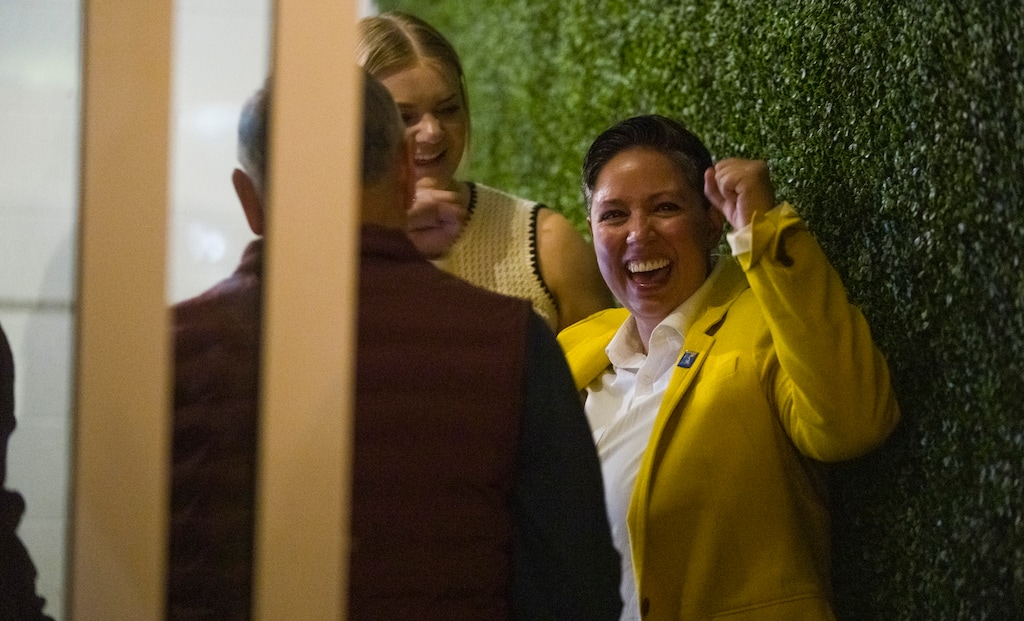
Carlsen declared victory shortly after those tallies emerged.
“Initial results are in,” she wrote in a news release, “and I am deeply grateful to be trusted with the opportunity to serve as the next Salt Lake City Council member for the people of District 5.”
(Bethany Baker | The Salt Lake Tribune) Signs are displayed during an election watch party for Salt Lake City Council District 5 candidate Erika Carlsen at Publik Coffee Roasters in Salt Lake City on Tuesday, Nov. 4, 2025.
On the campaign trail, she said she heard frequently about the rising cost of living, slowing traffic, preserving and growing community spaces, and supporting small businesses.
“But most of all,” Carlsen said, “they are looking for representation that is deeply grounded in community, that listens to residents’ needs and brings their priorities to City Hall.”
Although her opponent noted that more results were to come, Hawkins nonetheless reacted cordially Tuesday to Carlsen’s victory declaration.
“She did an incredible job fundraising and she’s done a lot of good for the community,” Hawkins said. “And I think we’ll probably continue to both work together for the good of the neighborhood.”
While the election may be over, she continued, “a lot of the important decision-making for at least the Ballpark neighborhood is yet to come.”
The district spans the neighborhoods of Ballpark, Central Ninth, Liberty Wells and East Liberty Park.
Marked by lopsided campaign spending by Carlsen, whose fundraising trounced her opponents and set new records, the race focused on public safety, affordability, green spaces and the redevelopment of the empty Smith’s Ballpark after the Salt Lake Bees’ 2024 departure.
And as with all the other contested races this season, coping with rising homelessness has dominated themes on this year’s campaign trails.
District 3
Candidates for Salt Lake City Council District 3, clockwise from top left: Blake McClary; Chris Wharton; Liddy Huntsman-Hernandez; Jake Seastrand; and David Berg.
Wharton appeared headed to a win in a five-way race to represent District 3, which spans the Avenues, Capitol Hill, Federal Heights and portions of the Guadalupe and Marmalade neighborhoods farther west.
Wharton, an attorney and business owner, touted his experience on the council as he faced four challengers: software executive Blake McClary; self-described stay-at-home mom and diabetes advocate Liddy Huntsman-Hernandez; health care worker David Berg; and judicial assistant and business owner Jake Seastrand.
Initial returns showed Wharton had 50% of the vote, followed by McClary with 28%. Huntsman-Hernandez, meanwhile, had captured 22% of the vote. With the ranked choice rules, Seastrand and Berg were eliminated.
Wharton also issued a statement declaring victory, saying he was “honored, humbled, and thrilled to have earned the trust of District 3 to continue serving you on the City Council.”
“While we’ve made progress on the most pressing issues, from housing affordability to public safety, to air quality, and more, there’s still a lot of work to be done,” Wharton said, “I’m excited to continue leading the way with forward-looking solutions.”
As a sixth-generation resident, he said, “this city is in my DNA, and I want to ensure we’re harnessing our full potential so that future generations, including my daughter, can enjoy all of the amazing opportunities that Salt Lake City has to offer.”
If any one issue had dominated their debates, it was housing and the wider notion of making life in the city less costly and more friendly to families. Key elements of Mayor Erin Mendenhall’s latest strategies for boosting public safety were a close second.
McClary, Wharton’s closest challenger, said he was looking forward to seeing final results, yet he acknowledged that his campaign was something of a long shot.
“We always knew it was going to be an ambitious task to run against a two-term incumbent who was well-funded,” McClary said in a statement. “I’m proud of our grassroots campaign. We centered our message around affordability and building a Salt Lake City where families, young professionals, and everyone in between can live and thrive.”
District 1
(Bethany Baker | The Salt Lake Tribune) Salt Lake City Council member Victoria Petro, District 1, speaks during a meeting of the Fairpark Community Council at Utah State Fairpark in Salt Lake City on Thursday, Sept. 25, 2025.
The city’s lone west-side seat up for grabs is for District 1, with Petro, the incumbent, seeking a second consecutive term against challenger Stephen Otterstrom.
Partial returns showed Petro had captured 52% of the vote, compared to Otterstrom’s 48%.
District 1 includes the Rose Park, Westpointe, Jordan Meadows and Northpointe areas, along with a slice of the Fairpark neighborhood.
A third candidate, Muslim community leader and business owner Yussuf Abdi, dropped out and threw his support behind Petro, a business and nonprofit advocate and consultant.
Otterstrom, a human resources consultant, ran a largely self-funded campaign to unseat Petro, with all three candidates highlighting affordable housing and the plight of the city’s working families as campaign cornerstones.
Public safety, homelessness and the planned Power District development along North Temple have been key topics in the race.