Harvey’s toll hits $80 billion so far in damage — making it the second most destructive storm in U.S. history
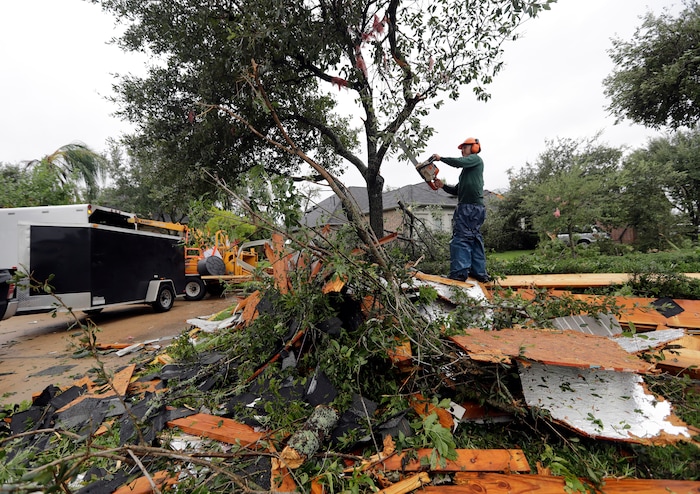
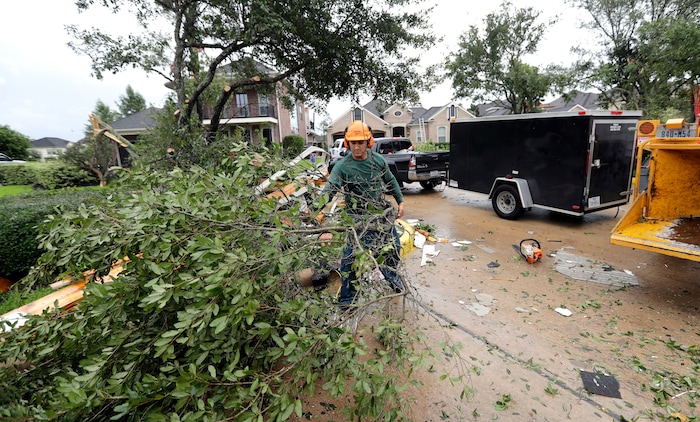
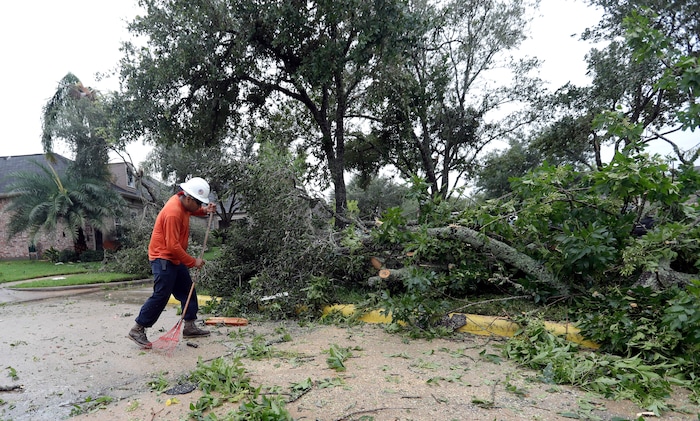
(David J. Phillip | The Associated Press) Henry Isaac cuts down broken tree limbs after Hurricane Harvey Saturday, Aug. 26, 2017, in Missouri City, Texas. Harvey rolled over the Texas Gulf Coast on Saturday, smashing homes and businesses and lashing the shore with wind and rain so intense that drivers were forced off the road because they could not see in front of them.
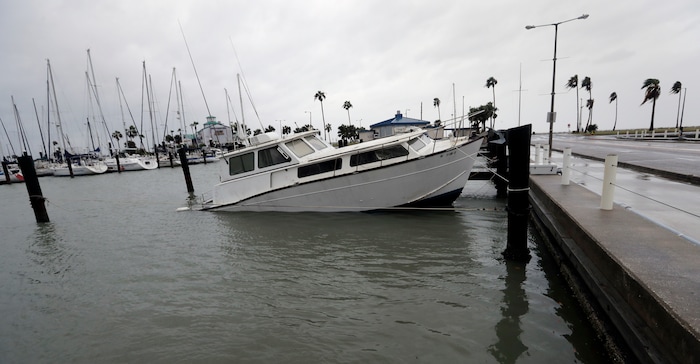
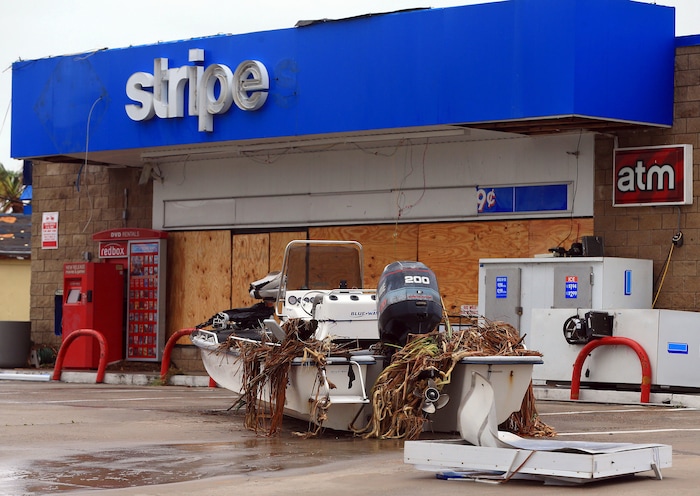
(Eric Gay | The Associated Press) A fishing boat is left partial submerged after Hurricane Harvey swept through the area, Saturday, Aug. 26, 2017, in Corpus Christi, Texas. Harvey has been further downgraded to a Category 1 hurricane as it churns slowly inland from the Texas Gulf Coast, already depositing more than 9 inches of rain in South Texas.
(David J. Phillip | The Associated Press) Henry Isaac removes broken tree limbs after Hurricane Harvey Saturday, Aug. 26, 2017, in Missouri City, Texas. Harvey rolled over the Texas Gulf Coast on Saturday, smashing homes and businesses and lashing the shore with wind and rain so intense that drivers were forced off the road because they could not see in front of them.
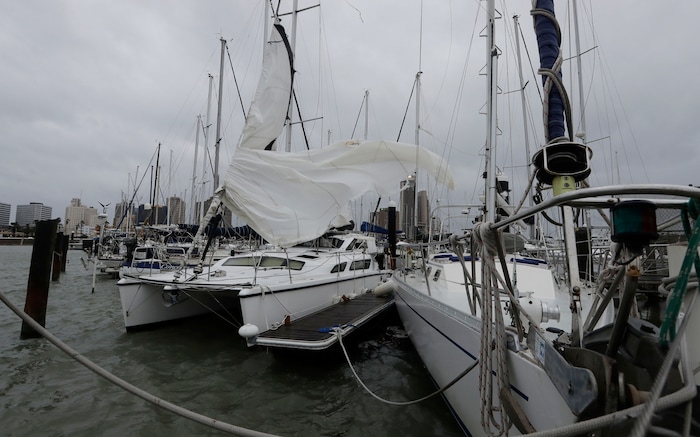
(Eric Gay | The Associated Press) Ripped sails of boats whip in the wind, damaged by Hurricane Harvey, Saturday, Aug. 26, 2017, in Corpus Christi, Texas. Harvey has been further downgraded to a Category 1 hurricane as it churns slowly inland from the Texas Gulf Coast, already depositing more than 9 inches of rain in South Texas.
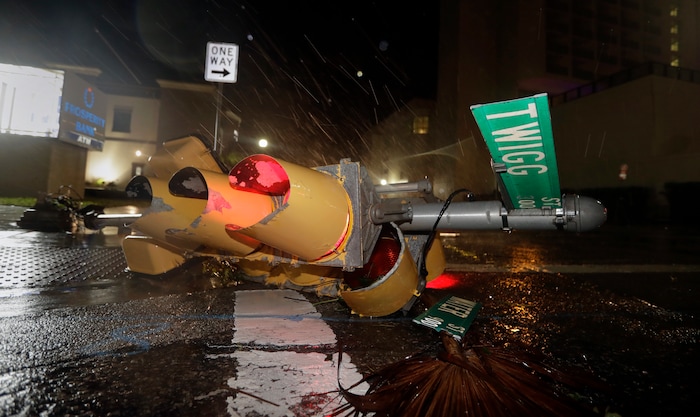
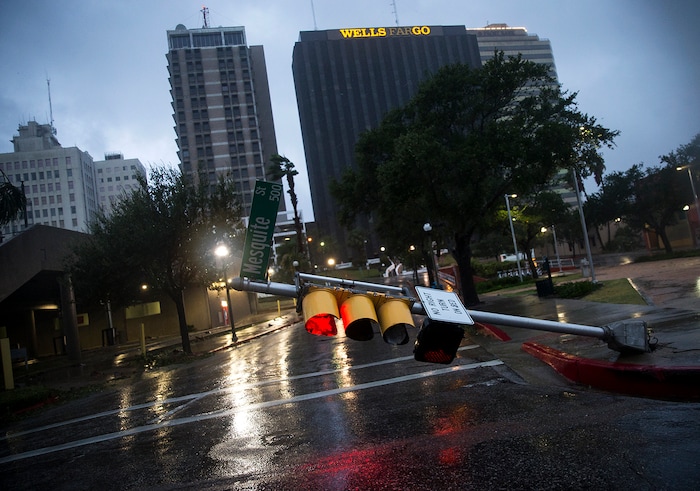
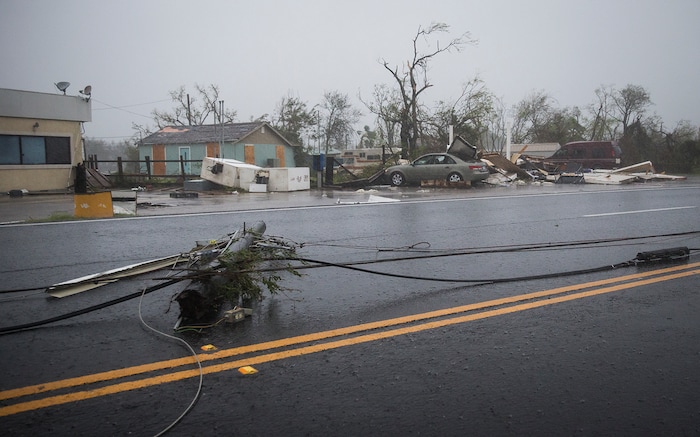
(Eric Gay | The Associated Press) A traffic signal topped by the winds of Hurricane Harvey lies in an intersection of downtown Corpus Christi, Texas, Saturday, Aug. 26, 2017. Harvey has been further downgraded to a Category 1 hurricane as it churns slowly inland from the Texas Gulf Coast, already depositing more than 9 inches of rain in South Texas.
(David J. Phillip | The Associated Press) Abel Carreno cleans up after Hurricane Harvey Saturday, Aug. 26, 2017, in Missouri City, Texas. Harvey rolled over the Texas Gulf Coast on Saturday, smashing homes and businesses and lashing the shore with wind and rain so intense that drivers were forced off the road because they could not see in front of them.
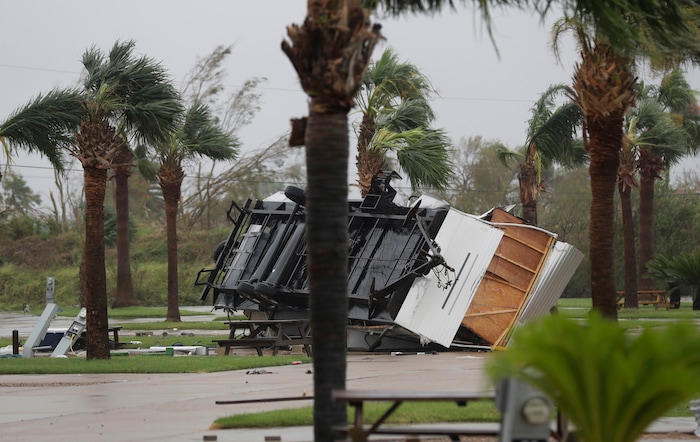
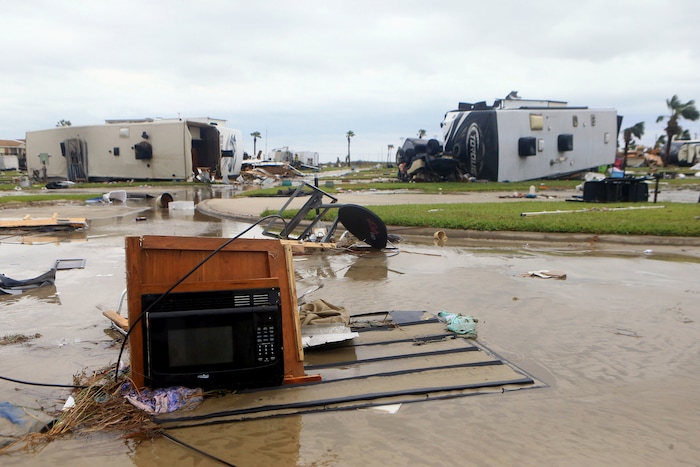
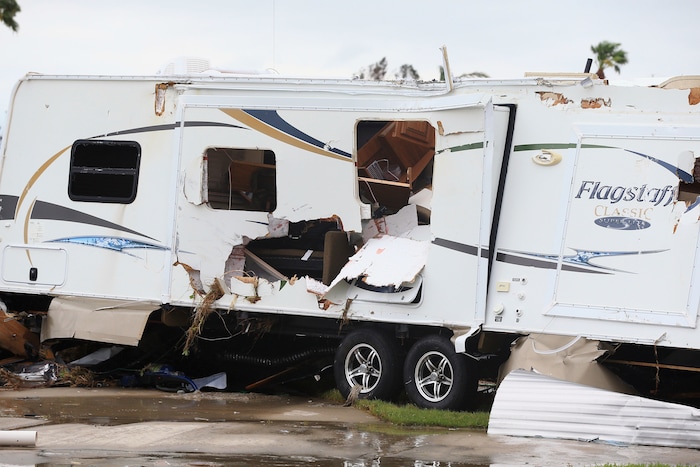
(Eric Gay | The Associated Press) An overturned trailer sits in a park in the wake of Hurricane Harvey, Saturday, Aug. 26, 2017, in Aransas Pass, Texas. Harvey rolled over the Texas Gulf Coast on Saturday, smashing homes and businesses and lashing the shore with wind and rain so intense that drivers were forced off the road because they could not see in front of them.
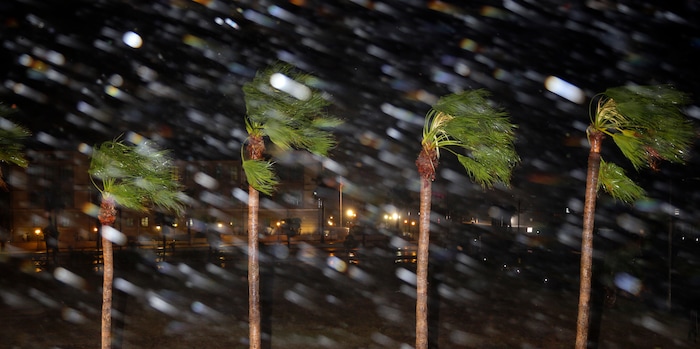
(Eric Gay | The Associated Press) Rain is blown past palm trees as Hurricane Harvey makes landfall, Friday, Aug. 25, 2017, in Corpus Christi, Texas. Harvey intensified into a hurricane Thursday and steered for the Texas coast with the potential for up to 3 feet of rain, 125 mph winds and 12-foot storm surges in what could be the fiercest hurricane to hit the United States in almost a dozen years.
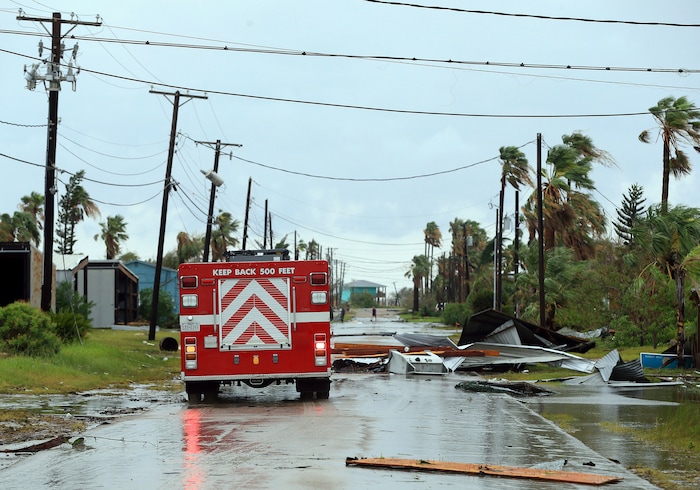
(Gabe Hernandez | Corpus Christi Caller-Times via AP) Port Aransas Fire Department survey the area after Hurricane Harvey landed in the Coast Bend area on Saturday, Aug. 26, 2017, in Port Aransas, Texas. The National Hurricane Center has downgraded Harvey from a Category 1 hurricane to a tropical storm. Harvey came ashore Friday along the Texas Gulf Coast as a Category 4 storm with 130 mph winds, the most powerful hurricane to hit the U.S. in more than a decade.
(Gabe Hernandez | Corpus Christi Caller-Times via AP) Mobile homes are destroyed at an RV park after Hurricane Harvey landed in the Coast Bend area on Saturday, Aug. 26, 2017, in Port Aransas, Texas. The National Hurricane Center has downgraded Harvey from a Category 1 hurricane to a tropical storm. Harvey came ashore Friday along the Texas Gulf Coast as a Category 4 storm with 130 mph winds, the most powerful hurricane to hit the U.S. in more than a decade.
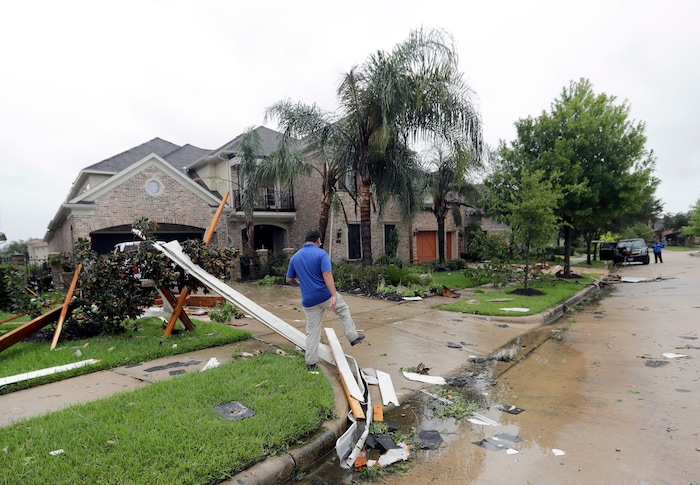
(David J. Phillip | The Associated Press) A contractor walks over debris from Hurricane Harvey Saturday, Aug. 26, 2017, in Missouri City, Texas. Harvey rolled over the Texas Gulf Coast on Saturday, smashing homes and businesses and lashing the shore with wind and rain so intense that drivers were forced off the road because they could not see in front of them.
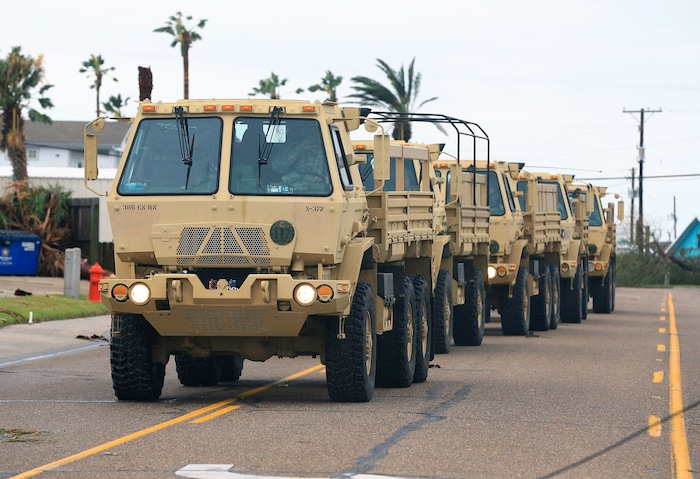
(Gabe Hernandez | Corpus Christi Caller-Times via AP) Members of the National Guard arrive at Port Aransas after Hurricane Harvey landed in the Coast Bend area on Saturday, Aug. 26, 2017, in Port Aransas, Texas. The National Hurricane Center has downgraded Harvey from a Category 1 hurricane to a tropical storm. Harvey came ashore Friday along the Texas Gulf Coast as a Category 4 storm with 130 mph winds, the most powerful hurricane to hit the U.S. in more than a decade.
(Gabe Hernandez | Corpus Christi Caller-Times via AP) Mobile homes are destroyed at an RV park after Hurricane Harvey landed in the Coast Bend area on Saturday, Aug. 26, 2017, in Port Aransas, Texas. The National Hurricane Center has downgraded Harvey from a Category 1 hurricane to a tropical storm. Harvey came ashore Friday along the Texas Gulf Coast as a Category 4 storm with 130 mph winds, the most powerful hurricane to hit the U.S. in more than a decade.
(Gabe Hernandez | Corpus Christi Caller-Times via AP) A boat is located on land after Hurricane Harvey landed in the Coast Bend area on Saturday, Aug. 26, 2017, in Port Aransas, Texas. The National Hurricane Center has downgraded Harvey from a Category 1 hurricane to a tropical storm. Harvey came ashore Friday along the Texas Gulf Coast as a Category 4 storm with 130 mph winds, the most powerful hurricane to hit the U.S. in more than a decade.
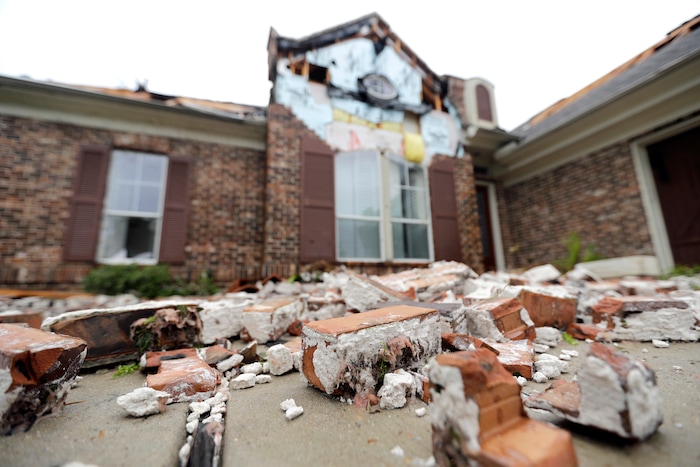
(David J. Phillip | The Associated Press) Fallen bricks from a home damaged by Hurricane Harvey sit on the ground Saturday, Aug. 26, 2017, in Missouri City, Texas. Harvey rolled over the Texas Gulf Coast on Saturday, smashing homes and businesses and lashing the shore with wind and rain so intense that drivers were forced off the road because they could not see in front of them.
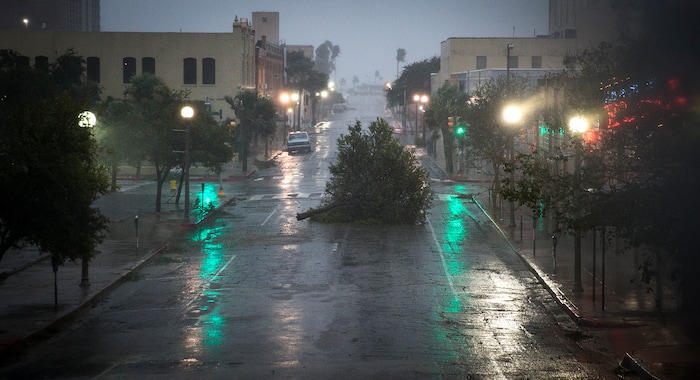
(Nick Wagner | Austin American-Statesman via AP) A tree blocks a street as Hurricane Harvey makes landfall in Corpus Christi, Texas, on Friday, Aug. 25, 2017. Hurricane Harvey smashed into Texas late Friday, lashing a wide swath of the Gulf Coast with strong winds and torrential rain from the fiercest hurricane to hit the U.S. in more than a decade.
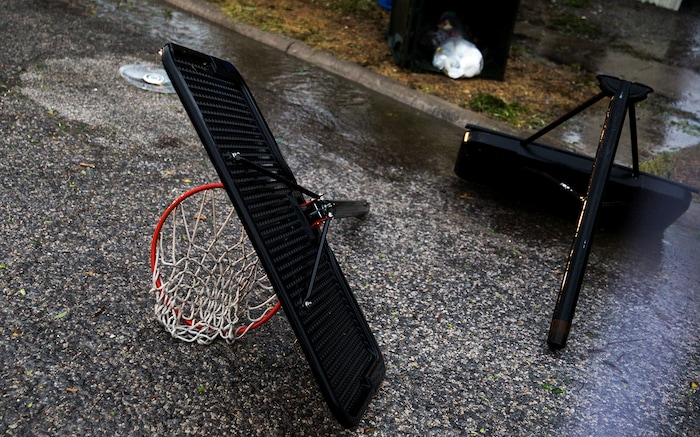
(Nick Wagner | Austin American-Statesman via AP) A basketball hoop lays in pieces as Hurricane Harvey makes landfall in Corpus Christi, Texas, on Friday, Aug. 25, 2017. Hurricane Harvey smashed into Texas late Friday, lashing a wide swath of the Gulf Coast with strong winds and torrential rain from the fiercest hurricane to hit the U.S. in more than a decade.
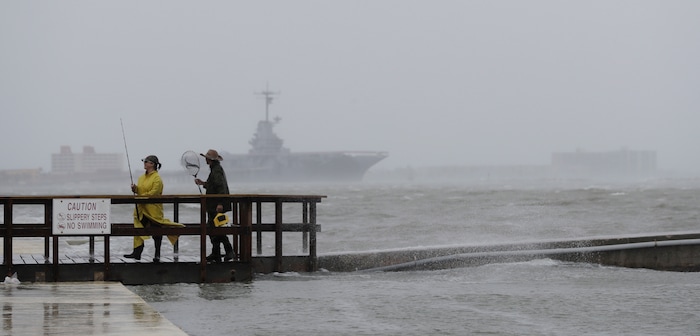
(Eric Gay | The Associated Press) Fishermen walk along a pier as the early bands of Hurricane Harvey make landfall, Friday, Aug. 25, 2017, in Corpus Christi, Texas. Harvey intensified into a hurricane Thursday and steered for the Texas coast with the potential for up to 3 feet of rain, 125 mph winds and 12-foot storm surges in what could be the fiercest hurricane to hit the United States in almost a dozen years.
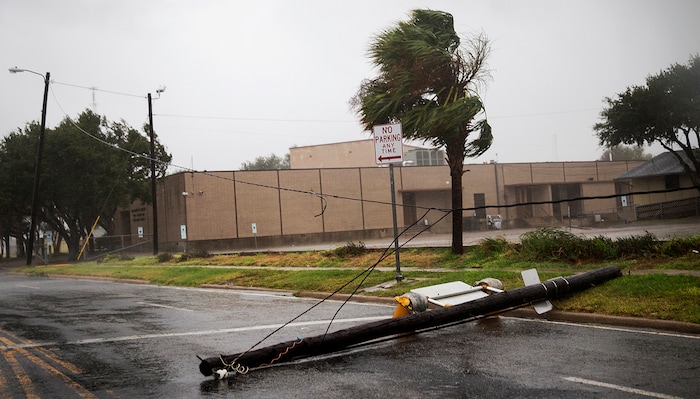
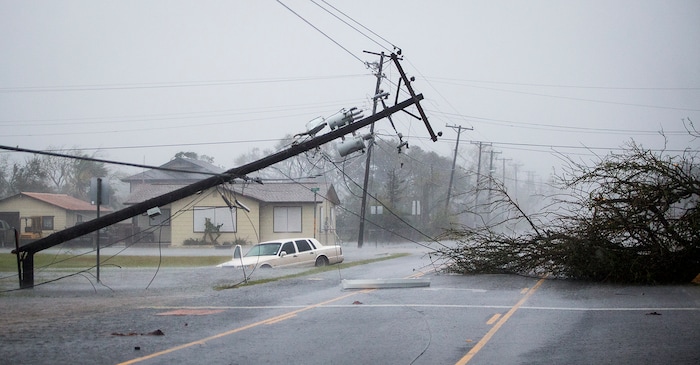
(Nick Wagner | Austin American-Statesman via AP) A power pole lays in the middle of a street as Hurricane Harvey makes landfall in Corpus Christi, Texas, on Friday, Aug. 25, 2017. Hurricane Harvey smashed into Texas late Friday, lashing a wide swath of the Gulf Coast with strong winds and torrential rain from the fiercest hurricane to hit the U.S. in more than a decade.
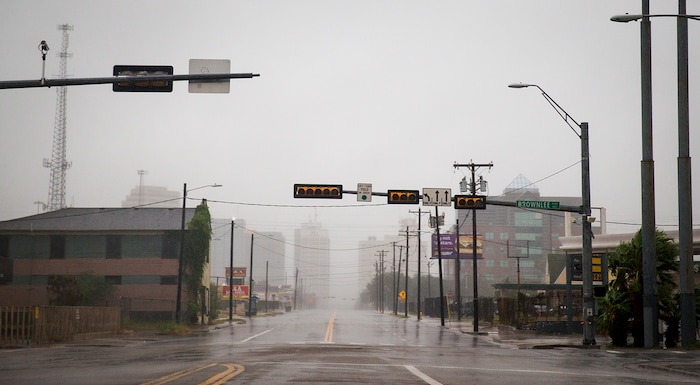
(Nick Wagner | Austin American-Statesman via AP) A street sits empty as Hurricane Harvey makes landfall in Corpus Christi, Texas, on Friday, Aug. 25, 2017. Hurricane Harvey smashed into Texas late Friday, lashing a wide swath of the Gulf Coast with strong winds and torrential rain from the fiercest hurricane to hit the U.S. in more than a decade.
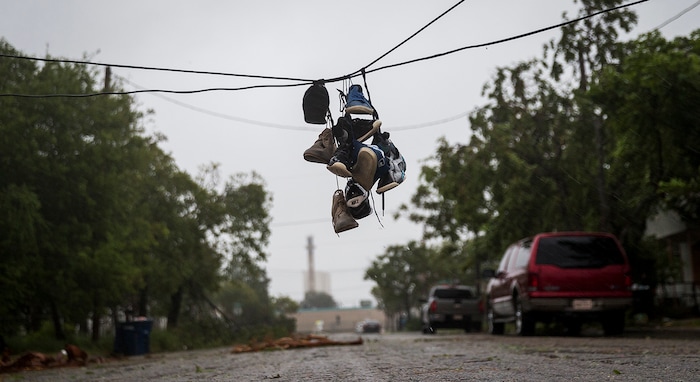
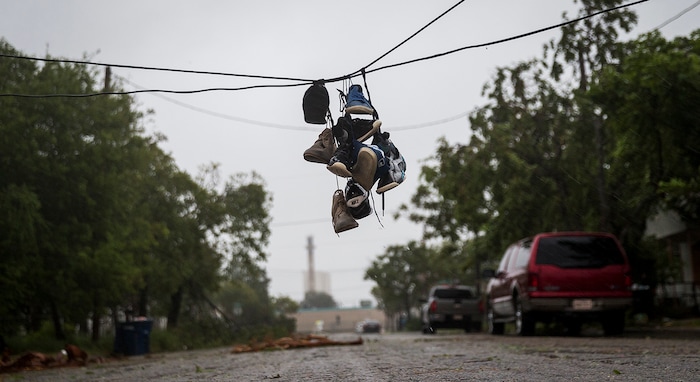
(Nick Wagner | Austin American-Statesman via AP) Shoes tied to a power line hang near a street after winds from Hurricane Harvey brought down a power pole in Corpus Christi, Texas, on Friday, Aug. 25, 2017. Hurricane Harvey smashed into Texas late Friday, lashing a wide swath of the Gulf Coast with strong winds and torrential rain from the fiercest hurricane to hit the U.S. in more than a decade.
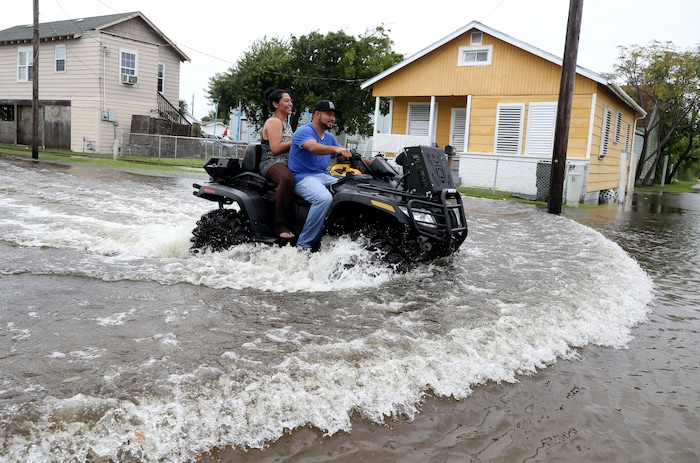
(Jennifer Reynolds | The Galveston County Daily News via AP) Galveston, Texas, residents ride an all terrain vehicle down 50th Street on Saturday, Aug. 26, 2017, as they survey the flooding from Hurricane Harvey in their neighborhood.
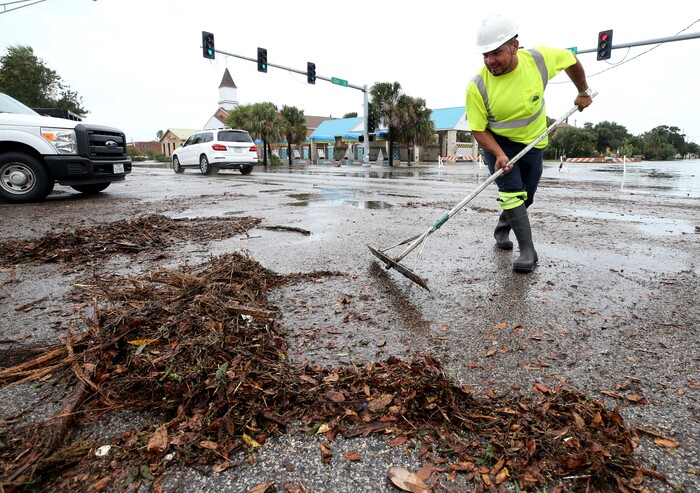
(Jennifer Reynolds | The Galveston County Daily News via AP) German Martinez, with Galveston's Public Works department, clears debris from the intersection of 33rd Street and Broadway on Saturday, Aug. 26, 2017, as high waters from Hurricane Harvey begin to recede.
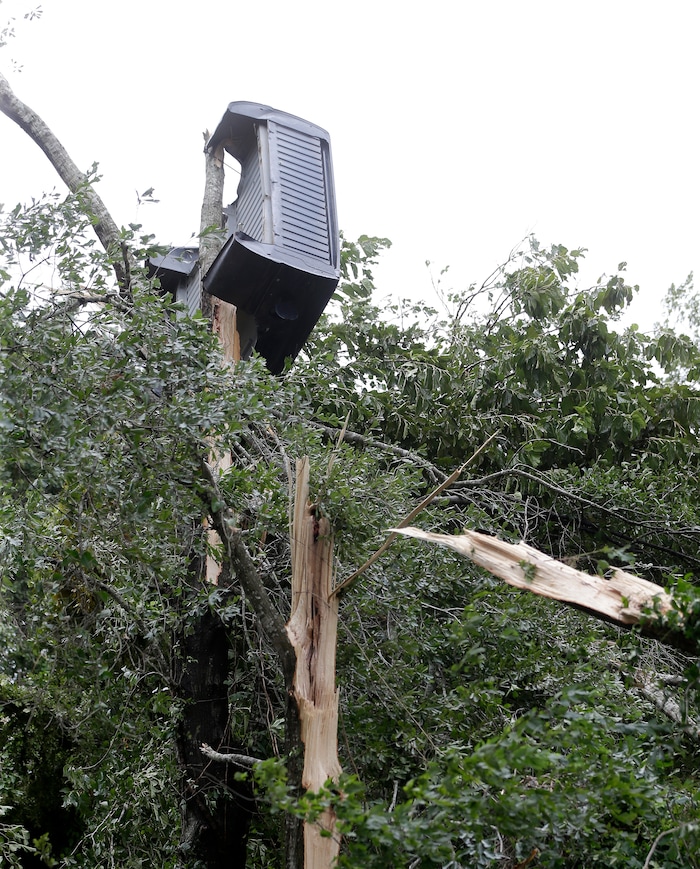
(Melissa Phillip | Houston Chronicle via AP) A truck bed lies in a tree near Bryant's Auto Sales in Katy, Texas, on Saturday, Aug. 26, 2017, after a possible tornado during Hurricane Harvey.
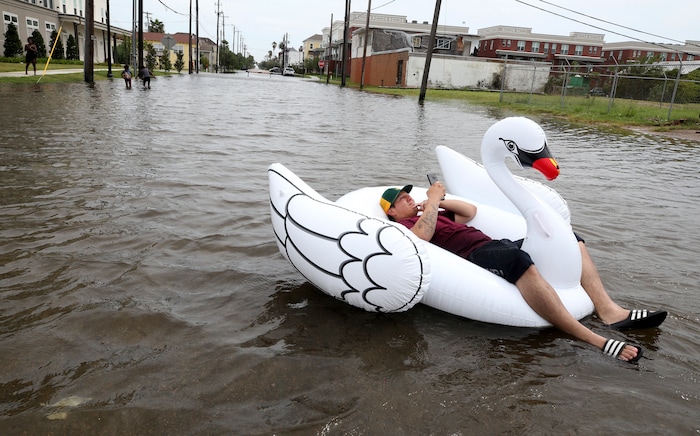
(Jennifer Reynolds | The Galveston County Daily News via AP) Julio Ostio sits in an inflatable swan as he floats down 16th Street near Strand Street in Galveston, Texas, on Saturday, Aug. 26, 2017, as he texts friends during a break in the rain from Hurricane Harvey.
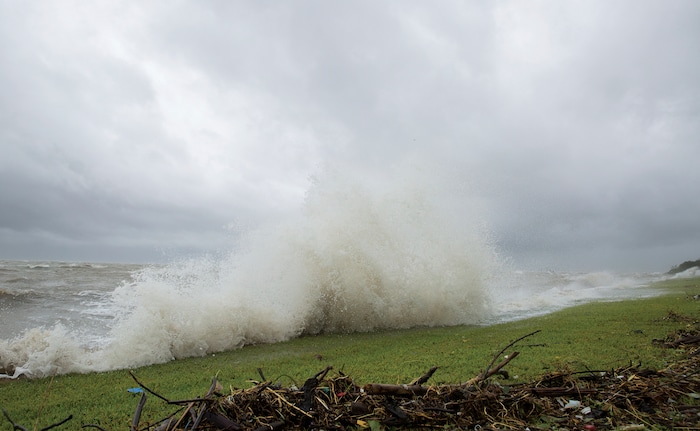
(Ana Ramirez | The Victoria Advocate via AP) Water crashes along the bay front in Port Lavaca, Texas, Friday, Aug. 25, 2017. Hurricane Harvey smashed into Texas late Friday, lashing a wide swath of the Gulf Coast with strong winds and torrential rain from the fiercest hurricane to hit the U.S. in more than a decade.
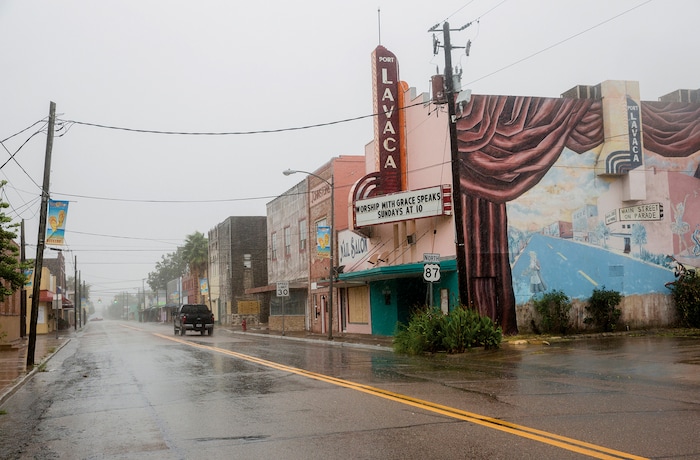
(Ana Ramirez | The Victoria Advocate via AP) A single truck drives down a street as Hurricane Harvey makes landfall in downtown Port Lavaca, Texas on Friday, Aug. 25, 2017. Hurricane Harvey smashed into Texas late Friday, lashing a wide swath of the Gulf Coast with strong winds and torrential rain from the fiercest hurricane to hit the U.S. in more than a decade.
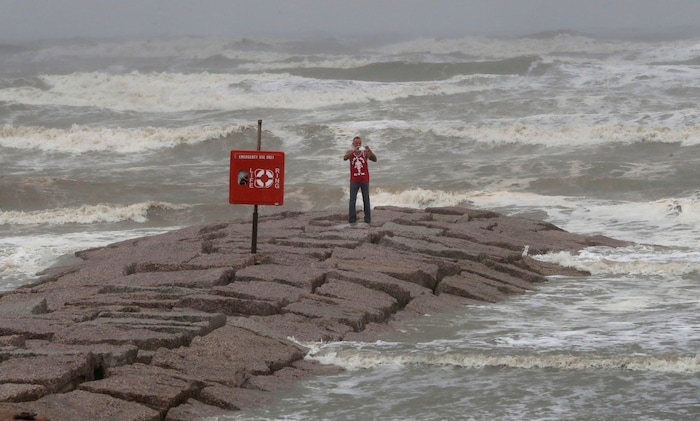
(Jennifer Reynolds | The Galveston County Daily News via AP) Michael Scott uses his smartphone to livestream the rain and storm surge of Hurricane Harvey from the 59th Street rock groin in Galveston, Texas on Saturday, Aug. 26, 2017.
(Nick Wagner | Austin American-Statesman via AP) A damaged stop light blocks a street as Hurricane Harvey makes landfall in Corpus Christi, Texas, on Friday, Aug. 25, 2017. Hurricane Harvey smashed into Texas late Friday, lashing a wide swath of the Gulf Coast with strong winds and torrential rain from the fiercest hurricane to hit the U.S. in more than a decade.
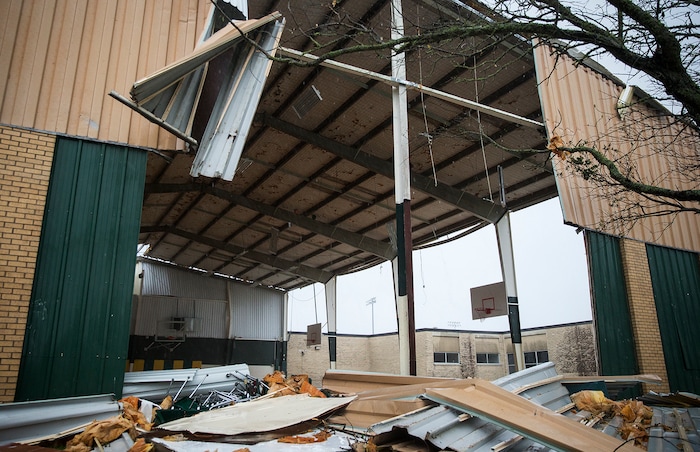
(Nick Wagner | Austin American-Statesman via AP) The Rockport-Fulton high school gymnasium walls expose the interior after Hurricane Harvey ripped through Rockport, Texas, on Saturday, Aug. 26, 2017. The fiercest hurricane to hit the U.S. in more than a decade spun across hundreds of miles of coastline where communities had prepared for life-threatening storm surges, walls of water rushing inland.
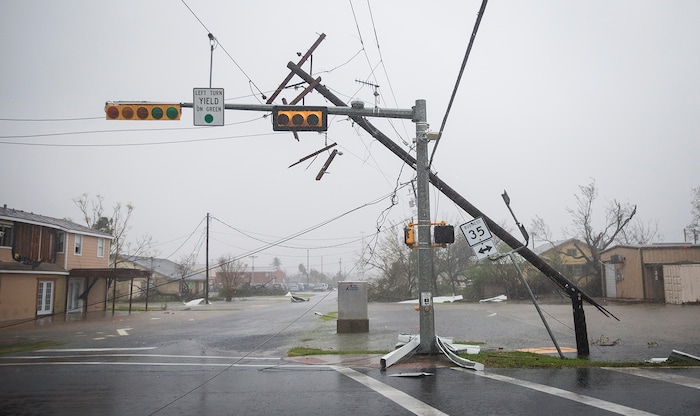
(Nick Wagner | Austin American-Statesman via AP) A snapped power pole leans against a stoplight after Hurricane Harvey ripped through Rockport, Texas, on Saturday, Aug. 26, 2017. The fiercest hurricane to hit the U.S. in more than a decade spun across hundreds of miles of coastline where communities had prepared for life-threatening storm surges — walls of water rushing inland.
(Nick Wagner | Austin American-Statesman via AP) A vehicle sits in standing water after Hurricane Harvey ripped through Rockport, Texas, on Saturday, Aug. 26, 2017. The fiercest hurricane to hit the U.S. in more than a decade spun across hundreds of miles of coastline where communities had prepared for life-threatening storm surges, walls of water rushing inland.
(Nick Wagner | Austin American-Statesman via AP) Debris is strewn all over after Hurricane Harvey ripped through in Rockport, Texas, on Saturday, Aug. 26, 2017. The fiercest hurricane to hit the U.S. in more than a decade spun across hundreds of miles of coastline where communities had prepared for life-threatening storm surges, walls of water rushing inland.
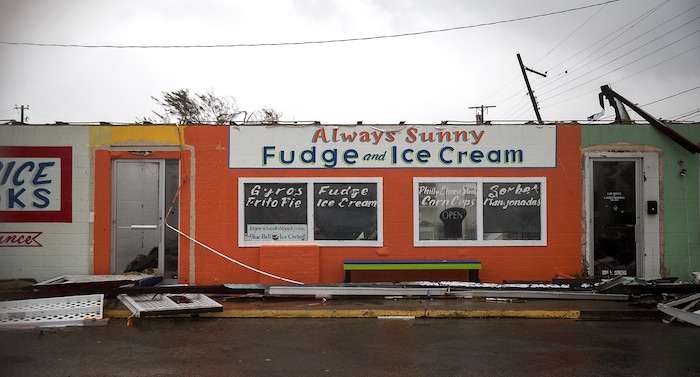
(Nick Wagner | Austin American-Statesman via AP) A store sits damaged after Hurricane Harvey ripped through Rockport, Texas, on Saturday, Aug. 26, 2017. The fiercest hurricane to hit the U.S. in more than a decade spun across hundreds of miles of coastline where communities had prepared for life-threatening storm surges, walls of water rushing inland.
(Nick Wagner | Austin American-Statesman via AP) Shoes tied to a power line hang near a street after winds from Hurricane Harvey brought down a power pole in Corpus Christi, Texas, on Friday, Aug. 25, 2017. Hurricane Harvey smashed into Texas late Friday, lashing a wide swath of the Gulf Coast with strong winds and torrential rain from the fiercest hurricane to hit the U.S. in more than a decade.
(Jay Janner | Austin American-Statesman via AP) A tattered U.S. flag whips in the wind in Geronimo, Texas, during Hurricane Harvey on Saturday August 26, 2017.
Hurricane Harvey is now the second most destructive storm in U.S. history, behind only Hurricane Katrina. The devastation is massive: 46 dead and an estimated $80 billion in damages — so far.
Harvey could end up being the most expensive of all. It depends on what happens in the coming days and weeks. The longer homes stay underwater and businesses remain closed, especially the major oil refineries that supply a substantial amount of America’s gas, the bigger the hit to Texas and the entire U.S. economy.
Gas prices are at the highest level in two years after Harvey decimated 20 percent of U.S. refining capacity. Americans across the country are seeing a hit to their wallets from the added costs, and the country might not be able to export oil for a while.
“This was a worst case situation,” says Chuck Watson, head of Enki Research, a company that forecasts natural disasters. His latest estimate is an $80 billion price tag for Harvey, double his initial prediction. The vast majority of that bill will be paid by taxpayers, since private insurance rarely covers flooding.
It’s too early to know the final toll. Current estimates differ wildly, ranging from $50 billion $190 billion. Watson says Harvey is “breaking all the models” because of the extensive flooding, which makes it hard to get a decisive read on the devastation. Katrina caused more than 1,800 deaths and $125 billion in damages when it hit the Gulf Coast in 2005. In today’s dollars, that equates to $160 billion, according to government calculations.
“This is clearly one of the bigger ones, if not the biggest in terms of damages,” says Michael Gapen, head of U.S. economic research at Barclays. “It could have a significant impact on growth, at least in the third quarter.”
If it ends up being similar to Katrina in terms of the cost and duration of the recovery, there will be a rapid hit to jobs and growth. Hundreds of thousands of people are likely to be out of work for days, if not weeks, and economic growth could be 1 percent lower in the third quarter, the period from July through September. That’s a substantial decline considering the United States only grew 3 percent in the spring. But the pain could be short-lived if the government steps in with a lot of aid.
“The lesson from both Katrina and Sandy is that the quicker government aid and insurance money gets to a ravaged area, the smaller the economic blow,” says Mark Zandi, chief economist at Moody’s Analytics.
President Donald Trump is expected to ask Congress for a speedy $6 billion as early as Friday, but that’s a small fraction of the total bill. Some federal aid is already flowing to Texas from existing Federal Emergency Management Agency and Small Business Administration funds. FEMA given out more than $35 million so far, for example.
Houston is America’s fourth-largest city and the hub of the country’s energy industry.About 100,000 homes are damaged, Homeland Security Adviser Tom Bossert said Thursday. He predicted a “long, frustrating recovery.”
Vice President Mike Pence was more upbeat. He stood in Rockport on Thursday and vowed Texas would come back “bigger and better than ever before.”
Economists surveyed by The Washington Post are also optimistic that the greater Houston area will rebound much faster than New Orleans did.
“Strong, vibrant economies recover,” says Kurt Karl, chief economist at insurance company Swiss Re. Unlike New Orleans, Houston had been growing rapidly before the storm hit. Oil is the heart of the region’s economy, but Houston has diversified in recent years with more jobs in health care, tourism and tech.
A key sign to watch is whether people flee Houston. New Orleans suffered a massive population exodus, causing the city to lose half of its people in the year following the storm. That means fewer workers, lower tax receipts and less spending in stores and restaurants.
“In Houston, people have not left. They are in shelters, but they aren’t gone. Sooner or later, they will rebuild,” predicts Rajeev Dhawan, director of Georgia State University’s Economic Forecasting Center.
(Steve Gonzales | Houston Chronicle) Grant Gaffney unloads sandbags from a flatbed Thursday, Aug. 24, 2017, in Houston. Tropical Storm Harvey intensified Thursday into a hurricane that forecasters said would be the first major hurricane to hit Texas in 12 years.
Once the reconstruction efforts get underway, it usually causes an economic boom that balances out — or even overcompensates — the losses. This will be a major opportunity for anyone involved in the construction industry. Contractors were already complaining they couldn’t find enough skilled workers. The dire need for builders may lure more workers to Houston, especially if wages spike since there’s so much demand that people are willing to pay more. Some argue immigrant labor from Mexico could also help speed up the rebuilding process.
It will also be a boon for stores and car manufacturers as people replace what they lost. The stocks of Ford and General Motors jumped this week as it became clear that tens of thousands of cars are damaged from the storm. Texans will likely be buying new vehicles soon.
“It feels wrong to think about it like this, but historically, these storms just cause temporary disturbances to the economy,” says Gapen. He expected a rebound by the fourth quarter.
Taxpayers will end up funding most of the rebuilding because traditional insurance doesn’t cover flooding. Business executives and homeowners have to go out and buy special flood insurance policies. More than 80 percent of homeowners in the areas hardest hit in southeast Texas didn’t do that. Flood insurance is only required for property owners in places that FEMA designates as extremely high risk. About two-thirds of the homes hit by Harvey weren’t in those zones, Watson says.
The National Flood Insurance Program, a government-run program, is the only place that offers U.S. homeowners flood insurance. NFIP will end up covering $9 billion, according to CoreLogic, a company that tracks losses. Private insurers only cover flooding damage to businesses, and even that is limited. Private insurers will pay around $2 billion, predicts AIR Worldwide, another catastrophe-modeling firm.
To put it another way, insurance of any sort will cover less than 15 percent of Harvey’s $80 billion tab. Charity and people’s savings will help a little, but the bulk of the humanitarian and rebuilding costs will come from government.
All the signs indicate Texas is likely to recover and the U.S. economy probably won’t see much lingering impact, but economists warn some families won’t be as lucky.
“There are individuals, households and businesses within these communities who can never recover,” says Matthew Fienup, director of the Center for Economic Research at California Lutheran University. “These should be the primary targets of the long-term policy response to this disaster.”

Donate to the newsroom now. The Salt Lake Tribune, Inc. is a 501(c)(3) public charity and contributions are tax deductible