FEMA director says Hurricane Harvey ‘probably the worst disaster’ in Texas history
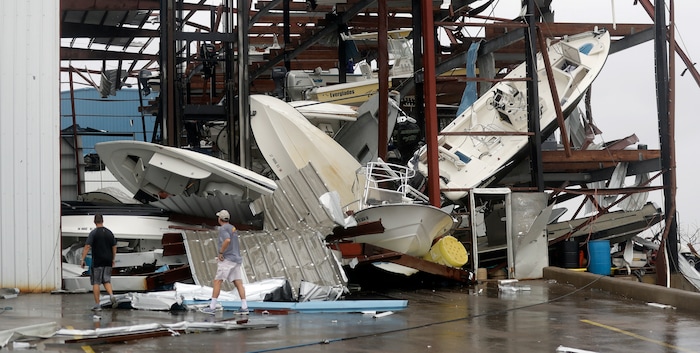
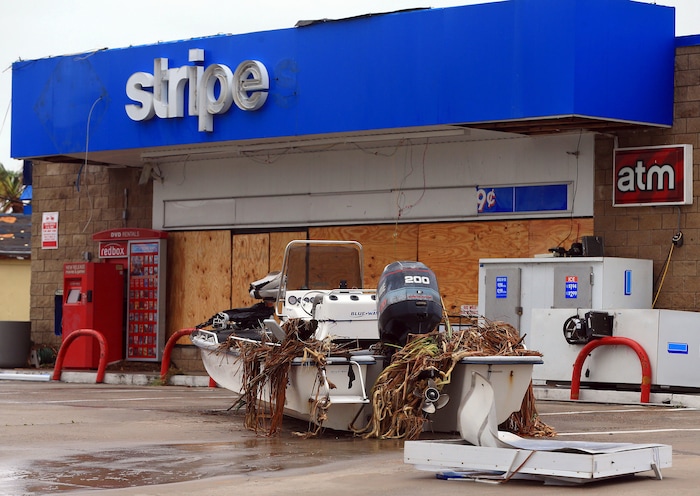
(AP Photo | Eric Gay) Men checks on a boat storage facility that was damaged by Hurricane Harvey, Saturday, Aug. 26, 2017, in Rockport, Texas.
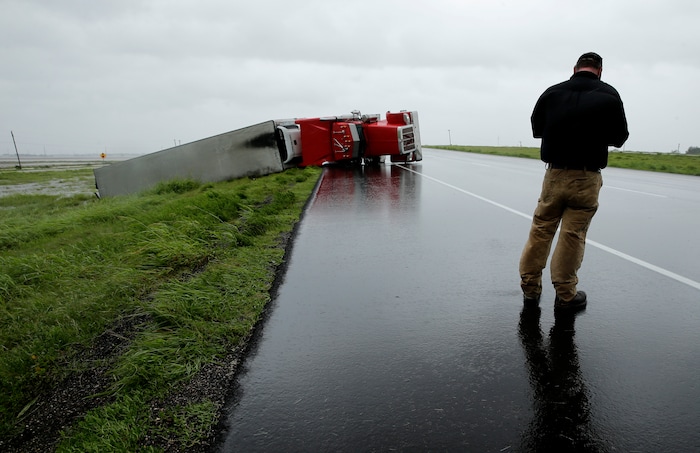
(Charlie Riedel | AP Photo) A passing motorist stops to look at a flipped truck in the aftermath of Hurricane Harvey Saturday, Aug. 26, 2017, north of Victoria, Texas.
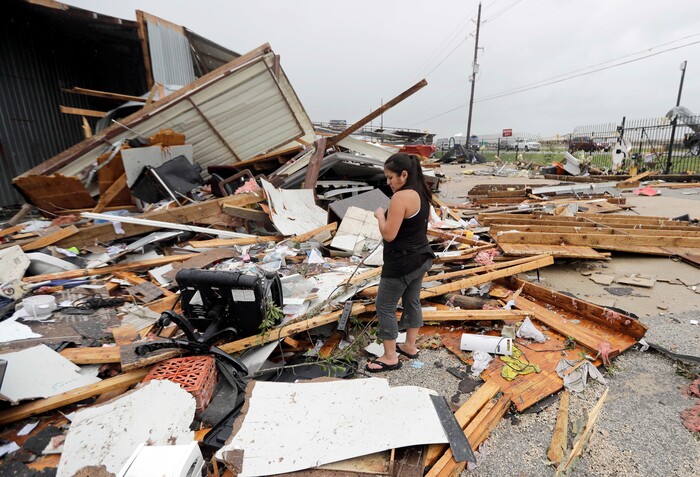
(David J. Phillip | AP Photo) Jennifer Bryant looks over the debris from her family business destroyed by Hurricane Harvey Saturday, Aug. 26, 2017, in Katy, Texas. Harvey rolled over the Texas Gulf Coast on Saturday, smashing homes and businesses and lashing the shore with wind and rain so intense that drivers were forced off the road because they could not see in front of them.
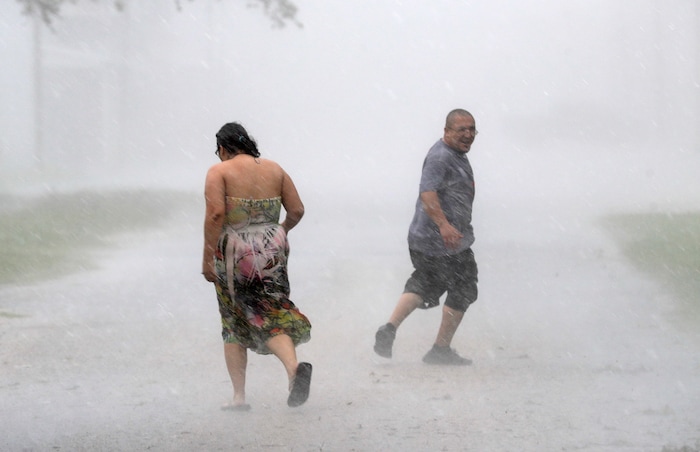
(AP Photo | David J. Phillip) Antonio Barron, right, looks back to his girlfriend, Melissa Rocha, as they run through the street during a band of heavy rain from Hurricane Harvey Saturday, Aug. 26, 2017, in Palacios, Texas.
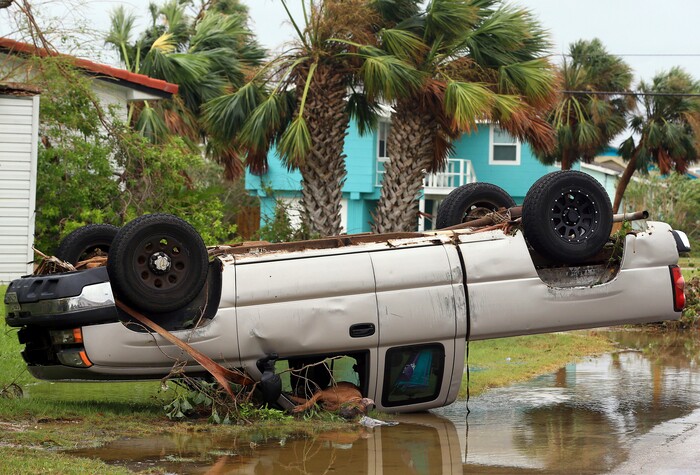
(Gabe Hernandez | Corpus Christi Caller-Times via AP) A dead dog lies out of the passenger window of an overturned pickup truck after Hurricane Harvey landed in the Coast Bend area in Port Aransas, Texas, on Saturday, Aug. 26, 2017. Harvey came ashore Friday along the Texas Gulf Coast as a Category 4 storm with 130 mph winds, the most powerful hurricane to hit the U.S. in more than a decade.
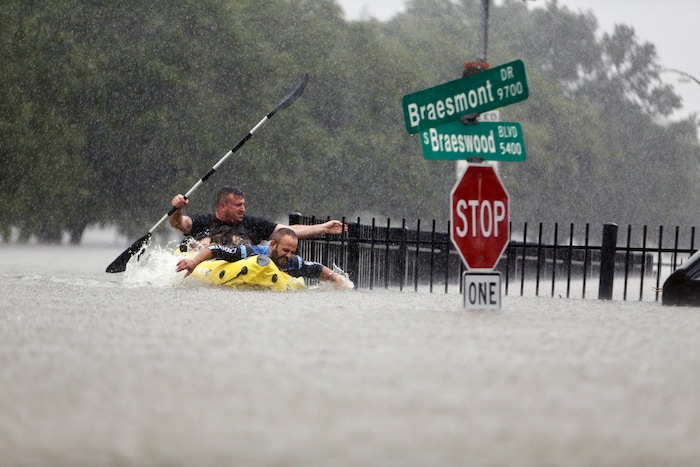
(Mark Mulligan| Houston Chronicle via AP) Two kayakers try to beat the current pushing them down an overflowing Brays Bayou from Tropical Storm Harvey in Houston, Texas, Sunday, Aug. 27, 2017.
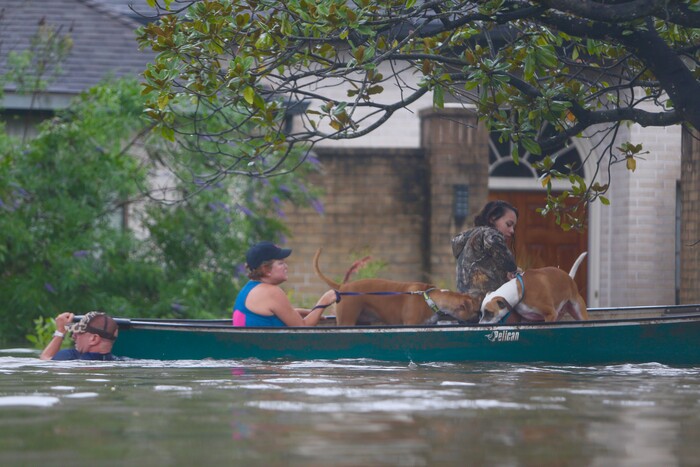
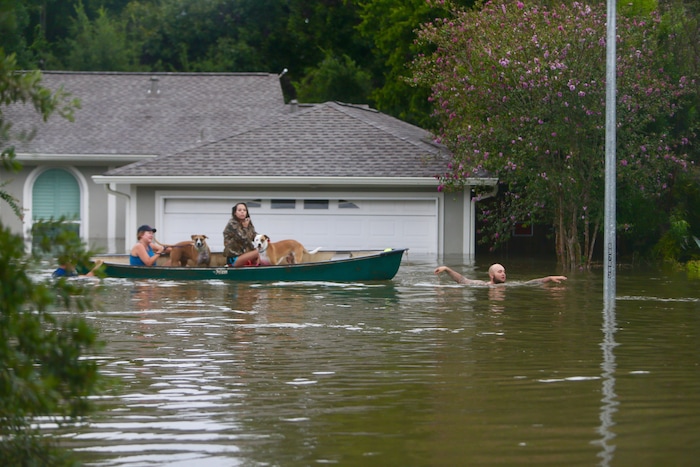
(Mark Mulligan | Houston Chronicle via AP) A family evacuates their Meyerland home in Houston, Sunday, Aug. 27, 2017. Rescuers answered hundreds of calls for help Sunday as floodwaters from the remnants of Hurricane Harvey rose high enough to begin filling second-story homes, and authorities urged stranded families to seek refuge on their rooftops.
(Mark Mulligan | Houston Chronicle via AP) A family evacuates their Meyerland home in Houston, Sunday, Aug. 27, 2017. Rescuers answered hundreds of calls for help Sunday as floodwaters from the remnants of Hurricane Harvey rose high enough to begin filling second-story homes, and authorities urged stranded families to seek refuge on their rooftops.
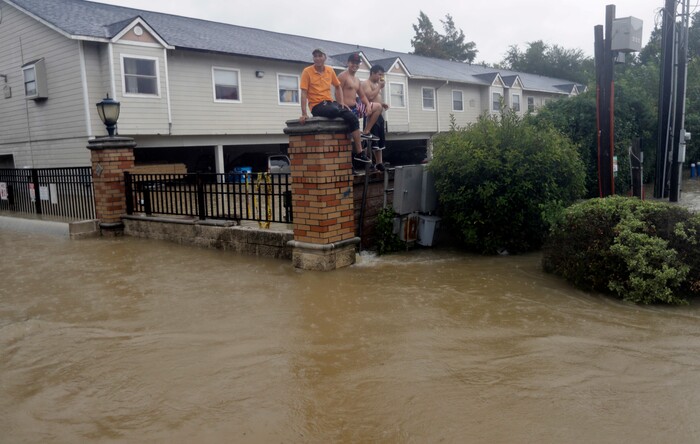
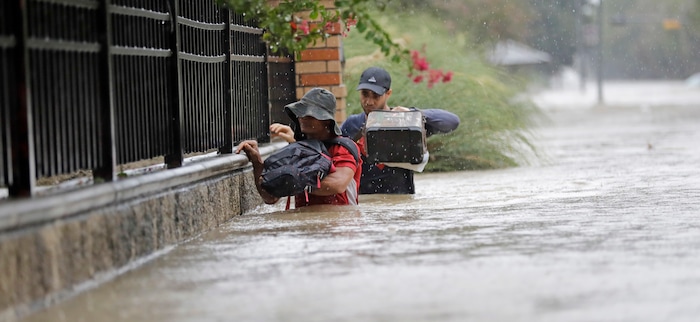
(David J. Phillip | The Associated Press) Residents sit on a fence surrounded by floodwaters from Tropical Storm Harvey on Sunday, Aug. 27, 2017, in Houston, Texas.
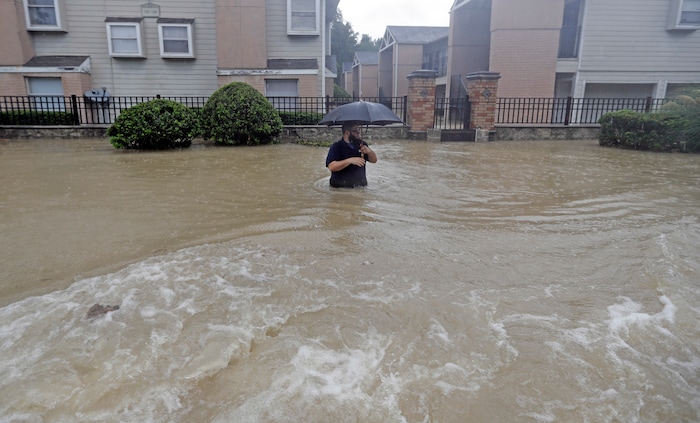
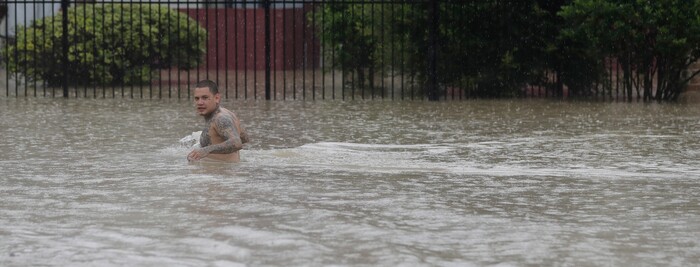
(David J. Phillip | The Associated Press) A man wades through floodwaters from Tropical Storm Harvey on Sunday, Aug. 27, 2017, in Houston, Texas.
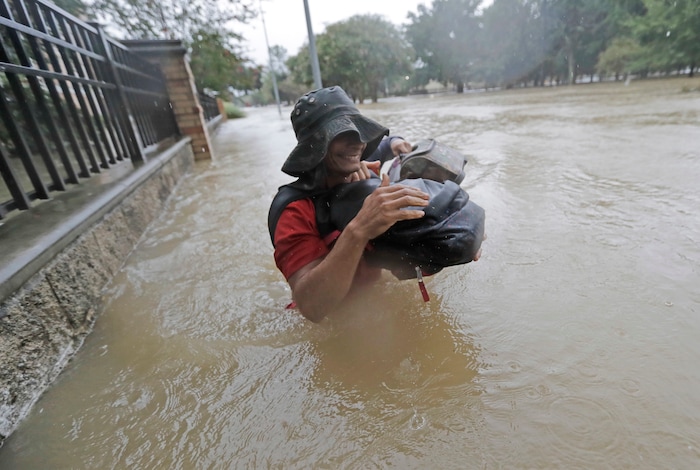
(Charlie Riedel | The Associated Press) A man walks through floodwaters from Tropical Storm Harvey as he evacuates his home on Sunday, Aug. 27, 2017, in Houston, Texas.
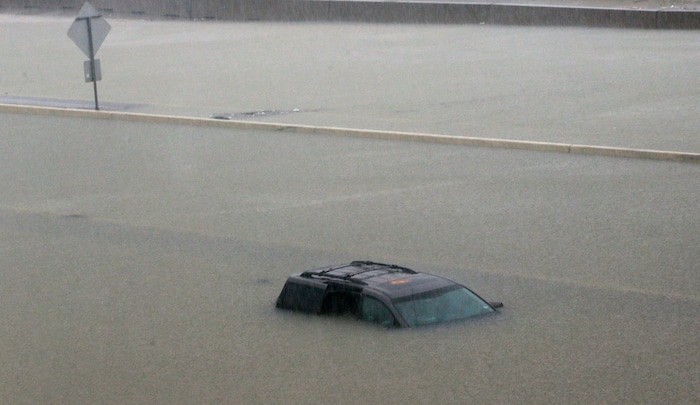
(LM Otero | The Associated Press) An abandoned vehicle sits in flood waters on the I-10 highway in Houston, Texas, Sunday, Aug. 27, 2017.
(David J. Phillip | The Associated Press) Residents wade through floodwaters from Tropical Storm Harvey Sunday, Aug. 27, 2017, in Houston, Texas.
(David J. Phillip | The Associated Press) Residents wade through floodwaters from Tropical Storm Harvey Sunday, Aug. 27, 2017, in Houston, Texas.
(David J. Phillip | The Associated Press) A man wades through floodwaters from Tropical Storm Harvey Sunday, Aug. 27, 2017, in Houston, Texas.
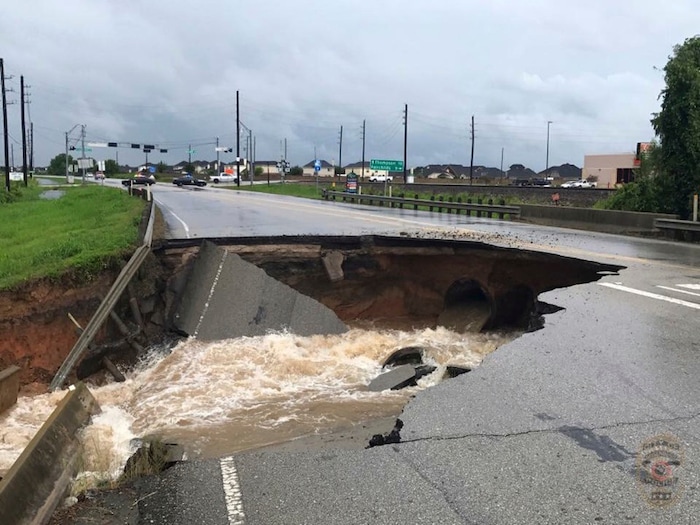
(Photo courtesy of the Rosenberg Police Department via AP) In this photo provided by the Rosenberg Police Department water rushes from a large sinkhole on Highway FM 762 in Rosenberg, Texas, near Houston, Sunday, Aug. 27, 2017. Police say the sinkhole has opened on the Texas highway as Tropical Storm Harvey dumps more rain on the region.
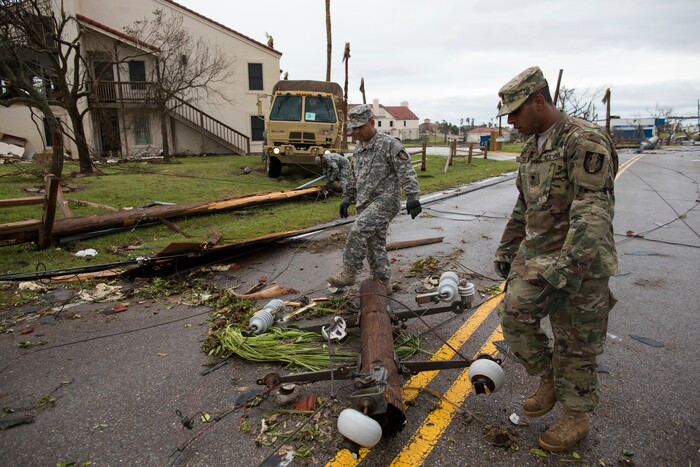
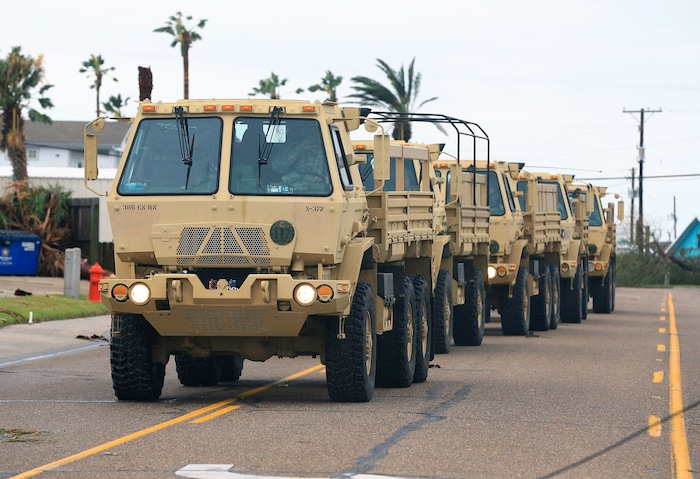
(Courtney Sacco | Corpus Christi Caller-Times via AP) Members of the Texas National Guard pull a utility poll from Fulton Beach Road on Sunday, Aug. 27, 2017, after Hurricane Harvey in Fulton, Texas. Harvey made landfall in Texas on Friday night as the strongest hurricane to hit the U.S. in more than a decade.
When disaster struck, many Texans discovered Sunday they had to be their own first responders. The government could help, but only to a point.
Police officers and firefighters rescued many people from floodwaters. Texas Gov. Greg Abbott, R, said Sunday that thousands of state and national guardsman, 20 helicopters, 60 boats and high-water vehicles had been deployed, and he declared that citizens should know “that the cavalry is coming.”
But the professional first responders could not handle each of the thousands of calls from people in distress from rising water. The roads were largely impassable. Residents reported calling 911 and getting no answer. The Red Cross command center in Houston became physically isolated amid floodwaters.
So people had to take matters into their own hands. They connected on social media, asking or offering help. They launched private boats and kayaks. They carried people to higher ground.
“You’re seeing rescues from very expensive high-end to very low-rent apartments,” said West Houston business owner Jody Goldstein, 51. “It’s hitting people equally.”
The disaster Hurricane Harvey has created is immense in scale, encompassing thousands of square miles of southeast Texas, and it includes epic flooding that will affect millions of people. Rivers are still rising, the rain still falling.
“This will be a devastating disaster, probably the worst disaster the state’s seen,” William “Brock” Long, director of the Federal Emergency Management Agency, told The Washington Post on Sunday. “The recovery to this event is going to last many years, to be able to help Texas and the people impacted by this event achieve a new normal.”
Long said in an interview a few weeks ago that there was one thing that worried him most when it comes to natural disasters: “You know what’s keeping me up at night? This country has not been hit by a major hurricane since 2005.”
That was the right thing to worry about, it turns out. Long, just two months on the job, is coordinating the federal response to Harvey — the first Category 3 or greater storm to hit the U.S. in 12 years — and its lethal aftermath.
FEMA acts as the nerve center for the entire federal government response, which now includes 5,000 federal employees in Texas, including the Coast Guard, the Energy Department (looking for power failures and effects on oil production), the Department of Health and Human Services and many other federal agencies.
FEMA said Sunday afternoon it had 400 urban search and rescue personnel in southeast Texas, and that more than 500 more rescuers would be arriving Sunday evening. As of noon Sunday, the Coast Guard had 423 active duty and auxiliary personnel and reservists deployed to the disaster zone, along with 16 helicopters flying rescue missions, said Coast Guard spokesman Dave French. By Monday morning, the number of helicopters is slated to increase to 24.
French said the agency has launched more than 2,000 rescue efforts and is searching for people stranded in homes and on rooftops in the Houston area.
The Department of Health and Human Services has assembled a team of 650 medical professionals in Dallas, waiting for orders to deploy to local communities hit by the storm. They flew into the area on Wednesday, Thursday and Friday from California, Ohio and other states. “We can open a small emergency room,” said Edward Gabriel, HHS’s principal deputy assistant secretary for preparedness and response.
President Donald Trump signed a federal disaster declaration for the state, and FEMA director Long said that freed him to unify efforts and send in federal resources. Trump’s declaration made federal financial assistance available to those affected by the storm; they will have to apply for federal aid and can find information at disasterassistance.gov.
The unfolding disaster reflects the special vulnerability of Houston, the nation’s fourth-largest city, which is barely above sea level, sits next to the stormy Gulf of Mexico, and has grown into a sprawling, heavily paved metropolis that is notorious for flooding.
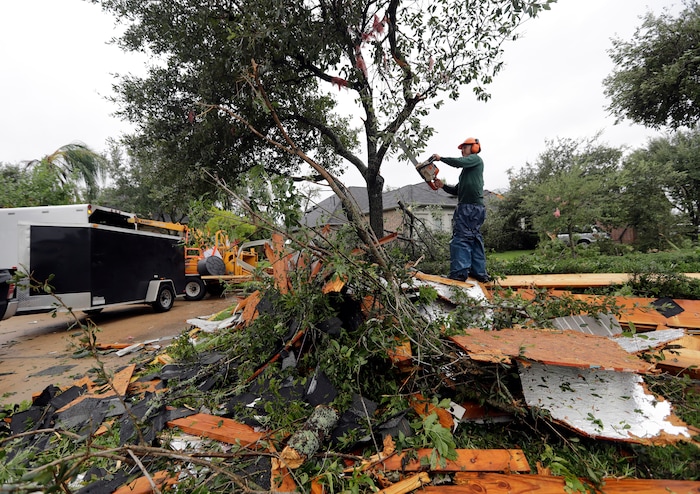
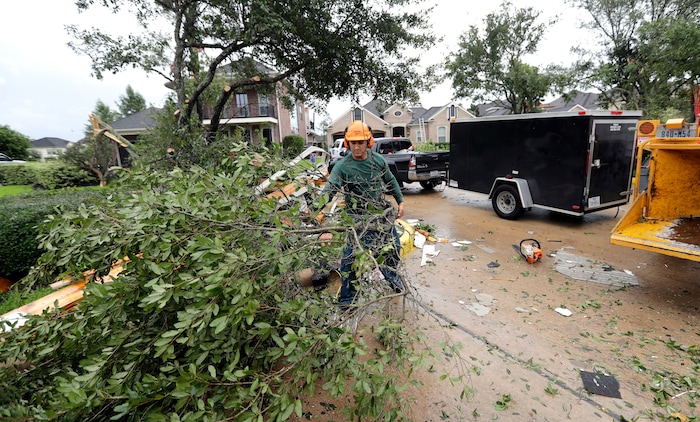
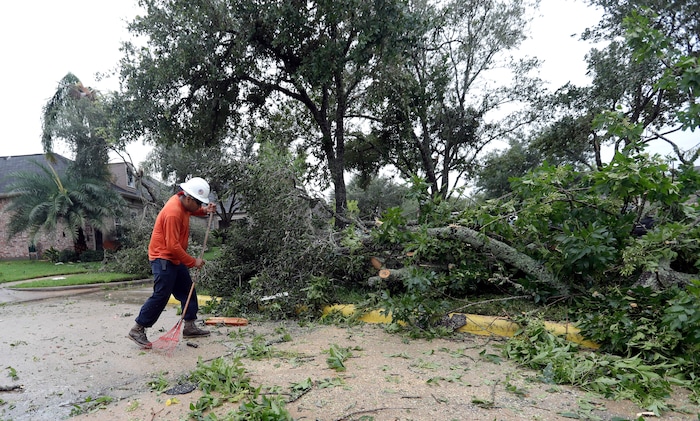
(David J. Phillip | The Associated Press) Henry Isaac cuts down broken tree limbs after Hurricane Harvey Saturday, Aug. 26, 2017, in Missouri City, Texas. Harvey rolled over the Texas Gulf Coast on Saturday, smashing homes and businesses and lashing the shore with wind and rain so intense that drivers were forced off the road because they could not see in front of them.
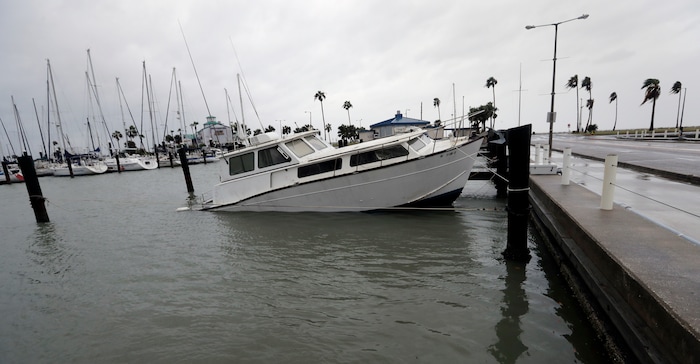
(Eric Gay | The Associated Press) A fishing boat is left partial submerged after Hurricane Harvey swept through the area, Saturday, Aug. 26, 2017, in Corpus Christi, Texas. Harvey has been further downgraded to a Category 1 hurricane as it churns slowly inland from the Texas Gulf Coast, already depositing more than 9 inches of rain in South Texas.
(David J. Phillip | The Associated Press) Henry Isaac removes broken tree limbs after Hurricane Harvey Saturday, Aug. 26, 2017, in Missouri City, Texas. Harvey rolled over the Texas Gulf Coast on Saturday, smashing homes and businesses and lashing the shore with wind and rain so intense that drivers were forced off the road because they could not see in front of them.
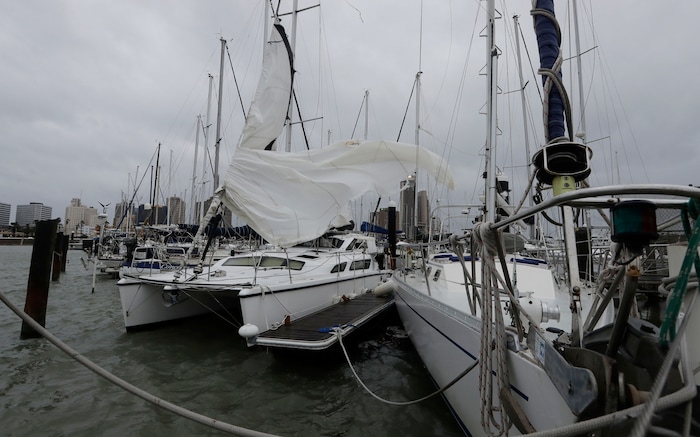
(Eric Gay | The Associated Press) Ripped sails of boats whip in the wind, damaged by Hurricane Harvey, Saturday, Aug. 26, 2017, in Corpus Christi, Texas. Harvey has been further downgraded to a Category 1 hurricane as it churns slowly inland from the Texas Gulf Coast, already depositing more than 9 inches of rain in South Texas.
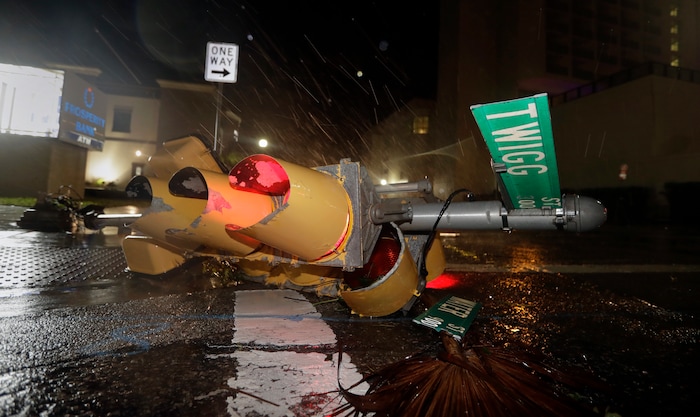
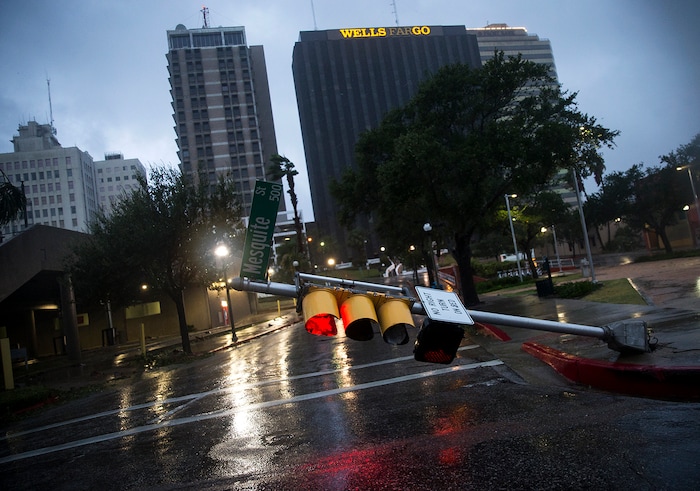
(Eric Gay | The Associated Press) A traffic signal topped by the winds of Hurricane Harvey lies in an intersection of downtown Corpus Christi, Texas, Saturday, Aug. 26, 2017. Harvey has been further downgraded to a Category 1 hurricane as it churns slowly inland from the Texas Gulf Coast, already depositing more than 9 inches of rain in South Texas.
(David J. Phillip | The Associated Press) Abel Carreno cleans up after Hurricane Harvey Saturday, Aug. 26, 2017, in Missouri City, Texas. Harvey rolled over the Texas Gulf Coast on Saturday, smashing homes and businesses and lashing the shore with wind and rain so intense that drivers were forced off the road because they could not see in front of them.
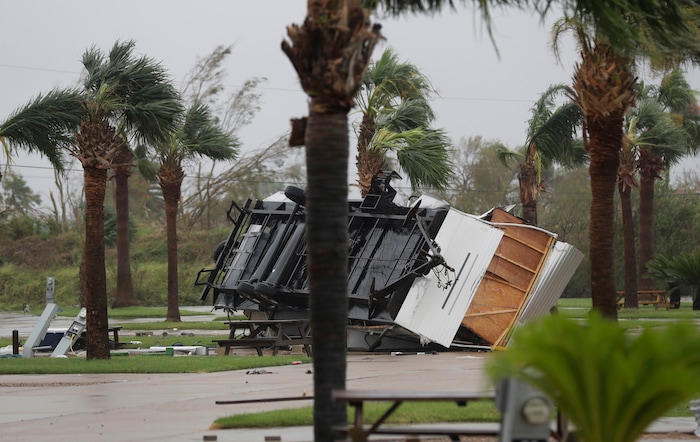
(Eric Gay | The Associated Press) An overturned trailer sits in a park in the wake of Hurricane Harvey, Saturday, Aug. 26, 2017, in Aransas Pass, Texas. Harvey rolled over the Texas Gulf Coast on Saturday, smashing homes and businesses and lashing the shore with wind and rain so intense that drivers were forced off the road because they could not see in front of them.
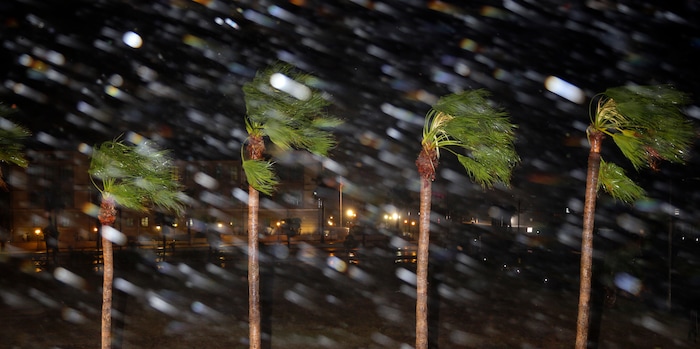
(Eric Gay | The Associated Press) Rain is blown past palm trees as Hurricane Harvey makes landfall, Friday, Aug. 25, 2017, in Corpus Christi, Texas. Harvey intensified into a hurricane Thursday and steered for the Texas coast with the potential for up to 3 feet of rain, 125 mph winds and 12-foot storm surges in what could be the fiercest hurricane to hit the United States in almost a dozen years.
(Gabe Hernandez | Corpus Christi Caller-Times via AP) Port Aransas Fire Department survey the area after Hurricane Harvey landed in the Coast Bend area on Saturday, Aug. 26, 2017, in Port Aransas, Texas. The National Hurricane Center has downgraded Harvey from a Category 1 hurricane to a tropical storm. Harvey came ashore Friday along the Texas Gulf Coast as a Category 4 storm with 130 mph winds, the most powerful hurricane to hit the U.S. in more than a decade.
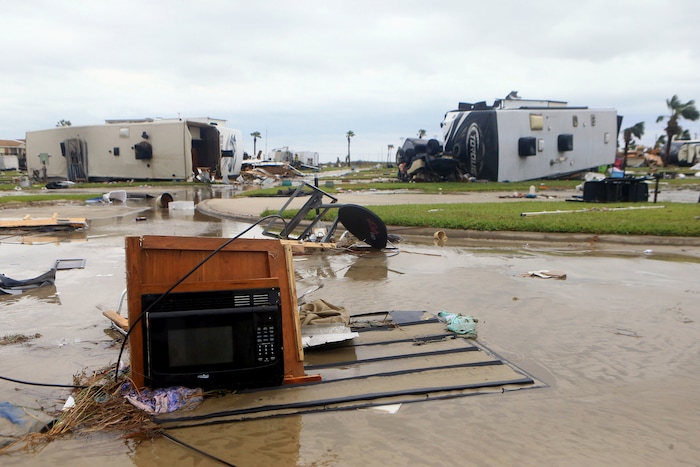
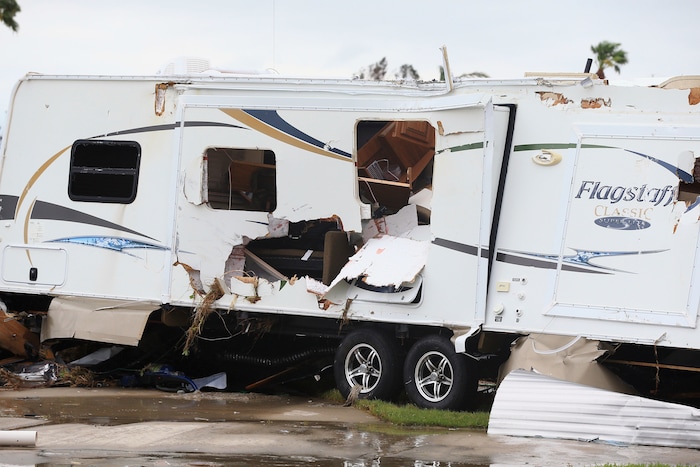
(Gabe Hernandez | Corpus Christi Caller-Times via AP) Mobile homes are destroyed at an RV park after Hurricane Harvey landed in the Coast Bend area on Saturday, Aug. 26, 2017, in Port Aransas, Texas. The National Hurricane Center has downgraded Harvey from a Category 1 hurricane to a tropical storm. Harvey came ashore Friday along the Texas Gulf Coast as a Category 4 storm with 130 mph winds, the most powerful hurricane to hit the U.S. in more than a decade.
(David J. Phillip | The Associated Press) A contractor walks over debris from Hurricane Harvey Saturday, Aug. 26, 2017, in Missouri City, Texas. Harvey rolled over the Texas Gulf Coast on Saturday, smashing homes and businesses and lashing the shore with wind and rain so intense that drivers were forced off the road because they could not see in front of them.
(Gabe Hernandez | Corpus Christi Caller-Times via AP) Members of the National Guard arrive at Port Aransas after Hurricane Harvey landed in the Coast Bend area on Saturday, Aug. 26, 2017, in Port Aransas, Texas. The National Hurricane Center has downgraded Harvey from a Category 1 hurricane to a tropical storm. Harvey came ashore Friday along the Texas Gulf Coast as a Category 4 storm with 130 mph winds, the most powerful hurricane to hit the U.S. in more than a decade.
(Gabe Hernandez | Corpus Christi Caller-Times via AP) Mobile homes are destroyed at an RV park after Hurricane Harvey landed in the Coast Bend area on Saturday, Aug. 26, 2017, in Port Aransas, Texas. The National Hurricane Center has downgraded Harvey from a Category 1 hurricane to a tropical storm. Harvey came ashore Friday along the Texas Gulf Coast as a Category 4 storm with 130 mph winds, the most powerful hurricane to hit the U.S. in more than a decade.
(Gabe Hernandez | Corpus Christi Caller-Times via AP) A boat is located on land after Hurricane Harvey landed in the Coast Bend area on Saturday, Aug. 26, 2017, in Port Aransas, Texas. The National Hurricane Center has downgraded Harvey from a Category 1 hurricane to a tropical storm. Harvey came ashore Friday along the Texas Gulf Coast as a Category 4 storm with 130 mph winds, the most powerful hurricane to hit the U.S. in more than a decade.
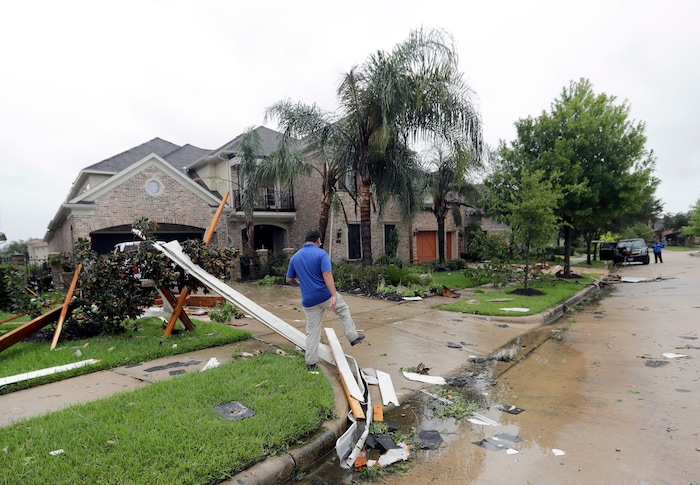
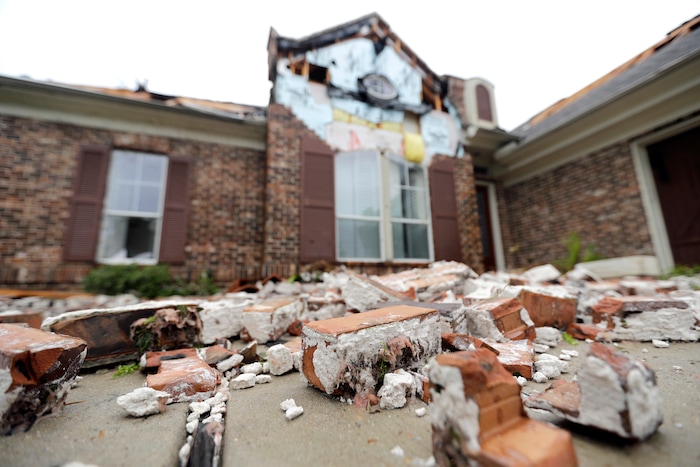
(David J. Phillip | The Associated Press) Fallen bricks from a home damaged by Hurricane Harvey sit on the ground Saturday, Aug. 26, 2017, in Missouri City, Texas. Harvey rolled over the Texas Gulf Coast on Saturday, smashing homes and businesses and lashing the shore with wind and rain so intense that drivers were forced off the road because they could not see in front of them.
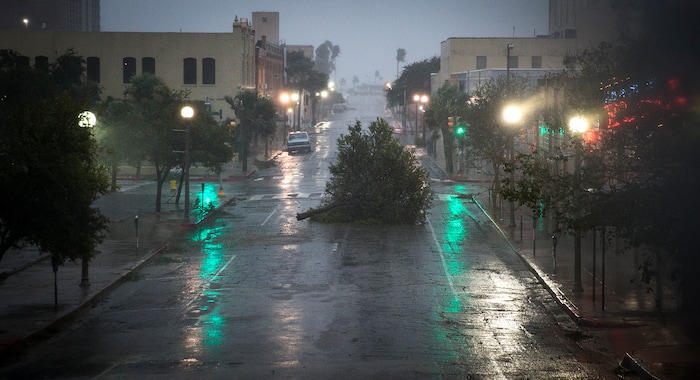
(Nick Wagner | Austin American-Statesman via AP) A tree blocks a street as Hurricane Harvey makes landfall in Corpus Christi, Texas, on Friday, Aug. 25, 2017. Hurricane Harvey smashed into Texas late Friday, lashing a wide swath of the Gulf Coast with strong winds and torrential rain from the fiercest hurricane to hit the U.S. in more than a decade.
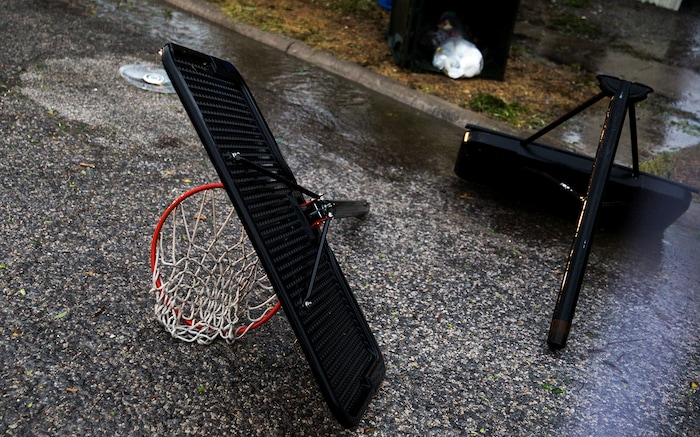
(Nick Wagner | Austin American-Statesman via AP) A basketball hoop lays in pieces as Hurricane Harvey makes landfall in Corpus Christi, Texas, on Friday, Aug. 25, 2017. Hurricane Harvey smashed into Texas late Friday, lashing a wide swath of the Gulf Coast with strong winds and torrential rain from the fiercest hurricane to hit the U.S. in more than a decade.
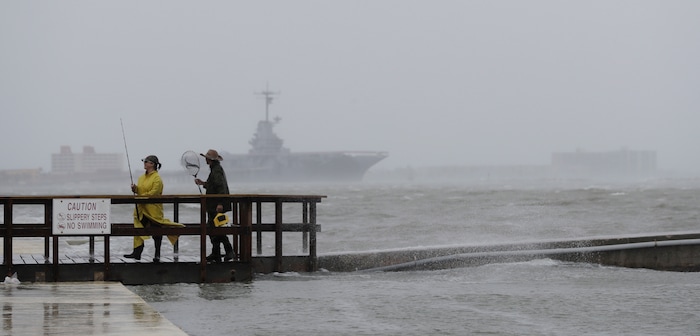
(Eric Gay | The Associated Press) Fishermen walk along a pier as the early bands of Hurricane Harvey make landfall, Friday, Aug. 25, 2017, in Corpus Christi, Texas. Harvey intensified into a hurricane Thursday and steered for the Texas coast with the potential for up to 3 feet of rain, 125 mph winds and 12-foot storm surges in what could be the fiercest hurricane to hit the United States in almost a dozen years.
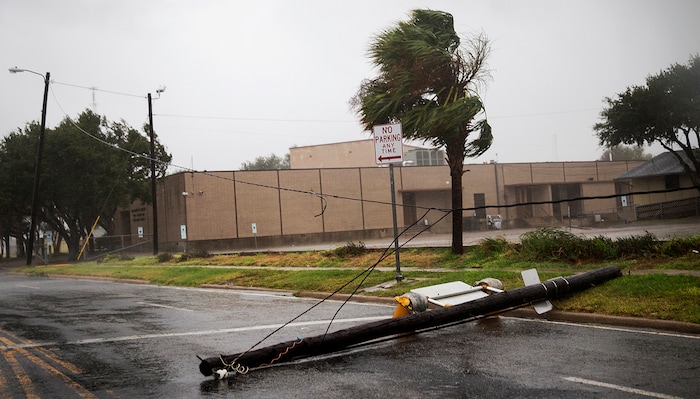
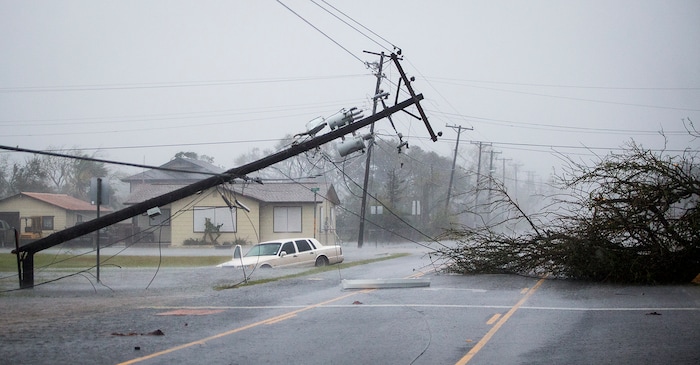
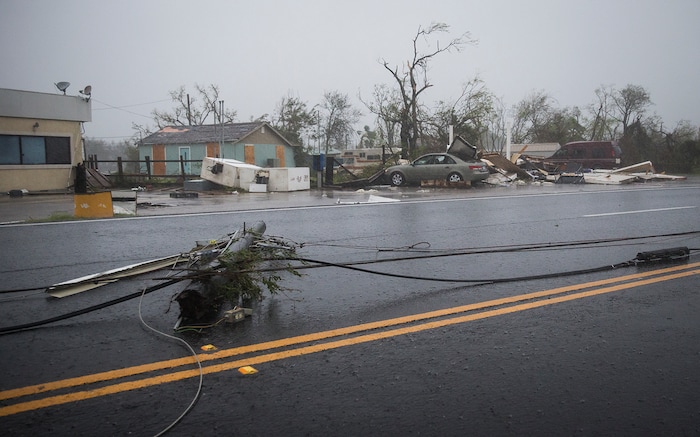
(Nick Wagner | Austin American-Statesman via AP) A power pole lays in the middle of a street as Hurricane Harvey makes landfall in Corpus Christi, Texas, on Friday, Aug. 25, 2017. Hurricane Harvey smashed into Texas late Friday, lashing a wide swath of the Gulf Coast with strong winds and torrential rain from the fiercest hurricane to hit the U.S. in more than a decade.
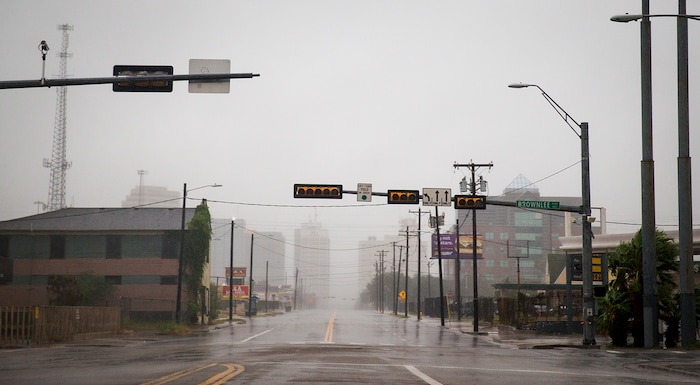
(Nick Wagner | Austin American-Statesman via AP) A street sits empty as Hurricane Harvey makes landfall in Corpus Christi, Texas, on Friday, Aug. 25, 2017. Hurricane Harvey smashed into Texas late Friday, lashing a wide swath of the Gulf Coast with strong winds and torrential rain from the fiercest hurricane to hit the U.S. in more than a decade.
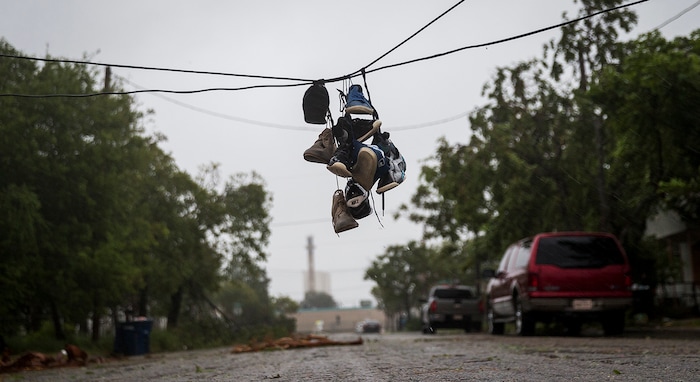
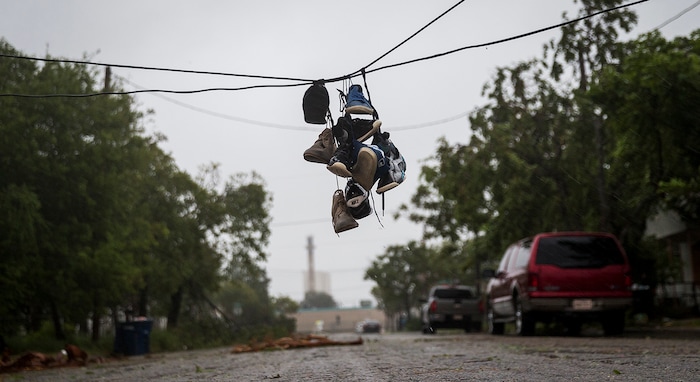
(Nick Wagner | Austin American-Statesman via AP) Shoes tied to a power line hang near a street after winds from Hurricane Harvey brought down a power pole in Corpus Christi, Texas, on Friday, Aug. 25, 2017. Hurricane Harvey smashed into Texas late Friday, lashing a wide swath of the Gulf Coast with strong winds and torrential rain from the fiercest hurricane to hit the U.S. in more than a decade.
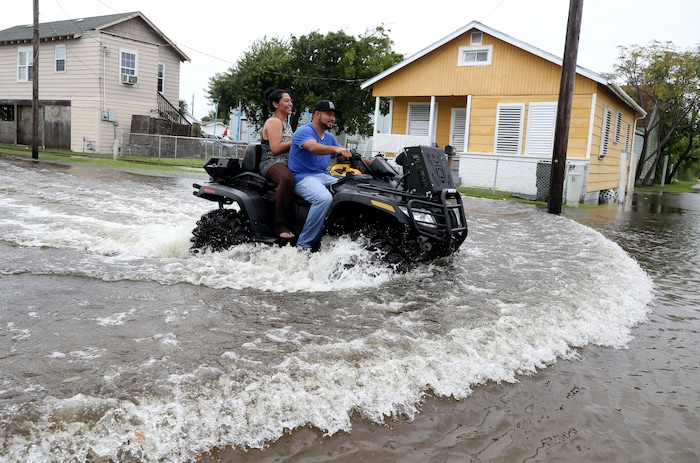
(Jennifer Reynolds | The Galveston County Daily News via AP) Galveston, Texas, residents ride an all terrain vehicle down 50th Street on Saturday, Aug. 26, 2017, as they survey the flooding from Hurricane Harvey in their neighborhood.
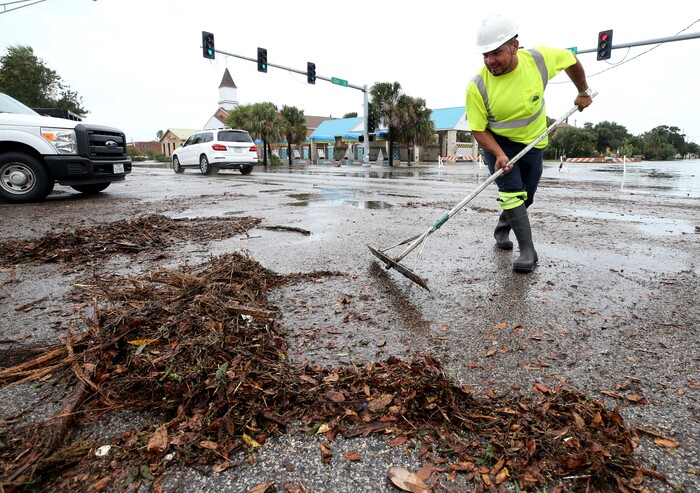
(Jennifer Reynolds | The Galveston County Daily News via AP) German Martinez, with Galveston's Public Works department, clears debris from the intersection of 33rd Street and Broadway on Saturday, Aug. 26, 2017, as high waters from Hurricane Harvey begin to recede.
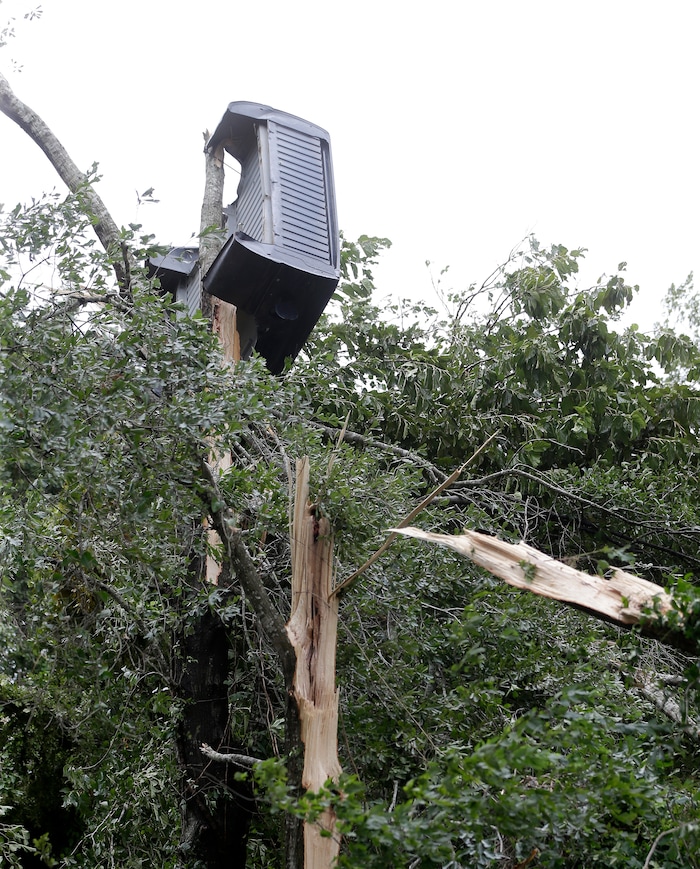
(Melissa Phillip | Houston Chronicle via AP) A truck bed lies in a tree near Bryant's Auto Sales in Katy, Texas, on Saturday, Aug. 26, 2017, after a possible tornado during Hurricane Harvey.
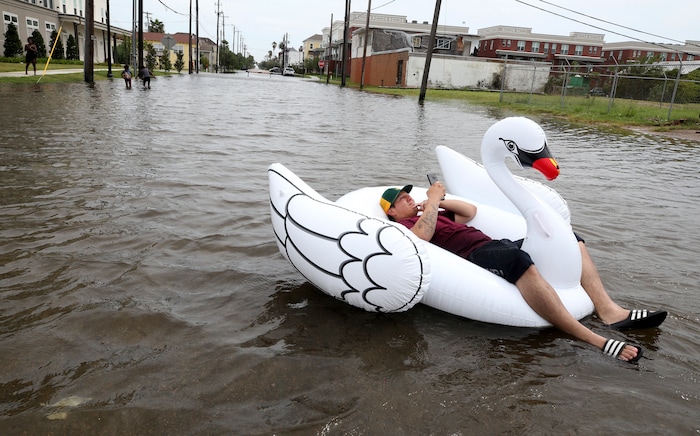
(Jennifer Reynolds | The Galveston County Daily News via AP) Julio Ostio sits in an inflatable swan as he floats down 16th Street near Strand Street in Galveston, Texas, on Saturday, Aug. 26, 2017, as he texts friends during a break in the rain from Hurricane Harvey.
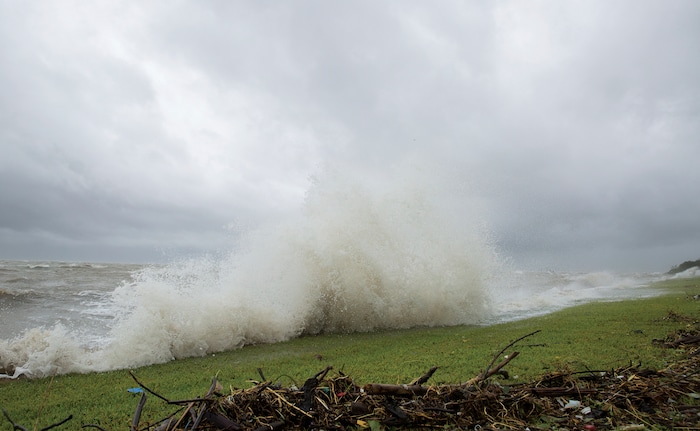
(Ana Ramirez | The Victoria Advocate via AP) Water crashes along the bay front in Port Lavaca, Texas, Friday, Aug. 25, 2017. Hurricane Harvey smashed into Texas late Friday, lashing a wide swath of the Gulf Coast with strong winds and torrential rain from the fiercest hurricane to hit the U.S. in more than a decade.
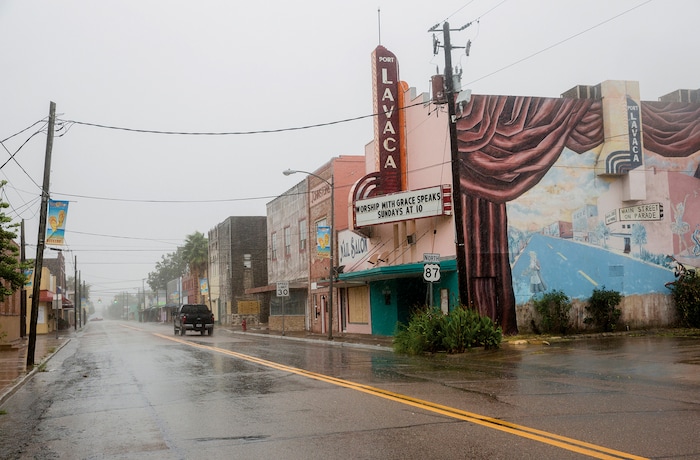
(Ana Ramirez | The Victoria Advocate via AP) A single truck drives down a street as Hurricane Harvey makes landfall in downtown Port Lavaca, Texas on Friday, Aug. 25, 2017. Hurricane Harvey smashed into Texas late Friday, lashing a wide swath of the Gulf Coast with strong winds and torrential rain from the fiercest hurricane to hit the U.S. in more than a decade.
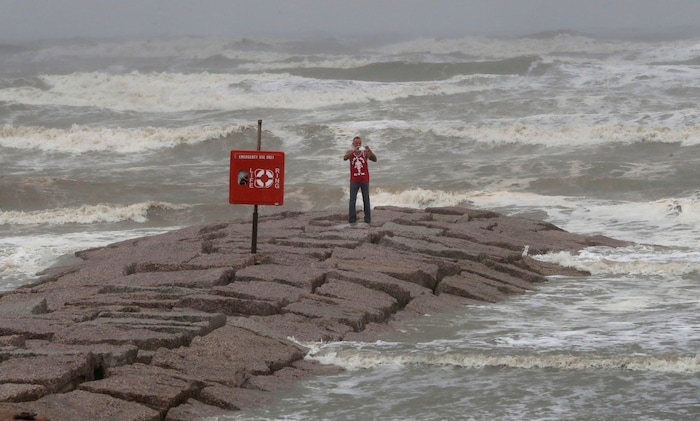
(Jennifer Reynolds | The Galveston County Daily News via AP) Michael Scott uses his smartphone to livestream the rain and storm surge of Hurricane Harvey from the 59th Street rock groin in Galveston, Texas on Saturday, Aug. 26, 2017.
(Nick Wagner | Austin American-Statesman via AP) A damaged stop light blocks a street as Hurricane Harvey makes landfall in Corpus Christi, Texas, on Friday, Aug. 25, 2017. Hurricane Harvey smashed into Texas late Friday, lashing a wide swath of the Gulf Coast with strong winds and torrential rain from the fiercest hurricane to hit the U.S. in more than a decade.
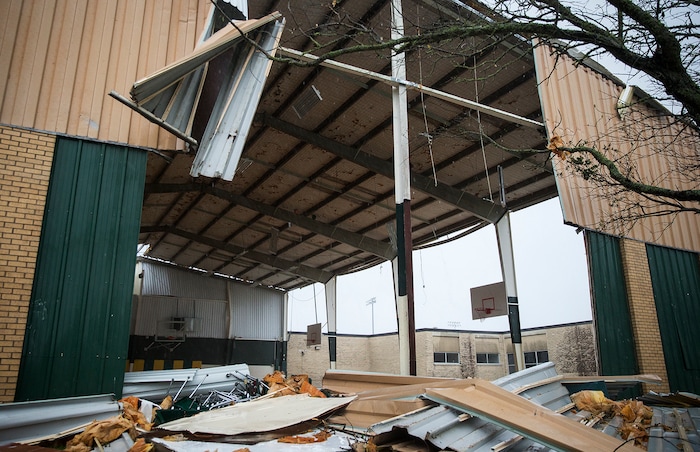
(Nick Wagner | Austin American-Statesman via AP) The Rockport-Fulton high school gymnasium walls expose the interior after Hurricane Harvey ripped through Rockport, Texas, on Saturday, Aug. 26, 2017. The fiercest hurricane to hit the U.S. in more than a decade spun across hundreds of miles of coastline where communities had prepared for life-threatening storm surges, walls of water rushing inland.
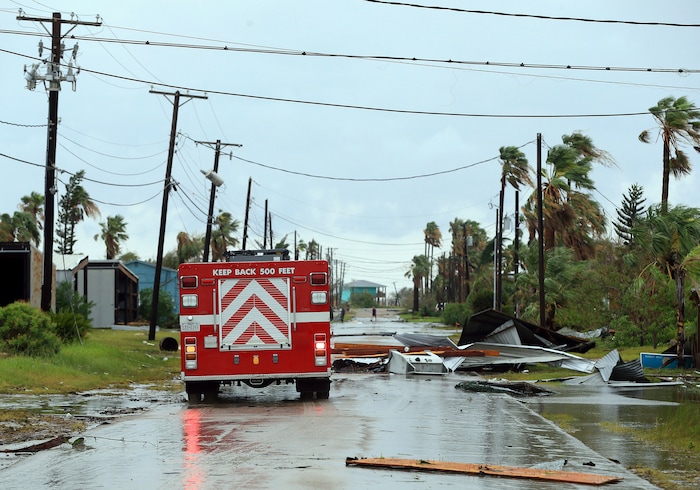
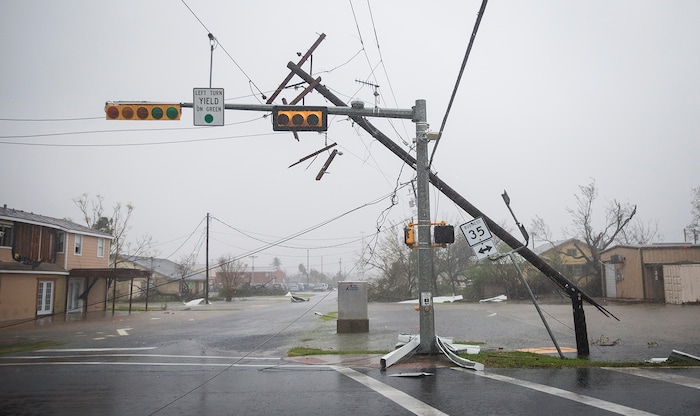
(Nick Wagner | Austin American-Statesman via AP) A snapped power pole leans against a stoplight after Hurricane Harvey ripped through Rockport, Texas, on Saturday, Aug. 26, 2017. The fiercest hurricane to hit the U.S. in more than a decade spun across hundreds of miles of coastline where communities had prepared for life-threatening storm surges — walls of water rushing inland.
(Nick Wagner | Austin American-Statesman via AP) A vehicle sits in standing water after Hurricane Harvey ripped through Rockport, Texas, on Saturday, Aug. 26, 2017. The fiercest hurricane to hit the U.S. in more than a decade spun across hundreds of miles of coastline where communities had prepared for life-threatening storm surges, walls of water rushing inland.
(Nick Wagner | Austin American-Statesman via AP) Debris is strewn all over after Hurricane Harvey ripped through in Rockport, Texas, on Saturday, Aug. 26, 2017. The fiercest hurricane to hit the U.S. in more than a decade spun across hundreds of miles of coastline where communities had prepared for life-threatening storm surges, walls of water rushing inland.
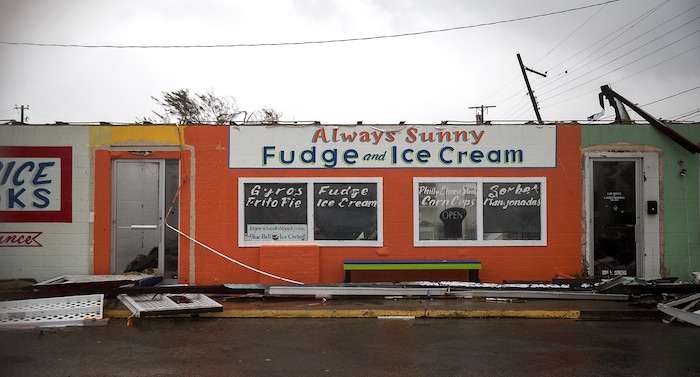
(Nick Wagner | Austin American-Statesman via AP) A store sits damaged after Hurricane Harvey ripped through Rockport, Texas, on Saturday, Aug. 26, 2017. The fiercest hurricane to hit the U.S. in more than a decade spun across hundreds of miles of coastline where communities had prepared for life-threatening storm surges, walls of water rushing inland.
(Nick Wagner | Austin American-Statesman via AP) Shoes tied to a power line hang near a street after winds from Hurricane Harvey brought down a power pole in Corpus Christi, Texas, on Friday, Aug. 25, 2017. Hurricane Harvey smashed into Texas late Friday, lashing a wide swath of the Gulf Coast with strong winds and torrential rain from the fiercest hurricane to hit the U.S. in more than a decade.
(Jay Janner | Austin American-Statesman via AP) A tattered U.S. flag whips in the wind in Geronimo, Texas, during Hurricane Harvey on Saturday August 26, 2017.
Harvey’s winds are creating a storm surge along the coast and in the bays and estuaries, essentially jacking up “sea level” and reducing drainage; gravity isn’t giving much help.
The flooding in Houston also is slowing down relief efforts elsewhere in Texas, which is experiencing widespread flooding. Hundreds of Red Cross staffers and volunteers flew into Houston, expecting to drive to other affected areas to the south. But as weather deteriorated Saturday, the organization determined it was not safe to divert its staff, issuing a “shelter in place” order.
Across Texas, 35 Red Cross shelters are open but officials say the number will greatly increase on Monday. Relief efforts also are being slowed by a lack of hotel rooms in Corpus Christi, where many businesses remain closed because of widespread power outages. Those that remain open are overwhelmed by an influx of utility workers, arriving fire and police crews, journalists and evacuees.
Though FEMA has jumped on the Texas storm, it’s director has emphasized in recent interviews with The Post that the initial response to a disaster — whether it’s a wildfire, a flood, a tornado, or some other calamity — has to come from local and state agencies.
“Emergency management’s a partnership, it’s all based on a community’s capacity to handle an event,” Long said. “All disasters begin and end at the local level.” As Long has described it, FEMA’s job is to arrive when the local and state agencies are overwhelmed, which is what is happening now in Texas.
(Courtney Sacco | Corpus Christi Caller-Times via AP) Members of the Texas National Guard pull a utility poll from Fulton Beach Road on Sunday, Aug. 27, 2017, after Hurricane Harvey in Fulton, Texas. Harvey made landfall in Texas on Friday night as the strongest hurricane to hit the U.S. in more than a decade.
Long has spoken of the need for a sea change in how the country prepares for disasters, noting that the federal government alone can’t always save the day. Ordinary citizens need to be prepared to be first responders, Long said. They need to have personal emergency plans. They need to be able to feed themselves for several days if disaster strikes. They need to be ready to save neighbors in harm’s way.
“People need to be the help before the help arrives,” he said earlier this month at FEMA headquarters on what the agency refers to as a “blue sky day” — a day without a major national catastrophe.
“I think we have to look at how we ask citizens to be ready, first of all. We used to look at citizens as disaster victims, now they’re looked at as what we call disaster survivors,” he said. “I think we have to focus our attention back on the citizens, and how we’re training citizens to be truly ready for a disaster. Whether it’s an active shooter, whether it’s a tornado, in many cases citizens find themselves having to render first aid, CPR, or making safety deicisons before the true first responders arrive.”
W. Craig Fugate, President Barack Obama’s FEMA director for two terms, said earlier this month that Long’s words about shared responsibility among federal, state and local agencies is an echo of what Fugate had been advocating when he ran the agency.
Both men said, in different language, something similar: Americans tend to get complacent about the possibility of a disaster. “We have a long way to go,” Long said about the nation’s overall disaster readiness. Fugate, now retired, was more blunt: “It sucks.”
Harvey made landfall late Friday as a Category 4 hurricane, then crept slowly inland. On Sunday it was still a tropical storm, with a center of circulation 35 miles west-northwest of Victoria, Tex. The system had started to backtrack slightly Sunday, moving at just 2 mph to the southeast.
Harvey is the first major hurricane — Category 3 or higher — to hit the U.S. since Wilma in 2005.
(Jennifer Reynolds | The Galveston County Daily News via AP) Michael Scott uses his smartphone to livestream the rain and storm surge of Hurricane Harvey from the 59th Street rock groin in Galveston, Texas on Saturday, Aug. 26, 2017.
Earlier that year, Hurricane Katrina killed more than 1,800 people, most of them in Louisiana, and put much of the city of New Orleans under water. FEMA’s initially sluggish and ineffective response to Katrina tarnished the agency’s reputation. It became a late-night talk show joke after President George W. Bush praised his FEMA director: “Brownie, you’re doing a heck of a job.”
A 2006 law Congress passed after Katrina is credited with improving the culture of an agency that had suffered from budget cuts and a lack of professional emergency managers early in the Bush presidency. The law required FEMA to dispatch teams to the scene along with massive relief supplies before a disaster hit.
Under former director Fugate, the agency improved coordination with the Red Cross and state and local emergency managers, and boosted its use of social media to offer assistance to storm victims.
Yet even as nearly 60 federal agencies from the Defense Department to the Internal Revenue Service were on hand for the response and recovery to Hurricane Sandy in 2012, FEMA confronted the limitations of bureaucracy in any disaster.
Large areas of New York and New Jersey were without electricity for weeks, for example, as FEMA struggled to get private utility companies and state agencies to move faster to restore power. Many homeowners who applied for disaster assistance found only confusion as they tried to navigate the many federal agencies tasked with helping them.
President Trump has proposed cuts to federal emergency response funding. FEMA’s $3.5 billion budget would lose $361 million under the spending plan the White House submitted to Congress in March.
Some programs criticized for a lack of effectiveness would be cut, but so would the federal commitment to helping state and local governments prepare for natural disasters through training, salaries and benefits for staff, coordination and state-of the-art equipment.
The Coast Guard’s $9.1 billion budget for the fiscal year that starts Oct. 1 would be cut too, by 14 percent.
With the Harvey disaster unfolding, the question is whether this could become another Katrina.
“It’s hard to say. This is totally different from Katrina,” Long said Sunday, recounting Harvey’s unusual weather pattern. “This is an incredibly unique event.”
The Washington Post’s Tim Craig in Corpus Christi contributed to this report.

Donate to the newsroom now. The Salt Lake Tribune, Inc. is a 501(c)(3) public charity and contributions are tax deductible