facebook-pixel

Utah Valley University wants to boost its police force by a third after Charlie Kirk’s killing. Safety experts say it’s not enough.

The school is looking to hire eight new officers. Advocates say that still leaves UVU’s policing far below recommended levels.
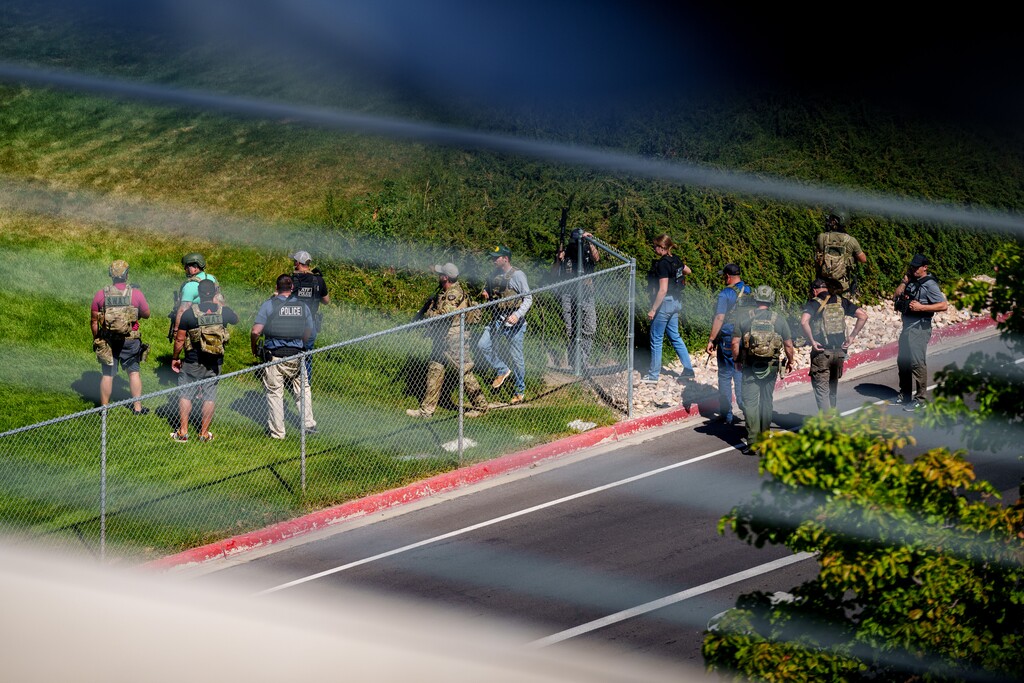
(Trent Nelson | The Salt Lake Tribune) Law enforcement conducts a search of the Utah Valley University campus in Orem after conservative commentator Charlie Kirk was shot during an event on Wednesday, Sept. 10, 2025.

Utah Valley University is looking to hire eight new police officers, a sizable expansion to its relatively small force after Charlie Kirk’s killing ignited concerns about the school’s limited campus security.

The extra officers would grow the school’s police force staffing by about 36% — but safety experts say it’s not enough.

The school declined to confirm how many officers it currently employs. But Utah salary data shows 22 people listed as campus officers this year, not counting police administrators. That aligns with a 2024 report from the university that noted it had 23 officers.

UVU is the largest university in Utah with more than 48,000 students currently enrolled. The jump to a roughly 30-officer force would still leave the school far behind the police staffing of other public campuses in the state. It’s also a smaller force than generally recommended based on student population.

“It is important to have a larger police presence — not just because of a single incident, but to have one that is commensurate with the size of an institution and the needs it has,” said S. Daniel Carter, a campus safety consultant who runs Safety Advisors for Educational Campuses, LLC.

University spokesperson Ellen Treanor said the Orem school has also approved two new job postings for safety managers, who will handle security coordination for future events.

She said that’s what the university is currently able to afford after budget discussions held on campus last week. She didn’t specify how much the hirings will cost the school or whether UVU plans to ask state lawmakers for more security funding.

None of the school’s legislative requests in the past few years appear to have asked for more police staffing. Instead, the school requested money this year for designing a new health professions building and creating an artificial intelligence center. It also received funds for a student athlete building this year and in 2024.

For the coming 2026 legislative session, the overarching Utah System of Higher Education that oversees the state’s eight public colleges and universities is asking for $3.4 million for “resources for enhanced campus safety and security.” That was not on the system’s list of priority budget requests last year.

UVU’s planned 2026 requests, so far, total about $20 million for employee retention, digital upgrades, a Utah Lake research center and an Olympics initiative. Policing isn’t mentioned.

Treanor wouldn’t specify what the school currently spends on policing. UVU’s annual financial report doesn’t include a line item for that. A legislative audit noted, though, that the school was spending $1.6 million in 2020 on campus policing.

Additionally, state salary data shows for this year, $947,000 was spent on pay for the 22 officers listed. That includes what appears to be about $15,000 in overtime.

Carter said he hopes the Utah Legislature would consider funding a bigger policing boost at UVU.

“I’m not looking for the university to pull it from thin air,” he said. “It’s a commitment the state should make.”

On the day of the shooting, eight UVU officers were staffing the Kirk event — six in uniform and two patrolling the crowd in plain clothes. Kirk also had his own eight-member private security force.

The school has declined to say if it asked for assistance from outside law enforcement ahead of the Sept. 10 event, which drew about 3,000 attendees.

UVU’s policing ratios

With about 22 officers currently on staff, that means UVU has less than one officer per every 1,000 students — or about 0.45 of an officer per 1,000 students.

Growing to 30 officers wouldn’t increase that ratio much, landing the school at a ratio of about 0.62 of an officer per 1,000 students.

That’s less than half of what Carter and other campus safety advocates generally recommend: an average of at least two officers per 1,000 students at public universities, as The Associated Press has reported.

There’s no set standard, but that recommendation seems to align with the norm. In 2021, a Bureau of Justice Statistics survey found the average policing ratio at public universities nationally was 2.2 officers per 1,000 students.

To reach that two-officer threshold, UVU would need to have 97 police officers. Even now, not all of its officers work full time; state salary data suggests eight work part time.

Carter says the calculation can change slightly, depending on a school’s setup. Colleges and universities that have on-campus student housing, for instance, should have more officers to patrol those areas.

UVU does not. Because of that, Carter estimates the university could probably do with somewhere around 50 to 75 full-time officers.

A U.S. Department of Justice report published in 2011 and updated in 2013 found that, at that time, public universities with more than 15,000 students had about 53 police officers, on average — more than double what UVU does now.

Carter said most schools have large physical footprints to secure. UVU, for instance, stretches out across about 300 acres, with roads and parking lots in addition to buildings that should be monitored.

Bringing a speaker to campus, Carter said, or hosting other large events only stretches a force’s capabilities. That’s why off-campus partnerships with local law enforcement agencies are needed to provide adequate coverage.

(Trent Nelson | The Salt Lake Tribune) Charlie Kirk appears at Utah Valley University in Orem on Wednesday, Sept. 10, 2025. He was fatally shot moments later.

Policing at other schools in the state

Weber State University in Ogden, for instance, has 11 of its own full-time officers, plus an additional 35 who work part-time at the school through partnerships with nearby law enforcement agencies, according to numbers provided during a recent meeting of the school’s board of trustees.

Weber has more than 33,000 students, according this fall’s enrollment numbers. That means (counting part-time officers) it has 1.36 officers per 1,000 students.

The University of Utah in Salt Lake City has 46 officers total and 38,257 students, making its ratio 1.2 officers per 1,000 students. The U. also has a separate security force that helps patrol, including at the on-campus hospital.

When Kirk visited the U.’s campus in 2020, the school sent 20 of its own officers; the Utah Highway Patrol and Salt Lake City Police Department also provided support.

Both Weber and the U. also have student dorms, so Carter said it makes sense they have more police. Both also spend more on policing. The U. spent $9.5 million for its main campus in 2020, according to the legislative audit; Weber spent $1.7 million.

The audit notes that every public college and university in the state spent signficantly less than its out-of-state peers.

The University of Utah’s police department has faced scrutiny in recent years after the October 2018 death of student-athlete Lauren McCluskey, who was killed by a man she briefly dated and repeatedly tried to report to campus police. U. officers did not take her concerns seriously, a review later found, and did little to investigate her case.

(Photo courtesy of Jill McCluskey) In this undated photo, Lauren McCluskey makes the "U" with her hands.

“Campus police are important day in and day out,” Carter said. “They don’t always get it right, but I’ve seen firsthand how important having them there when they’re needed is.”

At the same time, Carter said, he doesn’t believe there’s a campus police department in the country that could’ve handled the preparations and staffing for the Kirk event alone without asking for assistance. Having more officers on staff, though, “at the very least could’ve helped.”

A job listing posted online for a police officer position at UVU gives a glimpse into some aspects of the job. The salary range is listed at $58,725 to $69,088 annually.

If UVU hired the eight new officers it wants at the top of that salary range, it would require about half a million dollars.

The job listing doesn’t mention the Kirk shooting. But it asks for candidates willing to “provide protection for students, employees, visitors and property, and take a proactive approach to crime prevention, education and community engagement.”

Responsibilities include patrolling campus, making arrests, conducting formal investigations and performing “public relations activities as required to satisfy public inquiry,” it notes.

Signs of staffing issues before Kirk shooting

There were signs UVU’s police force wasn’t big enough even before the school hosted Kirk, Carter said.

In 2020, for instance, the university violated the Clery Act. That act requires universities to collect data on violence both on and near campus — including sexual assaults — and report it to the public.

The U.S. Department of Education found that UVU didn’t properly distribute its report, failed to collect statistics from four locations and underreported crimes.

“These are fairly common gaps in compliance that are generally due to a lack of robust compliance protocols,” Carter said. He doesn’t believe the police force had enough staff to fully report the data and vet it.

Last year, the school settled the case and paid a $200,000 fine

Days after Kirk was killed, UVU announced it was launching an independent review to examine its police plan and response to the event. School officials have said they are waiting on that review to finish before speaking further on the specifics of that day.

The school has not yet selected a company to perform that review, and it’s declined to provide an estimate on the cost.

University police Chief Jeff Long has previously said, though, the school made missteps on Sept. 10.

“You try to get your bases covered and, unfortunately, today we didn’t,” Long said.

(Bethany Baker | The Salt Lake Tribune) Utah Valley University police Chief Jeff Long speaks during a news conference following the shooting death of conservative commentator Charlie Kirk at Utah Valley University in Orem on Wednesday, Sept. 10, 2025.

Note to readers • This story is available to Salt Lake Tribune subscribers only. Thank you for supporting local journalism.