facebook-pixel

‘We as educators need to embrace it’: Here’s how Utah teachers say A.I. is giving them more time with students

About 80% of Utah school districts use SchoolAI, a generative AI model that can help teachers create lesson plans and more.
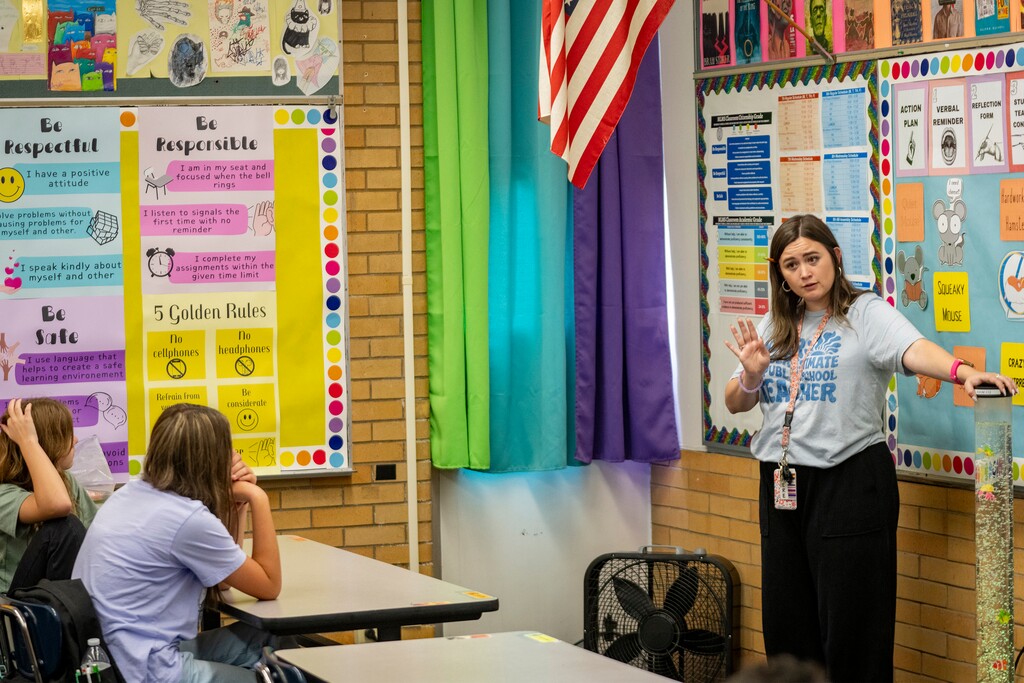
(Rick Egan | The Salt Lake Tribune) Raychel Rondash teaches English at Mount Logan Middle School in Logan, on Monday, August 25, 2025. Rondash has embraced artificial intelligence as an educating tool, using it to simulate student conversations with historical figures and fictional characters and more.

Imagine sitting beside Anne Frank in the Amsterdam annex where she hid with her family, passing notes in silent conversation to avoid being heard. Or asking Ponyboy, the protagonist of S.E. Hinton’s 1967 novel “The Outsiders,” what was going through his mind when he rushed into that burning church with children trapped inside.

For Raychel Rondash’s students at Mount Logan Middle School, this isn’t just a thought experiment. Simulated conversations with historical figures and fictional characters are a regular part of English class — with a little help from artificial intelligence.

“I set up a space where [students] could speak to Anne Frank, because we have read the ‘Diary of Anne Frank,’” Rondash said, referring to an AI program called SchoolAI that allows teachers to create digital “spaces” tailored to specific lesson plans, students and subjects.

“These kids actually want to be able to talk to these people,” Rondash said. “And I know it’s not exactly what [Anne Frank] would answer, but it’s still kind of giving them that taste.”

About 80% of Utah school districts use SchoolAI, according to a spokesperson with the Lehi-based company. The platform is a type of generative artificial intelligence, meaning it can create text, images, videos and more in response to queries, going beyond the instant messenger-like format of AI chatbots like ChatGPT.

In Utah, SchoolAI is generating entire lesson plans. It can automatically adjust digital classwork materials if it detects a student is struggling or needs more of a challenge; offer instant essay feedback aligned to teachers’ grading rubrics; detect plagiarism; and translate teaching materials into any language in real time.

(Bethany Baker | The Salt Lake Tribune) David Monson, the head of design at SchoolAI, speaks during a presentation at the SchoolAI headquarters in Lehi on Wednesday, July 16, 2025.

The technology is saving teachers time, and many, like Rondash, are embracing it. Even as Gov. Spencer Cox has warned against its “dangers.”

“Artificial intelligence is dumber than it will ever be right now, and it’s smarter than most of us right now,” Cox said July 10 at the annual “Show Up for Teachers” event. “We are unleashing a force on this Earth that we are not capable of controlling. … We no longer have to do any of the stuff that makes us human. And by the stuff, I just mean thinking. We no longer have to think anymore. And I think that is incredibly dangerous for all of us.”

How do Utah educators use AI?

In central Utah’s Iron County School District, SchoolAI officially began showing up in classrooms this school year after a year of “vetting,” said Robyn Brown, an instructional coach at North Elementary School in the district.

“When used responsibly and intentionally, it can enhance learning and save educators valuable time,” Brown said. “For example, I can now create a learning activity in seconds — something that would have taken hours before.”

It still requires some finesse and creativity, Rondash said. Even if the AI model can quickly create classroom activities and lesson plans, it relies on human prompts and instructions to do so.

For instance, when Rondash was building the Ponyboy chatbot, she instructed the program to respond to students’ questions as if they were still reading “The Outsiders,” so it wouldn’t reveal the book’s ending.

She’s also set parameters around things like essay feedback, limiting the AI model to offering real-time recommendations but not fixing errors.

“When there’s a boundary set in place … I think it’s showing them how to still be critical thinkers using AI,” she said.

(Rick Egan | The Salt Lake Tribune) Raychel Rondash teaches English at Mount Logan Middle School in Logan, on Monday, August 25, 2025.

Rondash cautioned that AI can’t — and shouldn’t — replace human connection. “I think you can mimic it as much as you want, but it’s still not as great and as personalized as the real thing.”

It can give teachers more time for that, though. For instance, AI can instantly customize lessons to individual student needs — something that can take careful teachers days to identify and address.

That feature has been particularly helpful for her students who have struggled to understand figurative language. She said she built two “AI spaces” — one for those with trouble and another for those who grasped the concept.

Students who understood figurative language wrote a story with guidance from a “mystical owl,” Rondash said. Those who needed more support worked with a digital English teacher who asked them about their hobbies and interests to help them make personal connections to figurative language and better retain the lesson.

“It does help save me time,” Rondash said. “Because then I can target those kids who need a little bit more one-on-one.”

Benefits like that are hard to ignore, Brown said.

“Rather than fearing AI, we as educators need to embrace it, understand its capabilities and guide our students in how to use it ethically and creatively,” Brown said.

Utah: An early adopter of AI

(Bethany Baker | The Salt Lake Tribune) Matt Winters, the AI education specialist for the Utah State Board of Education, speaks during a panel discussion at the SchoolAI headquarters in Lehi on Wednesday, July 16, 2025.

Utah became the first in the nation to appoint an AI education specialist at the state level when it hired Matt Winters for the role last May, Winters said.

Before that, Winters did “massive” amounts of AI work as a trainer for the Utah Education Network (UEN), he said. The organization is charged with providing internet and other online resources to schools across the state.

Winters’ new job with the Utah State Board of Education is to keep his “hand on the wheel” of artificial intelligence. He works with local and national policymakers to help shape AI education laws, trains educators on the technology and works to prioritize student privacy.

Utah is one of just a few states that has additional student data privacy laws in place on top of existing federal mandates, he noted. Here, companies offering AI products to Utah schools, like SchoolAI, must agree to meet those stringent requirements before they can launch their programs.

“We’re seeing, in Utah, really good adoption rates,” Winters said of AI in schools. “In other places around the country and around the globe, it’s much slower, and there may not be systemic things around training or working with teachers to make sure that they’re prepared — let alone students or parents.”

(Rick Egan | The Salt Lake Tribune) Raychel Rondash teaches English at Mount Logan Middle School in Logan, on Monday, August 25, 2025.

Part of the state’s effort to prepare schools is its “Artificial Intelligence Framework,” for prekindergarten through 12th grade, a “living document” that Winters has helped shape.

“It digs into — what’s the purpose of AI in education, what are some positive uses, and then what are some prohibitive uses as well, “ Winters explained.

He said he believes Utah was an early adopter of AI because of its unique “human environment,” driven by collaborative groups like the Utah Technology Content Forum, also known as The C-Forum.

The group, which is part of the Utah Education Network, is made up of technology professionals who since 1999 have met monthly during each school year to discuss best practices. There are several other groups like the C-Forum for different specialities, too, Winters said.

“It’s been encouraged over the last couple of decades to have these collaborative environments, particularly virtually, so that everyone can participate,” Winters said. “...Other states aren’t always doing that, but we in Utah make a point of it and do it every single school year.”

Winters also attributes Utah’s early adoption of AI to its early investment in school internet and technology.

In 1991, lawmakers launched the “Educational Technology Initiative” to support school districts and colleges in developing tech-based learning programs. Over the next decade, the state invested $188 million across four major initiatives, including $39 million for UtahLINK (now UEN) to build a statewide computer infrastructure network.

“We have internet in every school, mostly at 100 gigabit speeds, particularly in rural schools,” Winters said. “That is a massive shift from a lot of other states.”

Note to readers • This story is available to Salt Lake Tribune subscribers only. Thank you for supporting local journalism.