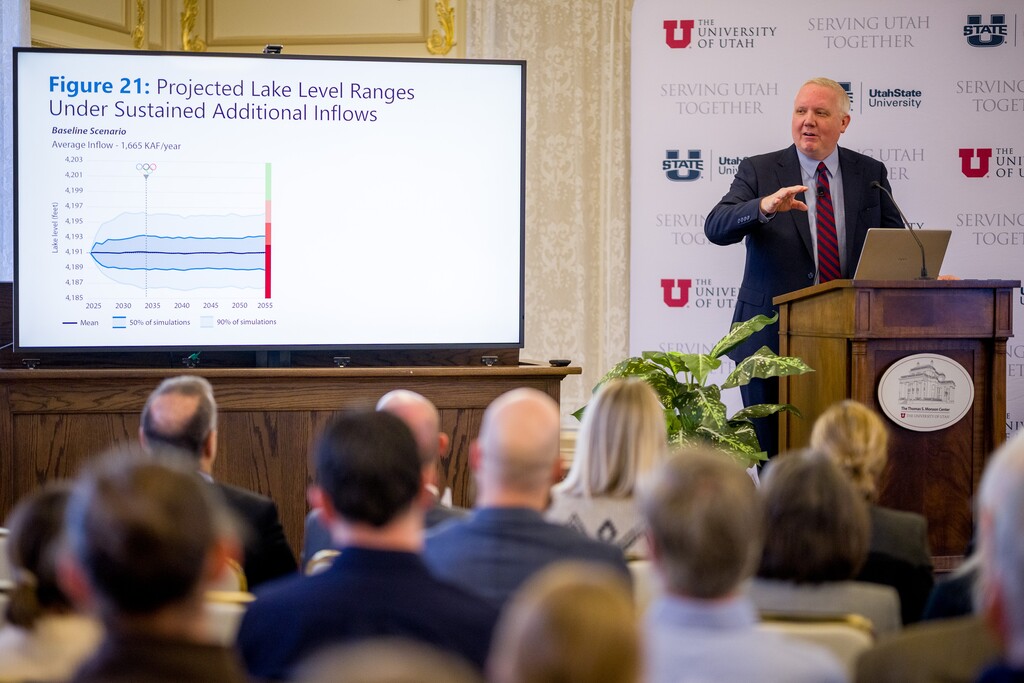
The man tasked by Utah political leaders with saving the Great Salt Lake is stepping away from his job.
Fox 13 News has confirmed Brian Steed will leave his role as Great Salt Lake commissioner to work as Utah State University’s vice-president of government affairs. He will also step away as leader of the Lawson Institute for Land, Water & Air at USU. The university confirmed the role change on Friday.
“I am incredibly honored to step into this new role at Utah State University. As a powerhouse of research and education, USU plays a vital role in shaping the next generation of leadership and informing decisions through sound science. I look forward to building upon the strong foundation already in place to strengthen our partnerships across the state and nation,” Steed said in a statement to Fox 13 News released through Utah’s Department of Natural Resources, which oversees the Great Salt Lake commissioner’s office.
“While I am excited for this new chapter, my commitment to the Great Salt Lake and the ongoing efforts to preserve it remains a primary focus. I will continue to serve as the Great Salt Lake Commissioner until July 1. It has been an honor to lead these efforts. The health of the lake is a top priority for Utah’s future, and I am proud of the progress we have made and the many partners who are now working together to protect this incredible resource.”
Steed stepped into the role, appointed by Gov. Spencer Cox, Senate President Stuart Adams and House Speaker Mike Schultz, with the mandate to reverse the lake’s declines and prevent an ecological catastrophe in Utah. He has worked in a largely political role, pushing legislation that would help the lake while killing bills that would harm the lake. He also has worked to secure money and water for the lake and navigated competing interests from agriculture, industry and environmentalism to lawmakers who may not view the lake as a top priority.
Commissioner Joel Ferry, who heads the Utah Department of Natural Resources, praised Steed and the work he has done.
“Brian has been a tireless champion for Utah’s natural resources, especially in his work as the Great Salt Lake Commissioner. His ability to navigate complex challenges while bringing people together has been key to making the lake a top state priority. We are grateful he is staying on through July 1 to ensure a smooth transition for this critical work,” Ferry said. “On behalf of the Department of Natural Resources, I thank Brian for his service and wish him the very best. I have no doubt he will continue to do great things.”
Lynn de Freitas, the head of the environmental group Friends of Great Salt Lake, said Steed brought together political, academic and business communities. She was watching who would replace him.
“During his service, he leveraged effective relationships and tools that translated into timely measures on behalf of the Lake. Hopefully, his successor will also effectively carry the mantle of GSL and its future. He will be missed,” she said.
This article is published through the Great Salt Lake Collaborative, a solutions journalism initiative that partners news, education and media organizations to help inform people about the plight of the Great Salt Lake—and what can be done to make a difference before it is too late. Read all of our stories at greatsaltlakenews.org.