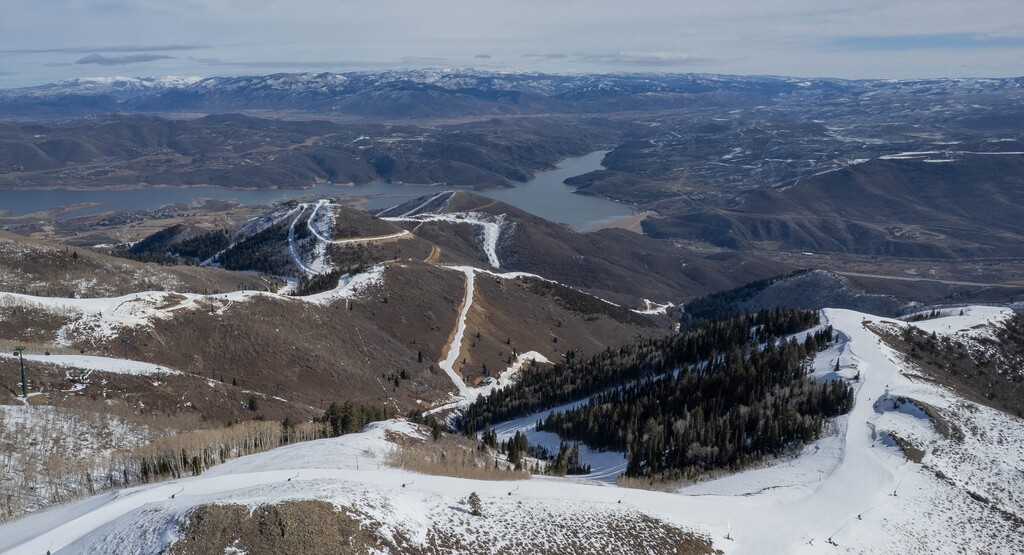
At last, winter weather may actually be on its way to the Beehive State.
Up to 3 feet of powder in the Cottonwood Canyons and the Bear River Range. Valley snow in the forecast. Wind gusts up to 50 mph.
“Finally, [we’re] starting to see winter show its face here,” said Salt Lake City National Weather Service meteorologist Sam Webber.
A pair of incoming back-to-back storms this week — the latter colder and stronger than the first — have prompted weather service officials to issue winter storm warnings or advisories for much of Utah’s mountainous spine. In valleys west of the Wasatch Mountains and in the south-central part of the state, residents can expect gusting winds, too.
The wintry weather would be a welcome change for a state that’s experiencing its worst snowpack on record.
The first storm is expected to run from late Monday into early Tuesday and drop up to a foot of snow at high elevations in the Cottonwoods, the Tushar Mountains, and at Logan-area peaks. However, because of remaining warm air, communities in lower valleys are expected to only see rain.
The second storm is forecast to arrive early on Wednesday and wrap up Thursday. It could drop up to two feet in the Cottonwoods and likely a foot or more in other parts of Utah’s mountainous terrain. Temperatures are expected to plunge to about 10 degrees below average for this time of year, meaning the Salt Lake Valley could see anywhere from a little less than an inch to up to 5 inches of snow, with bench neighborhoods pushing 9 inches. Similar conditions are forecast for Davis and Weber counties.
Webber said Utah skiers and snowboarders across the state should expect a good week, but cautioned that travel to and through mountain ranges could get dicey as the storms roll through.
Other dangers, Webber warned, include avalanche conditions and gusty winds causing isolated power outages.
Ski resort outlooks
The Cottonwood Canyons are expected to reap the most rewards from the storms, with forecasts of 44 total inches at Alta Ski Area and 43 inches at Brighton Resort by Friday.
Nordic Valley — which announced last Friday that it would close temporarily due to high temperatures and lack of snowfall — could squeeze 21 inches from the storm. To the north near Logan, forecasts call for up to 25 inches at Beaver Mountain.
To the south near Cedar City, Brian Head could pick up nearly 30 inches. Eagle Point, also in the Tushar Mountains, could see a dump, too, Webber said.
“The highest density snow of the cycle [will be] at the beginning, which is a good thing,” OpenSnow.com forecaster Evan Thayer wrote in his blog. The benefit is that the early, heavier layer can be packed down by the ensuing snowfalls, creating a more stable and resilient snowpack.
Backcountry ski conditions, however, could be dangerous, Utah Avalanche Center officials warned ahead of the snowfall.
“The incoming storm will overload widespread fragile layers of weak, faceted snow that formed during the mid-winter dry spell,” the center shared in a news release Monday. “This setup is well known for producing dangerous, unpredictable avalanches that can be triggered remotely and break much wider and larger than expected.”
The center said avalanches are likely in high-elevation terrain across northern, central and southwestern Utah from Tuesday through the rest of the week.
What it means for water
Speaking of snowpack, the storms could provide a boost to the state’s languishing water supply.
“Big picture, it’s going to help, but it’s not going to be enough to dig us out of the hole that we’re in right now,” Webber said. “We need that trend to continue through April.”
For example, Webber said the snowpack at Snowbird Ski Resort in Little Cottonwood Canyon sits at about 70% of normal. The expected snowfall could bump that number to about 80%.
While it’s possible strong late winter and early spring precipitation could salvage the snowpack before runoff season, Webber said all previous years similar to this one have ended below average.
Salt Lake City has only seen 0.1 inches of snow this year, a record low if it holds. The least snowy known season in the valley was 1933-34, Webber said. At the end of that period, though, snowfall totaled 14.3 inches in the city.
That means that even if this week’s storms perform at the high end of meteorologists’ predictions, dropping five inches in the Salt Lake Valley, the season total would still be significantly below that record low from the 1930s.