Note to readers • This story is jointly published by nonprofits Amplify Utah and The Salt Lake Tribune, to elevate perspectives in local media through student journalism.
Vernal • When Richard McDonald first heard about Project Alley, he was surprised and concerned.
McDonald has lived in the Dry Fork area, northwest of Vernal in eastern Utah, since 1987, and described it as a quiet and rural area of homes separated by fields. And when he discovered who had purchased the house across the street from him, “immediately I was mad,” he said. “That was my first response.”
But McDonald now counts himself among the many residents of Vernal and its surrounding communities who are supporters of the women’s addiction recovery home, which opened its doors to its first five residents in late November.
“I look at this as another opportunity to help people, so I feel a little better,” McDonald said. “Now, I’ve got involved in it because if I’m gonna be a good neighbor, I need to know what they’re doing.”
“What they’re doing” is similar to what’s been happening at the Uintah Basin men’s addiction recovery home, the Thompsen House of Hope, which opened in Vernal in 2019.
But organizers said there was still a big need in eastern Utah for a similar space for women.
Project Alley filed as a nonprofit in the beginning of 2023.
“I often hear it said that addiction doesn’t discriminate and it’s so true,” said director Heath McDougal-Deans, who said he is also a recovering addict. “I mean, addiction affects all walks of life. It could be your neighbor, you have no idea.”
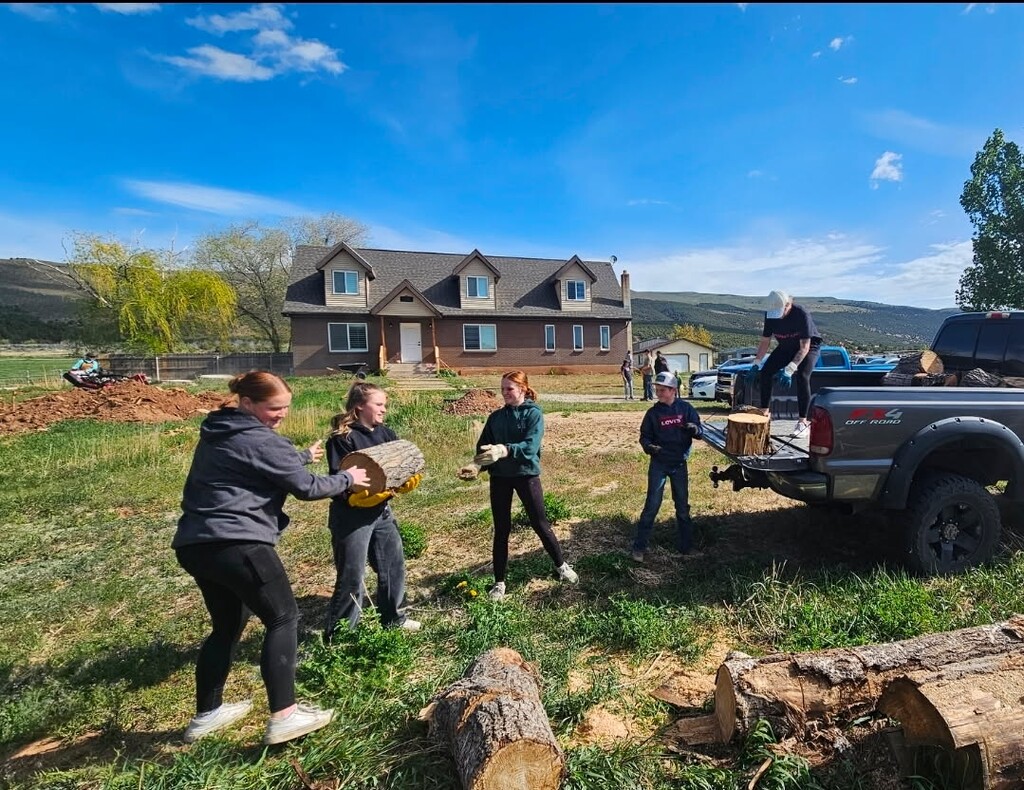
As community members have gotten a better idea, though, they’ve jumped in to help bring the program to life — repeatedly answering calls to help out with projects including tree removal, garden planting and housework that have been posted on JustServe, a website managed by The Church of Jesus Christ of Latter-day Saints where volunteering opportunities are posted.
Ken and Ro Jean Bassett are among those who have answered those calls.
“Neighbors, you know, around these areas are really suspicious of what’s going to go on,” Ken Bassett said.
But once they know, Bassett said, they’re eager to contribute. “People here in our community are very excited about having a recovery home right here locally,” he said, “rather than sending these women out to locations outside of our area.”
Project Alley has also gotten support from the business community. Strata Networks, the Basin’s phone and network provider, donated nearly $32,000 in 2024. Hotel Vernal — a haunted attraction that supports local charities — donated $34,000 in 2023 and made another unspecified donation last month.
“I don’t know if they knew the impact it made for Project Alley,” said Cathy Tesar, a committee member for the recovery home. “It’s been amazing in how the community is starting to embrace this project, and understanding the need for this in the community, and I hope it continues. I hope this is a real positive thing for Vernal.”
Organizers and supporters remain concerned, though, about the long-term sustainability of the program. The residents are selected through an application process and expected to meet monthly fees throughout their three-to-five month stay. But, Tesar said, “not all of the girls may have a lot of money to be able to give, you know, to support this, their stay there.”
The home’s director of development, Kennedy Chivers, said it won’t immediately be clear how the home, its residents, and the community will ensure the project keeps going.
“Every recovery home’s different, everybody operates different, and so we’re just wanting to really find what works for us,” Chivers said. “I think that’s just kind of where we’re at: Open and get these women in and see what it’s like.”
Faith Rust wrote this story as a student journalist at Utah State University. It is published as part of an ongoing collaborative including nonprofits Amplify Utah and The Salt Lake Tribune.
Donate to the newsroom now. The Salt Lake Tribune, Inc. is a 501(c)(3) public charity and contributions are tax deductible