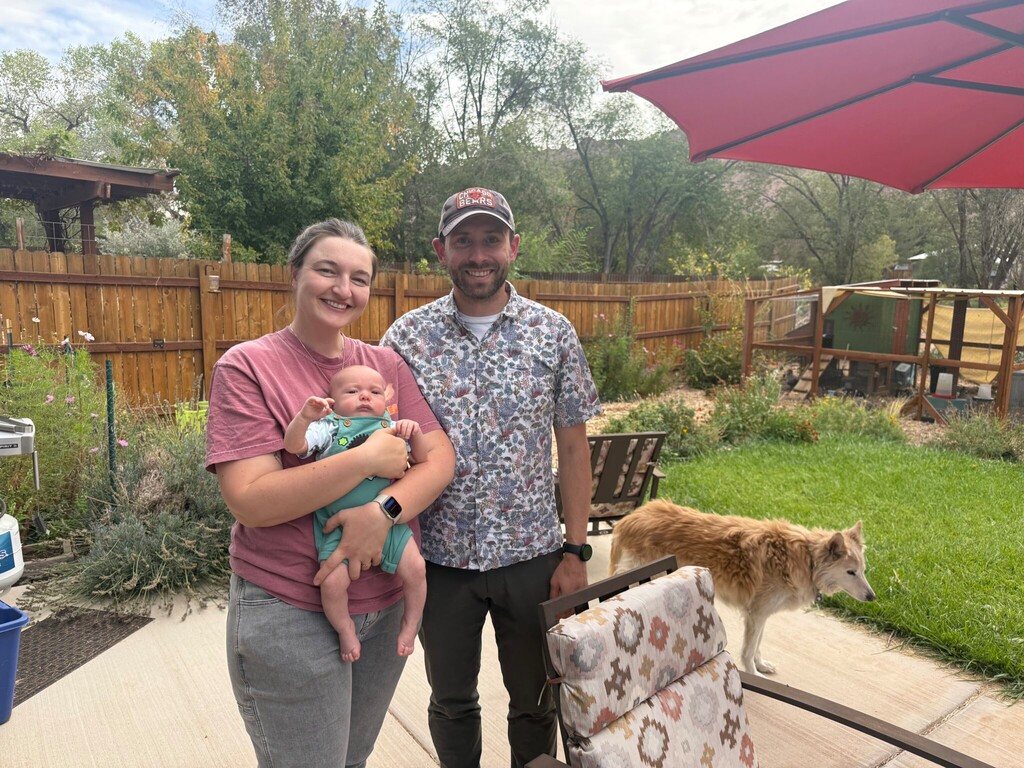
Kya Marienfeld and Moab City Councilor Luke Wojciechowski had just welcomed their son, Arthur, at Moab Regional Hospital after what Kya described as a smooth, joyful birth. But less than a day later, she noticed something wasn’t right — leading her and Arthur rushing to another hospital less than 24 hours later.
“We were hanging out in the hospital room, and he was just like making weird noises when he was on his back, almost sort of like gagging [and] choking,” Marienfeld said.
When Arthur was hooked up to an oxygen monitor, doctors noticed his levels were low, and a nurse, seeing his small jaw, began researching possible causes.
By morning, doctors flew Marienfeld and Arthur to Timpanogos Regional Hospital in Orem, where specialists diagnosed the newborn with Pierre Robin Sequence (PRS) – a rare condition that can make it difficult for babies to breathe and eat.
“I ended up running back home, just kind of frantically running around the house, grabbing whatever I could — a bunch of stuff that we didn’t need — and then I just drove up,” Wojciechowski said.
Over the three hour drive, Wojciechowski listened to all the podcasts he could about PRS,which can be genetic or random, affecting roughly 1 in every 8,500 to 14,000 newborns.
“I think the first three days felt like 30 days, as we kind of just started wrapping our heads around what was happening, really coming to terms [with] this is real and we need to move forward,” Wojciechowski said.
Doctors monitored Arthur closely while helping the new parents learn how to care for him — how to feed him, position him safely and keep him strong enough for surgery.
Wojciechowski quickly turned to the local community for help. A friend connected them with a couple in Orem who offered their condo, car and space for their dogs.
The diagnosis launched the couple into an unexpected 50-day stretch in a neonatal intensive care unit, learning to care for their son and finding strength in one another — an experience that would change everything, including Wojciechowski’s outlook on family, community and public service.
50 days in the hospital
For the next 50 days, Wojciechowski said, life in the neonatal intensive care unit felt like “an alternate reality.” The couple rarely left the small, windowless room where Arthur was kept.
“Combined between Kya and myself, we probably spent a total of three hours outside of the NICU walls,” Wojciechowski said. “We were separated from our community, our family, our friends. This start for our family that we had dreamt of, and really worked towards curating at home, was taken away from us.”
Both said their workplaces were supportive. Marienfeld, an attorney with the Southern Utah Wilderness Alliance, said her coworkers sent “an absurd amount” of DoorDash credits — their main source of meals. Because neither parent wanted to leave Arthur alone, they ate in shifts.
“Luke and I didn’t eat a meal together for probably the whole 50 days,” Marienfeld said. “Towards the end … we got to stay in a room as a family together for the last week and a half or so. That was the first time where one of us wasn’t eating a cold meal,” Wojciechowski added.
Despite the isolation, Wojciechowski said they knew they were lucky. Unlike other NICU parents who had to return home to jobs or other children, they could stay by Arthur’s side.
Finding light in stillness
Arthur’s recovery would take about a year, beginning with mandibular distraction surgery — a procedure that gradually lengthens the jaw with two small devices placed behind the ears to open his airway.
“We called [them] ‘his little antenna,’” Wojciechowski said. “When he would eat, they would wiggle because they were under his ears. They were cute.”
Wojciechowski said they had to say goodbye to “a lot of cute things” — Arthur’s tiny jaw and the little noises that came with it. At first the antennas were annoying, but they grew to love them, joking that Arthur was their “cyborg baby.”
In the midst of trying to find light and joy in difficult times, they both felt they were stuck in a pattern — like Groundhog Day.
One morning, when they were feeling especially drained, a text from his stepdad broke through the haze. It was written as if from Arthur:
“Dear Dad, this is Arthur. [I] was hoping to go outdoors for a while with you and mom,” the message read “Would like to see some trees, birds and things, you know, nature stuff. Thank you.”
Wojciechowski wanted to say “you [expletive], like he’s not allowed outside the NICU.” But later that morning, a child life specialist surprised them with news: Arthur could finally go outdoors.
“I kind of just lost it there, because it’s just like what the hell? I quickly texted him ‘I don’t know what you did, but I think you spoke this into existence,’” Wojciechowski said.
As they felt a breeze, Wojciechowski realized at 28 days old, it was Arthur’s first time outdoors, feeling the sun and fresh air.
The family began taking short walks, unhooked from monitors, reminding them that there was life outside of the hospital walls.
“It kind of reignited that hope and reminder that there is an end to this,” Wojciechowski said. “Even though it was indeterminate and indefinite at that time, there is an end.”
Life after surgery
Soon after, doctors prepared Arthur for surgery. Family members visited to say goodbye to “his tiny jaw,” joking they were part of a “small, select club” who got to see it. Wojciechowski and Marienfeld walked him to the operating room before handing him over to the team — and began the long wait for news.
The surgery was a success, though not without complications. Doctors had to intubate Arthur when his oxygen levels suddenly dropped, and the tube irritated one lung, causing fluid to build up.
“That is something that is just forever going to be burned into my brain,” Wojciechowski said, as he started to tear up. “You have this kid who’s 29 days old when he went in for surgery and there’s just this confusion and fear. You could see him trying to cry, but because he’s intubated, there’s no noise coming out. At one point we just locked eyes and it was just this terror and confusion.”
Wojciechowski felt Arthur was screaming for help in his eyes, and he felt the most helpless he’s ever felt in his life. “It broke me,” he said.
All Marienfeld and Wojciechowski could do was to just be there with Arthur.
That night was the hardest as Arthur’s lungs crackled with fluid and he struggled to cough, Wojciechowski said. But within 12 hours the tube was removed, and by the next day Arthur was breathing and feeding on his own.
“The strongest pain med that he had was Tylenol,” Wojciechowski said. “They literally severed his jaw, drilled a bunch of stuff [into it] … [and] he handled it so much better than Kya and I did.”
Arthur recovered faster than expected. A brief infection scare required antibiotics, which disrupted his eating and raised the possibility of another feeding-tube surgery.
“It would be the second time before he’s two months old that he would go under general anesthesia,” Wojciechowski said. “But we felt like we were at the end of that marathon and we were really missing home in our community and our friends and our ability to allow him to flourish more in terms of a developmental perspective. We were really stuck in these sterile walls, constantly hooking up to monitors.”
After long talks, they decided to hold off on the procedure.
“I don’t know if he heard us or whatever, but after that day, he started kicking ass again,” Wojciechowski said.
(Courtesy photo) The family’s graduation photo when Arthur was finally able to go home.
Going home
The departing family was met with a small graduation for Arthur. There were tears shared between the family, nurses and doctors.
“It was a really bittersweet moment in a lot of ways,” Wojciechowski said. “We were so ready to get home, but there is this very real recognition that outside of Kya and myself, the nursing and the medical staff were the people that knew him better than literally anybody else on Earth.”
Back home, Marienfeld and Wojciechowski faced a few setbacks — another round of antibiotics after Arthur’s cheeks swelled, and renewed concerns about his nutrition and hydration that again raised the possibility of a feeding tube.
Arthur has since been making his debuts around town, and the couple said they’ve been grateful by all the support from the Moab community.
“Being on the receiving end, it’s really impressive. Moab has no business being as wonderful as it is. In ways it doesn’t make sense,” Marienfeld said.
Marienfeld said it was a blessing in disguise that they didn’t know about Arthur’s condition before his birth.
“We got to have a really wonderful pregnancy and a really wonderful birth here in our home with people that know us,” Marienfeld said. “Not in some sterile room surrounded by people in emergency mode up in Salt Lake City.”
The family still faces a year-long recovery and several more trips to Orem for Arthur’s follow-up procedures before this chapter closes.
This story was first published by The Times-Independent.
Note to readers • Lizzie Ramirez is a Report for America corps member covering local government and tourism in Grand County for The Times-Independent. Your donation to match our RFA grant helps keep her writing stories. Please consider making a tax-deductible gift of any amount today by clicking here.
Donate to the newsroom now. The Salt Lake Tribune, Inc. is a 501(c)(3) public charity and contributions are tax deductible