 Sean P. Means
When Ben Trentelman goes shopping at his neighborhood supermarket, there’s something new in the routine: His 8-year-old daughter, Alice, is running the show.
“I put her in charge of the scanner,” said Trentelman, who lives in Salt Lake City’s Rose Park neighborhood. “She’s getting a really solid idea of the true cost of the food at our house. … We’ve talked about those things, [but] we were presented with this really awesome tool that helped her grasp that.”
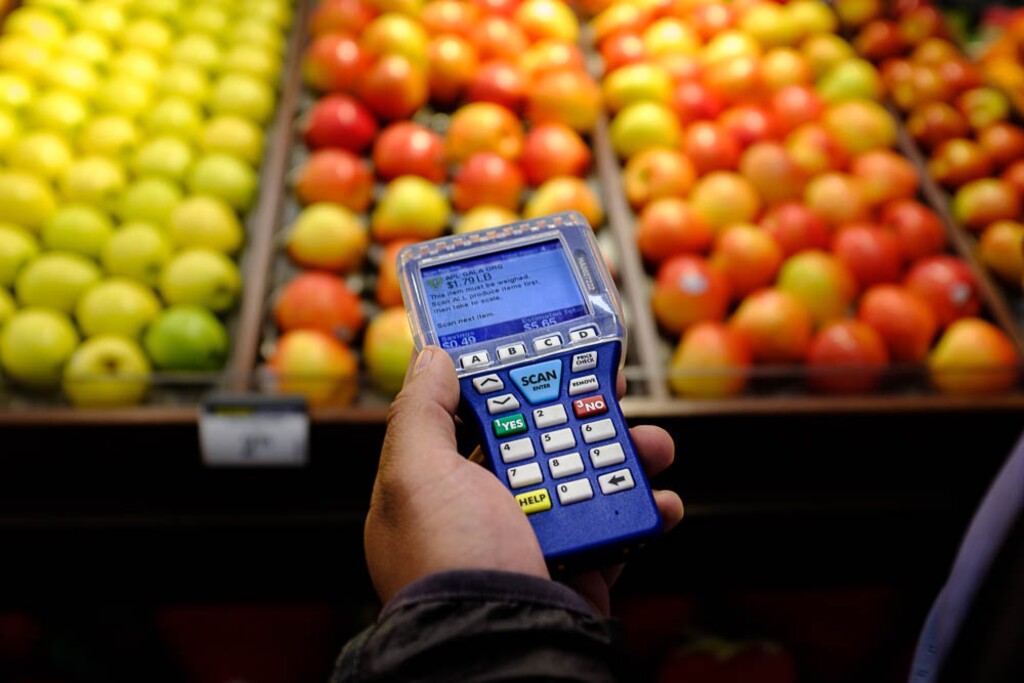
That tool is a handheld grocery scanner, now in use at four Smith’s Food and Drug stores in the Salt Lake Valley — including the Rose Park location.
“It’s pretty convenient and straightforward,” Trentelman said of the scanning system, called Scan, Bag, Go, and being rolled out slowly nationwide by Smith’s parent company, Kroger.
“One thing retailers are really, really good at is putting their ear to the ground to hear what their customers are saying,” said David Davis, president of the Utah Food Industry Association. Kroger’s new scanner system, he said, “gives the consumer more and more control on the whole shopping experience.”
Smith’s new program also is in place in its Avenues store in Salt Lake City, and one store each in Ogden and Orem. Next up are locations in West Jordan and Syracuse in May. By the end of the year, 32 Smith’s locations in seven states will offer the handheld scanners, said Adrian Ortega, who is overseeing the program’s rollout for Smith’s.
It’s a trend being seen in other stores. Associated Food Stores has an app, Skip Checkout, that lets shoppers scan barcodes with the camera on their smartphones. The system is being deployed at several Utah stores, including Maceys, Davis said. (Smith’s has its own app for shoppers who want to use their own smartphone instead of the handheld units.)
Aubriana Martindale, corporate affairs manager for Kroger’s Smith’s division, called the handheld scanners and smartphone app ways to give customers “a personalized shopping experience. … They want different options at checkout. In turn, we gain their loyalty by serving those needs.”
Some customers in Rose Park say they like the new scanners.
“For me, it’s worth it because I’m bagging it myself,” said Emily Fischio, a stay-at-home mom in Rose Park. “Before, I’d get really upset. They packed in a little watermelon with my yogurt, and I’ve had a yogurt smushed.”
Trentelman, operations director of the Utah Afterschool Network, said he’s “able to move through the store more quickly.”
There have been concerns in Rose Park, which Trentelman describes as “a blue-collar community,” about the future of the store’s employees. People posting on the Rose Park Community Facebook page are worried the new scanners, and the added self-checkout kiosks, will mean cashiers will lose their jobs.
In a letter to the editor published in March in The Salt Lake Tribune, Salt Lake City resident Brandi Chase lamented the technological change. “By steadily replacing human interaction with AI interfaces, we render more and more human beings irrelevant,” Chase wrote.
The notion that the new technology will drive out workers is a “misperception,” said Martindale, who pointed out a “now hiring” poster on display at checkout.
Another tech-driven industry trend, online shopping — now being offered at Smith’s, Harmons, Whole Foods, Walmart and other outlets — is creating a need for more employees, she noted.
In the past, Martindale said, a rush of customers at the checkout lines meant pulling managers from other departments, such as produce or the bakery, to work as cashiers. “Now we’re allowing them to focus on their prime roles and responsibilities, without calling on them as relief help,” she said.
Also, Martindale noted, customers who prefer interaction with a human cashier can still have that, if they’re willing to stand in line.
Another concern is shoplifting, either deliberate or inadvertent. Ortega said attendants at checkout won’t check bags — the way employees do at, say, Costco — but will monitor customers’ purchases unobtrusively, a task made easier by the clear plastic bags the store provides.
“We trust our customers,” Ortega added. “I would say 99.9 percent of our customers are completely honest.”
Smith’s is offering incentives to entice shoppers to try the handheld scanners. The chain is promising to station employees at the self-checkout kiosks and the produce department to help first-time users. And shoppers in the store’s loyalty program who spend at least $35 will get $5 off their purchase the first three times they use the scanners.
Smith’s is among the first divisions among Kroger’s stores in 35 states to test the Scan, Bag, Go system. “Our customers are pretty honest with their feedback here with the Smith’s division,” Martindale said. “We’re usually one of the first divisions to pilot services.”
So far, Ortega said, feedback has been positive.
“They’re actually associating the word ‘fun’ with shopping again,” he said.
Sean P. Means has been reporting and editing for The Salt Lake Tribune since 1991 — including 25 years as movie critic. Since 2018, he has reported on arts and culture reporter, and breaking news — and was part of The Tribune’s COVID-19 reporting team. He reviews movies for MovieCricket.net and X96’s “Radio From Hell” program.