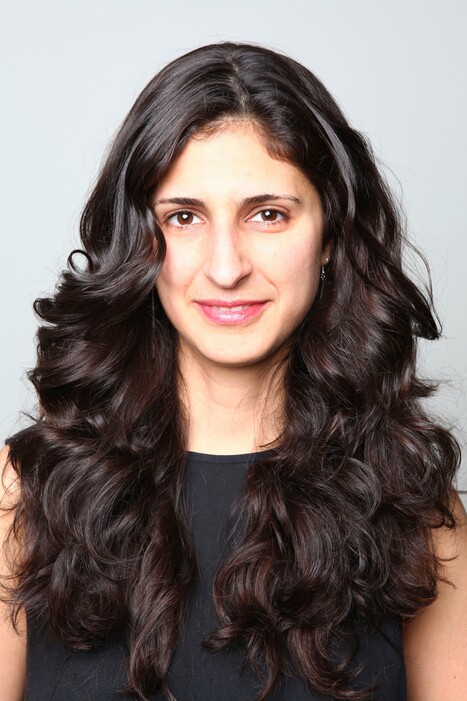
Eyes are what led Nina Tandon to bones.
The researcher's brother and two sisters are colorblind, and her family has a genetic history of retinitis pigmentosa, a disease that affects the tissue of the inner eye.
Growing up, said Tandon, "every person in my family saw the world differently than I did. It's a visceral reminder that our genetics have a real effect on our experiences in life."
It also is one of the things that led her into the science field, ultimately becoming co-founder and chief executive of EpiBone, a New York-based company that grows bones from adult stem cell tissue for skeletal reconstruction.
Tandon will give two lectures on the company's groundbreaking research Wednesday and Thursday. Her presentation kicks off the Natural History Museum of Utah's 2015 "Envisioning the Future" lecture series that examines revolutionary, cutting-edge innovations in the areas of medical science, astrobiology and technology. (See box for full schedule.)
While EpiBone is a relatively young company, incorporated in 2013, the tissue research has been going on for several years.
"My colleagues who co-founded the company have been growing bones successfully for about four years, but we have never put them to use in people. We are hoping to do that within a year," she said. "Right now we are experimenting on pigs and other large animals and working toward human clinical trials."
Tandon earned her doctorate in 2009 and was a postdoctoral researcher in the Laboratory for Stem Cells and Tissue Engineering at Columbia University, where she worked closely with several researchers who ultimately became her EpiBone co-founders.
Her executive MBA, completed in parallel with her postdoctoral work, focused on health care and entrepreneurship. She is the co-author of "Super Cells: Building with Biology," a book that explores the new frontier of biotech, and is a TED Senior Fellow.
During a recent telephone interview, she answered questions about the real-life applications of the science and the role Utah played in her research.
There are so many bones, are you focusing on a particular part of the body?
Right now our research is concentrated on bones in the head and face, because everybody's face is different and shape really matters.
What are some examples where growing a new bone is necessary?
There are three categories where it might be used: trauma to the head (from an accident); and a sickness, like cancer, might affect the bones. A third category that most people don't think about are congenital defects, maybe a child with a severe cleft palate.
How has your company avoided stem cell research controversies?
We use adult stem cells. Samples are taken through liposuction, which is less invasive and has never been controversial (like embryonic stem cells). When trying to understand stem cells, it is important for us to understand biology. One thing I encourage people to think about is organ donation. One can no longer be alive, but the cells within that person are. Blood donation is similar.
Some of your early research was on artificial hearts and tissue. Have you ever done any work with doctors at the University of Utah, the home of the first artificial heart?
I haven't visited campus. But I do have an association with Utah. I attended the Keystone Symposia at Snowbird in 2007. The topic was tissue engineering and developmental biology. My job was to document the conference, so I was really deeply paying attention. It was a very good introduction and made me realize those fields should be spending more time together. The idea that biology is nature's playbook and that we can learn from nature came together for me in Utah. Also, all my family's genetic tests (for retinitis pigmentosa) were sent to an academic lab in Utah. I'd really like to visit while I'm there.
What do you hope people will learn by coming to your Utah lectures?
What I really hope people get excited about is the technology that is living within themselves every day. The miraculousness of daily life. Our bodies are such exquisite biological machines — the idea that the body is its own ecosystem and renewable resource.
kathys@sltrib.com