 Palak Jayswal
Sixty or so years ago, a Utah band was about to make it big.
Multiple record companies were trying to recruit the folk-turned-rock band The Grimm. The group’s tunes were filling local radio airwaves.
And then, it all came to a sudden stop. The Vietnam War came calling. The band, first formed in 1961, was torn apart by the mandatory draft and other obligations.
“It was like a gut punch. It absolutely stopped all the momentum,” Greg Ericksen, lead vocalist and guitarist, said. “It took away our youth.”
But six decades later, Ericksen is back on the stage, playing the songs that might have been lost forever if not for a fateful discovery in his father’s attic.
The storybook tale of The Grimm
The band formed in a Bountiful junior high acapella class. The teacher said the school needed performers for an assembly, and Ericksen, who had been playing guitar for a few years, saw it as a chance to get some practice.
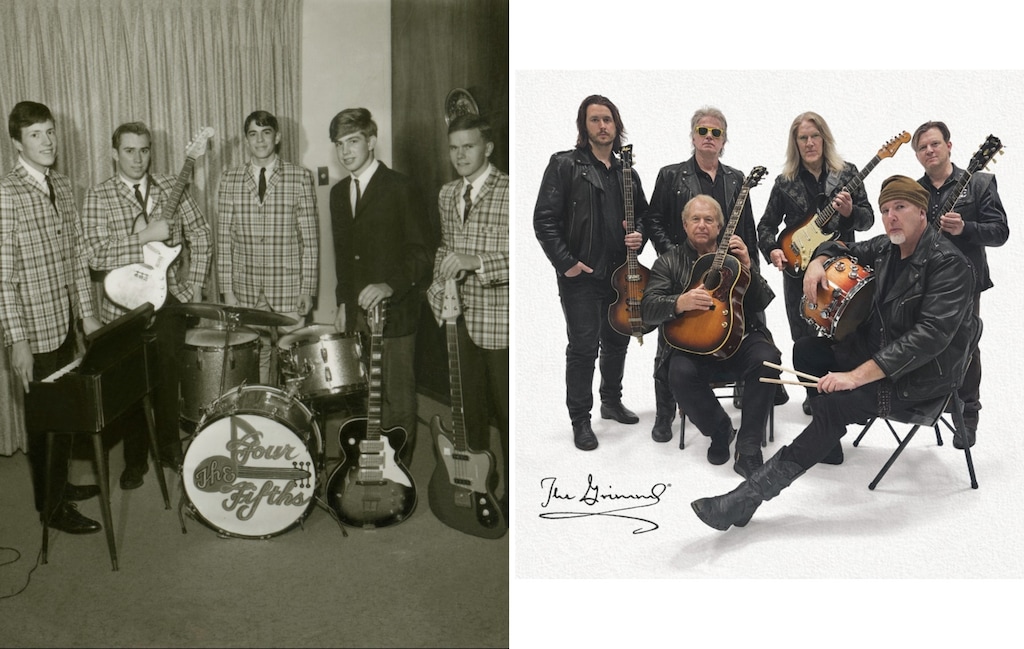
So, he and the other students in the class started learning a few folk songs from Bob Dylan and Peter, Paul and Mary. Their group ended up being called The Four Fifths because they had four boys and one girl, and they performed one song at the assembly. It was enough to kickstart their careers.
(The Grimm) Utah band The Four Fifths pictured during their heyday in 1960s.
“Everybody was yelling and clapping, and we just were hooked,” Ericksen recalls. “So we decided to start performing around at shopping centers, a couple of local television shows.”
They appeared on the Eugene Jelesnik talent show and Ted Mack and the Original Amateur Hour. They were reported on in The Salt Lake Tribune and Deseret News.
“Then in 1963, December, The Beatles — the British Invasion — hit America and everybody started converting to rock and roll,” Ericksen said.
So, his band followed suit and became The Grimm.
Eventually, the band won a battle of the bands and scored a recording contract with Warner Bros.
“Then the Vietnam War came along, and they told every young man that was born between [1944 to 1950] that they were going to be drafted and there was no way he could get out of it,” Ericksen said.
(The Grimm) Utah band The Four Fifths pictured during their heyday in 1960s.
One member left for the Air Force. Others left for missions. Some stayed in school because they were draft exempt — until the 1969 draft lottery came around.
“The long and the short of it is, by then, the band had pretty well disbanded,” Ericksen said.
Ericksen would go on to study at the University of Utah, then attend law school in California and become a lawyer. In 1999, he was driving to a deposition in Wyoming when his “gift” struck.
“I hear music in my mind similar to The Beatles. If you know the story about the Beatles, they couldn’t read music, but they could write music from what they heard,” Ericksen said.
On that drive home, he heard “the most marvelous song.” Ericksen recorded it, and in 2002 he presented it to the Winter Olympic officials.
They chose “Light Up the Land” as the inspirational song of the Olympics.
That experience got Ericksen to pick up writing music again, and would lead into a few curious experiences over the next decade or so.
The Lost Tapes
Around 2013, Eriksen got a call at his law office from a fan who had found one of the band’s singles on vinyl from the ’60s, but lost it in a divorce settlement with his wife. He wanted another one.
Ericksen was shocked, but he helped get the track recorded on CD for the fan. Later on, when he went into Randy’s Records in Salt Lake City with one of the band’s old albums. The clerk recognized him and said they had found one of their singles. The clerk wanted another one, too.
“Again, it was a connection between people that were saying ‘we felt something with your music,’” Ericksen said.
Then, a former band member found someone selling their old memorabilia on eBay. It was the final catalyst Ericksen needed to get the band back together, at least, for dinner.
When the band was younger, Ericksen’s dad served as their manager. In 2014, when his father passed on, Ericksen discovered a box of tapes in the attic. There were over 30 recorded songs that never got released.
(The Grimm) Lost tapes from Utah band The Four Fifths, now known as the Grimm.
Ericksen mentioned the discovery at the dinner, and the band members decided they would try to piece together what they could from the tapes to preserve history — mementos for their families.
It became the first installment of “Lost Tracks.” A second followed. All five of the band’s albums from the past few years feature songs from the tapes.
At Sun Records in Hollywood, they re-recorded about 15 of the old songs using their original instruments.
In 2021, The Grimm reformed. The group started with five members. Now there are six — Tommy Hopkins, Levi Wunderlich, Andrew Doolittle, Brett Raymond and Joel Stevenett — and Ericksen, who is the only remaining original member.
They have since released five albums. Their most recent release is called “Grimm Fairy Tales.”
They blend their old, rediscovered tracks with new material. Revisiting the older songs has been a fun experience for Ericksen.
“You can remember what caused you to write some of the music that you wrote,” he said. “Every song is spurred by some kind of emotion.”
(The Grimm) Utah band The Grimm, previously known as The Four Fifths, making a comeback.
“Somewhere in the Night,” a catchy song, for example, is about a missed connection at a dance Ericksen attended as a young man. He and a girl kept making eye contact, but by the time he decided to go say hello, she was gone, and he went home and wrote the track.
“Hit Me Now,” a more recent track, is about navigating conflicts with a significant other, while “Ride Pony Ride,” a song from the lost tapes, is about making the right choices.
Ericksen is happy to be creating music again, and reclaiming some of that lost youth from decades prior. Releasing their old music is also an ode to the culture of the 60s and 70s that raised him.
“We were jumping under desks because we thought that Russia was going to drop a nuclear bomb on us. We were seeing political leaders shot and killed, people beaten up because of their race,” Ericksen said. “All that time gave people a deeper sense of creativity to express those emotions.”