As two Utah LGBTQ+ nonprofits — SLCPride and the Utah Pride Center — gear up for their pride month festivities, Utahns may notice that both events are scaled back this year.
Bonnie O’Brien, the festival director of SLCPride, a grassroots Pride festival, said that even though the group posted a profit in its inaugural year, their goal remains the same, “to break even.”
Accomplishing that goal in 2025, though, is becoming a bit more tricky.
The Trump administration has issued executive orders pulling back on diversity, equity and inclusion efforts, and corporations and businesses have reacted accordingly. In the case of SLCPride and the Utah Pride Festival, it means less sponsorship money and tighter budgets.
“From a state and a national level, we’re getting laws and restrictions that are impacting how Pride has traditionally happened,” Chad Call, executive director of the Utah Pride Center, said. “Major companies have stripped away a lot of funding that has traditionally made its way to the Pride Center.”
In 2024, SLCPride had a slew of inaugural donors. This year, according to data shared with The Salt Lake Tribune, SLCPride will have nine returning sponsors from 2024.
According to O’Brien, five organizations who sponsored last year’s event declined to do so this year after pulling back on DEI initiatives, including large corporations like Walmart, Lowe’s and Citibank, as well as the University of Utah and Utah Valley University, who pulled back on DEI efforts after an anti-DEI bill was signed into state law in 2024, but didn’t go into effect until July.
“These are people that donated to Utah Pride and to SLCPride last year, and you won’t see them in the parade, and you won’t see them in our festival in any way, shape or form,” O’Brien said. “There is no money and … DEI is why.”
(Bethany Baker | The Salt Lake Tribune) Bonnie O'Brien, the festival director for SLC Pride, speaks at a planning meeting for the festival in Salt Lake City on Tuesday, May 7, 2024.
O’Brien said the country’s uncertain economic outlook has also played a role in keeping some local businesses from donating to this year’s festival.
“Small businesses and large businesses that are affected by tariffs are nervous about donating even the smallest amount,” she explains.
Thirty-four small businesses who donated in 2024 declined to donate in 2025, but 27 individual donors who gave more than $250 in 2024 will do so again in 2025, according to the data.
(Bethany Baker | The Salt Lake Tribune) A sticker for SLC Pride at a planning meeting in Salt Lake City on Tuesday, May 7, 2024.
O’Brien said SLCPride’s executive committee realized in mid-February that they were not going to get the same amount of sponsorship money they got in the previous year and decided they needed to try to cut their operating budget in half. In 2024, expenses for the festival came in at nearly $144,000.
The committee turned to hosting smaller events and offering donation incentives throughout the year, such as a discount program called Queer Card that offers discounts at various small businesses around Utah.
The festival is also already scaled back, compared to the larger and longer-running Utah Pride. O’Brien said the executive committee members have their personal credit cards on file for expenses in case the organization can’t break even on the $30,000 it will take to put on this year’s festival.
UPC, which hosts the Utah Pride Festival, is also seeing a lack of sponsorship money this year, according to Call, the organizations director.
Call said that most of their sponsors do not indicate why they chose not to sponsor again, and that they “can only assume that a lot of that is impacted from pressures on a national level.”
In 2024, Utah Pride had 64 sponsors. This year they have 59.
Accordingto information provided by the center, 20 sponsors did not return this year — including The University of Utah, Utah Transit Authority, UFirst Credit Union, Deer Valley Resort, JetPride, Chevron, Amazon and Walmart.
(Chris Samuels | The Salt Lake Tribune) New executive director of the Utah Pride Center Chad Call speaks to media at the center’s offices in Salt Lake City, Wednesday, May 1, 2024.
In 2022 and 2023, Call said the festival was built around a $750,000 sponsorship model, a goal they met in both years.
But in 2024, they saw a decline in sponsorships, coming in at just under $500,000. Call attributes that decline to the late start the group got in selling sponsorships and the internal turmoil the center has gone through in the past few years. Still, they were able to generate a profit from the festival last year.
Call projects that the center will land somewhere near $375,000 in sponsorship money in 2025, despite trying harder to sell more sponsorships.
While sponsorships are taking a hit this year, other forces weigh heavily on the two organizations as they prepare for their festivals in June. The Trump Administration continues to issue orders that impact the LGBTQ+ community. Participation in the festival’s longstanding parade has also fluctuated.
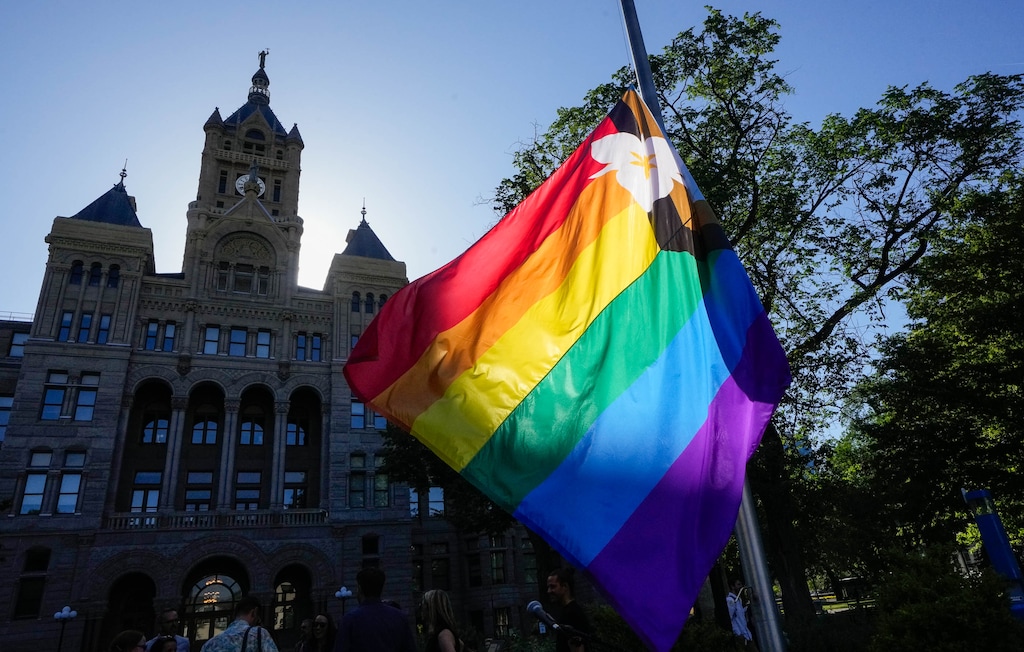
Another local impact to Pride, Call said, was Utah’s decision to ban Pride flags from public schools and on government property in the state. State lawmakers passed HB77 earlier this year, and it became law without Utah Gov. Spencer Cox’s signature.
Call said that seeing who has continued to donate amid the political climate has shown him “who our real allies are.”
“I look at the queer community as one of the more resilient communities out there … our community does know how to rally together and has supported one another through difficult times like this before,” Call said.
(Francisco Kjolseth | The Salt Lake Tribune) Friends Kelly Anne Ward, left, and September McKinnon dance to the music at the Utah Capitol for the Rainbow March and Rally to City Hall in downtown Salt Lake City for Pride Week on Saturday, June 1, 2024.