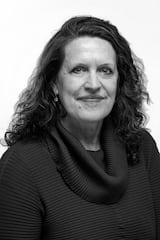
(Al Hartmann | The Salt Lake Tribune)
Director Jenny Mackenzie, left, Dr. Kristen Ries, and physician's assistant Maggie Snyder attend the first Sundance screening of documentary "Quiet Heroes," celebrating the medical team (Ries and Snyder) that were the first and, for a while, the only medical professionals to treat HIV/AIDS patients in Utah.
(Al Hartmann | The Salt Lake Tribune)
Dr. Kristen Ries, left, and physician's assistant Maggie Snyder attend the first Sundance screening of documentary "Quiet Heroes," celebrating the medical team that was the first (and, for a while, only) to treat HIV/AIDS patients in Utah.
(Al Hartmann | The Salt Lake Tribune)
Director Jenny Mackenzie attends the 2018 Sundance premiere Jan. 21, of documentary "Quiet Heroes," celebrating Dr. Kristen Ries and physician's assistant Maggie Snyder, who were the first and, for a while, the only medical professionals to treat HIV/AIDS patients in Utah.
(Al Hartmann | The Salt Lake Tribune)
Executive Producer/Co-Director Jared Ruga attends the first Sundance screening of documentary "Quiet Heroes," celebrating Dr. Kristen Ries and physician's assistant Maggie Snyder who were the first and, for a while, the only medical professionals to treat HIV/AIDS patients in Utah.
(Al Hartmann | The Salt Lake Tribune)
Co-Director Amanda Stoddard attends the first Sundance screening of documentary "Quiet Heroes," celebrating Dr. Kristen Ries and physician's assistant Maggie Snyder who were the first and, for a while, the only medical professionals to treat HIV/AIDS patients in Utah.
(Al Hartmann | The Salt Lake Tribune)
Co-directors Jared Ruga and Amanda Stoddard with Director Jenny Mackenzie attend the first Sundance screening of documentary "Quiet Heroes," celebrating Dr. Kristen Ries and physician's assistant Maggie Snyder, who were the first and, for a while, the only medical professionals to treat HIV/AIDS patients in Utah.
(Al Hartmann | The Salt Lake Tribune)
Rose Wagner Performing Arts Center in Salt Lake City hosts the first Sundance screening of "Quiet Heroes," celebrating Dr. Kristen Ries and physician's assistant Maggie Snyder that were the first and, for a while, the only medical professionals to treat HIV/AIDS patients in Utah.
(Al Hartmann | The Salt Lake Tribune)
Crew attends the first Sundance screening of documentary "Quiet Heroes," celebrating Dr. Kristen Ries and physician's assistant Maggie Snyder who were the first and, for a while, the only medical professionals to treat HIV/AIDS patients in Utah.
So many sick and dying patients in the waiting room of Kristen Ries’ busy practice at Holy Cross Hospital. So many sick people to attend to that there just wasn’t enough time to attend funerals.
On weekends, during the height of Utah’s AIDS epidemic in the 1980s and ’90s, Ries and physician assistant Maggie Snyder made house calls to examine patients who were too ill to travel. In their spare time, they visited schools and businesses, feeling driven by an obligation to educate the community about the virus.
So many patients too ill to work, most without insurance. So many sick people ostracized by families or partners due to homosexuality or drug use.
“Atrocious waiting times,” says Snyder, but their patients knew in advance about the wait. “They knew that once they got in, we would help them and deal with their concerns.”
The work was hard, but the science and medical parts were exciting, says Ries, an infectious-disease specialist. “There was something new to learn every day.
“We want people to know what really happened back then, and how inhumane people were by just throwing their fellow mankind away,” says Ries, adding that the fear of infectious diseases, such as SARS or Ebola, reaches back into history. “I’ve been very concerned right now with the current milieu because I feel that tension again.”
The documentary draws upon hours of interviews with Ries and Snyder, now retired at 77 and 64, as well as the records the couple donated to the University of Utah’s Marriott Library in 2015. “They opened their arms and took care of these people who were not only sick and dying but emotionally scarred in such deep ways because their families were rejecting them,” Mackenzie says.
Get Utah Eats newsletter. Every Wednesday, we bring you what you need to know about Utah’s bar and restaurant scene.
“Quiet Heroes” includes interviews with Utah Sen. Jim Dabakis, Ballet West’s Peter Christie, an AIDS survivor, and Ben Barr, the former head of the Utah AIDS Foundation. Other voices include Kim Smith, a Mormon mother who lives with HIV, and whose family was featured in an influential PBS documentary in 2002; and the family of late activist Cindy Stoddard Kidd, who successfully sued the state to allow people with AIDS to marry.
“A lot of quiet heroes in there,” says filmmaker Stoddard, while Ries and Snyder are the focus. “They didn’t actually believe they did anything exceptional,” Ruga says. “They believe they just did their jobs.”
One of the film’s most remarkable moments comes in a joint interview with Ries and Snyder, who — true to their low-key, practical natures — got married in October 2013 in San Francisco during a lunch break at a medical conference. On camera, they acknowledge that they passed forward expensive drugs belonging to dead patients, which was illegal.
They were aware of medical colleagues across the nation doing the same thing. But they were always discreet and careful to inform patients of the risks. “I believe in being authentic and telling the truth, like I remember it,” Ries says. “It was a different time, and, being me, I would do it again, because it’s the right thing to do.”
( Courtesy of Sundance Institute | photo by Torben Bernhard) Kristen Ries and Maggie Snyder appear in "Quiet Heroes" by Jenny Mackenzie, Jared Ruga and Amanda Stoddard, an official selection of the Documentary Premieres program at the 2018 Sundance Film Festival.
The idea for the documentary was launched when Ruga was searching through Ries and Snyder’s HIV/AIDS archive for a graduate school assignment. The 29-year-old thought a film about Utah’s AIDS years could serve as a wake-up call to younger activists and storytellers, who might be “generationally segregated.”
The film explores the reaction to the AIDS crisis from Catholic nuns who worked as nurses at Holy Cross, as well as the institutional response by The Church of Jesus Christ of Latter-day Saints. “That’s a conversation we’re still having in society, right, which is: What is the role of religion?” Ruga says.
“We stuck to the facts,” says Stoddard, a Salt Lake City native who was raised in the LDS Church. “We weren’t trying to call the church out, but we wanted to represent the environment at the time.”
The film ends with a scene of survivors who gathered at City Hall in March 2016, when Salt Lake City Mayor Jackie Biskupski proclaimed Kristen Ries and Maggie Snyder Day.
“This is a story relevant today because it’s about hope and resilience and doing the right thing in the middle of darkness,” Ruga says. “At a time when a community was vilified and exiled, this is a reminder that it just took two people to stand up.”
How to Sundance<br>When • Jan. 18-28<br>Where • Park City and venues in Salt Lake City and the Sundance resort in Provo Canyon<br>Passes and ticket packages • On sale at sundance.org/festivals<br>Individual tickets • $25 for the first half of the festival in Park City (Jan. 18-23), $20 for Salt Lake City screenings and for the second half in Park City (Jan. 24-28)<br>Information • sundance.org/festivals<br>”Quiet Heroes” • The film, part of the Documentary Premieres program, premieres Sunday at 6:30 p.m. at the Rose Wagner Performing Arts Center in Salt Lake City. Visit sundance,org for more screening times.
(Courtesy Sundance Film Festival) | Maggie Snyder and Dr. Kristen Ries tell the story of Utah's AIDS crises in the new documentary "Quiet Heroes."
(Trent Nelson | The Salt Lake Tribune) Amanda Stoddard, Jared Ruga, and Jenny MacKenzie, the filmmakers of “Quiet Heroes,” which will appear in the Sundance Film Festival. The film is about Dr Kristen Rees and Maggie Snyder, who were the only medical professionals who would treat Utah AIDS patients in the 1980s.
(Courtesy Sundance Institute) Amanda Stoddard is one of the producers of "Quiet Heroes," which will screen in the Documentary Premieres section of the 2018 Sundance film Festival.
(Trent Nelson | The Salt Lake Tribune) Amanda Stoddard, Jared Ruga, and Jenny MacKenzie, Utah filmmakers of, “Quiet Heroes,” which will appear in the Sundance Film Festival. The documentary is about Dr Kristen Rees and Maggie Snyder, who were the only medical professionals who would treat Utah AIDS patients in the 1980s.
(Courtesy Sundance Institute) Jared Ruga is one of the producers of "Quiet Heroes," which will screen in the Documentary Premieres section of the 2018 Sundance film Festival.
( Courtesy of Sundance Institute | photo by Torben Bernhard) Kristen Ries and Maggie Snyder appear in "Quiet Heroes" by Jenny Mackenzie, Jared Ruga and Amanda Stoddard, an official selection of the Documentary Premieres program at the 2018 Sundance Film Festival.
(Courtesy of Sundance Institute) Jenny Mackenzie, director of "Quiet Heroes," an official selection of the Documentary Premieres program at the 2018 Sundance Film Festival.
(Photo courtesy of the Sundance Film Festival) | Dr. Kristen Ries of the documentary "Quiet Heroes."
(Courtesy of Sundance Institute) Sister Linda Bellemore appears in "Quiet Heroes" by Jenny Mackenzie, Jared Ruga and Amanda Stoddard, an official selection of the Documentary Premieres program at the 2018 Sundance Film Festival.
(Courtesy of Sundance Institute | photo by Torben Bernhard) Kristen Ries, left, appears in "Quiet Heroes" by Jenny Mackenzie, Jared Ruga and Amanda Stoddard, an official selection of the Documentary Premieres program at the 2018 Sundance Film Festival.
(Courtesy of Sundance Institute | photo by Torben Bernhard) Maggie Snyder and Kristen Ries appear in "Quiet Heroes" by Jenny Mackenzie, Jared Ruga and Amanda Stoddard, an official selection of the Documentary Premieres program at the 2018 Sundance Film Festival.
1 / 11
Support free news for Utah
sltrib.com is now free to access — no subscription required. We made this decision because we believe access to trustworthy, independent news shouldn’t depend on what you can afford — especially as misinformation and AI-generated content continue to rise.
Free to read doesn’t mean free to produce. Our reporters show up every day to ask hard questions and hold powerful institutions to account. That work takes resources. As a nonprofit newsroom, we rely on support from people who believe it matters. Make a donation today to fund local news that serves Utah communities.
You can help us bring more local news to more communities today.
 Ellen Fagg Weist