



This is an archived article that was published on sltrib.com in 2012, and information in the article may be outdated. It is provided only for personal research purposes and may not be reprinted.
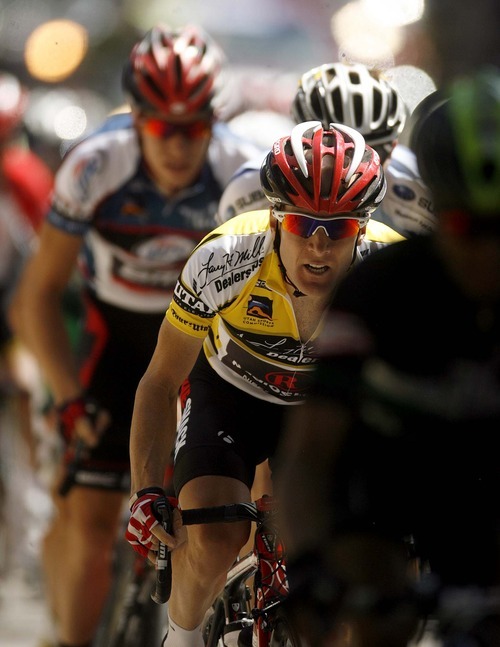
Two cyclists with Utah ties who rode with Lance Armstrong admitted in sworn statements released Wednesday that they took performance-enhancing drugs themselves and knew of the extensive doping cover-up by Armstrong, a seven-time Tour de France champion.
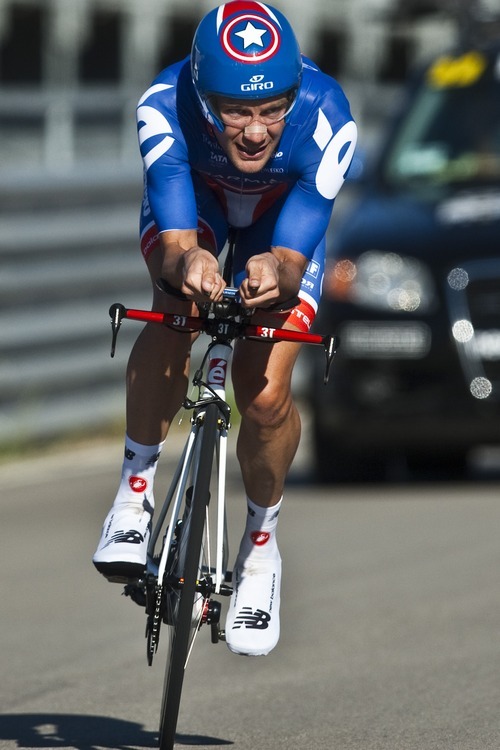
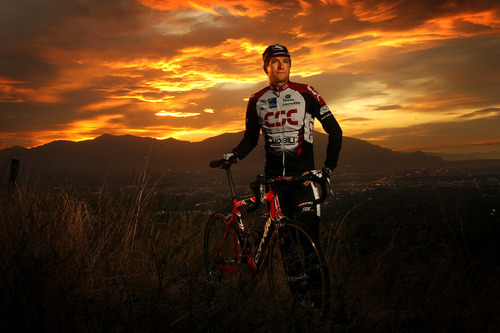
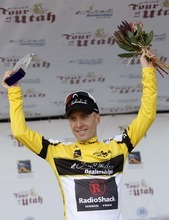
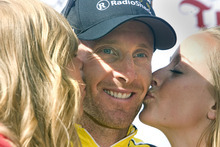
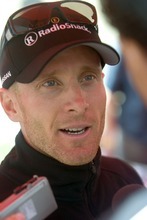
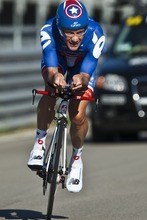
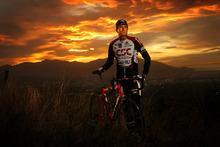
Salt Lake City native David Zabriskie and former Utahn Levi Leipheimer are among 26 people — including 11 ex-teammates — whose testimony against the world's most famous cyclist was revealed in a 202-page United States Anti-Doping Agency report.
Armstrong, who USADA banned from cycling and stripped of his Tour de France titles in August — although there is still a question of whether USADA or the International Cycling Union has the ultimate authority to take away his Tour titles — opted not to fight the sanctions, but called on the agency to name his accusers and present solid evidence against him.
Wednesday's report reveals that evidence in vivid detail, describing hotel rooms riders transformed into makeshift blood-transfusion centers and chronicling how Armstrong's ex-wife rolled cortisone pills into foil and handed them out to all the cyclists.
It is the most detailed, unflinching portrayal yet of Armstrong as a man who, day after day, week after week, year after year, spared no expense — financially, emotionally or physically — to win.
In his sworn testimony, Zabriskie, who raced with Armstrong on the U.S. Postal team from 2003-2004, said cycling was a "refuge" for him and helped him deal with his father's history of substance abuse. He noted the irony that he himself turned to drugs at the behest of team management in 2003.
"I never used drugs and never intended to," he said in his statement. "I questioned, I resisted, but in the end, I felt cornered and succumbed to the pressure."
Zabriskie said he stopped doping and was clean long before the Anti-Doping Commitment was issued for riders in 2007.
"I want to play my part in making it the sport I had always hoped it would be and know that it can be," his testimony said.
Zabriskie did not immediately return phone messages Wednesday.
Leipheimer, a Rowland Hall graduate who raced with Armstrong on several teams including U.S. Postal Service, detailed how he used the synthetic blood booster Erythropoietin (EPO) in the 1990s. He also said he used a version of testosterone called "Andriol" in 2005 and underwent blood transfusions in 2005, 2006 and 2007.
Leipheimer accepted responsibility in a statement Wednesday.
"I've been racing clean for more than five years in a changed and much cleaner sport," he said. "I hope that my admission will help to make these changes permanent."
Max Testa, Leipheimer's coach, said he and the cyclist never talked about supplements.
"I worked with him as a coach, not a doctor," he said.
"From the perspective I saw I didn't see anything that made me think he was doing anything wrong," Testa said. "It's not his personality ... to take advantage of a situation."
USADA banned both Leipheimer and Zabriskie from cycling for six months and stripped them of some results.
"I hope he [Leipheimer] can put this behind him," Testa said. "He still has a couple good years ahead of him."
Leipheimer's and Zabriskie's admissions were just two of many incriminating testimonies that detailed the doping coverup. George Hincapie, Tyler Hamilton, Tom Danielson, Floyd Landis and Christian Vande Velde also testified, helping mount a case against Armstrong that produced financial payments, e-mails and lab results as evidence of the doping ring.
"The [U.S. Postal Service] Team doping conspiracy was professionally designed to groom and pressure athletes to use dangerous drugs, to evade detection, to ensure its secrecy and ultimately gain an unfair competitive advantage through superior doping practices," according to USADA.
Armstrong's attorney, Tim Herman, called the report "a one-sided hatchet job — a taxpayer funded tabloid piece rehashing old, disproved, unreliable allegations based largely on axe-grinders, serial perjurers, coerced testimony, sweetheart deals and threat-induced stories."
Aware of the criticism his agency has faced from Armstrong and his legion of followers, USADA chief executive Travis Tygart insisted his group handled this case under the same rules as any other. Armstrong was given the chance to take his case to arbitration and declined, he noted.
Utah's cycling community reacted to the USADA report with disappointment but not surprise.
Marty Jemison, a University of Utah graduate who rode on the U.S. Postal team from 1998 to 2000 and now runs cycling tours out of Park City, declined to comment.
Former cycling pro and Salt Lake City resident Burke Swindlehurst said he hoped this was the 'bottom," for cycling and that the sport can rebuild itself.
"I love the sport of cycling," he said. "It's become a cliche to say it, but it really is the most utterly demanding and beautiful sport in the world."
Ryan Littlefield, the owner of Contender Bicycles in Salt Lake City, expressed sympathy for the riders, believing the pressure to win was just too much for them to overcome.
"I know those guys and it's sad," he said. "It's easy to point a finger at those guys, but they went all-in. You get over there to Europe and you see everyone else doing it, you can't fault them for doing it."
Mike Hansen, the owner of Millcreek Bicycles, believes Wednesday's revelations will hurt pro cycling but not the sport in general.
"The entire pro market is driven by advertising people and big corporations are not going to want to be associated with that behavior," he said. "It's going to hurt pro cycling, but I still love to ride my bike. I don't need to take testosterone to do it."
The Associated Press contributed to this story. Utah ties to Lance Armstrong case
Wednesday's incriminating evidence against Lance Armstrong included testimony from two cyclists with Utah ties who also admitted to doping. They are:
David Zabriskie
A member of the U.S. Postal team from 2001-04, he said Postal team boss Johan Bruyneel introduced him to doping. He said he also took drugs while on the CSC team (2005-07).
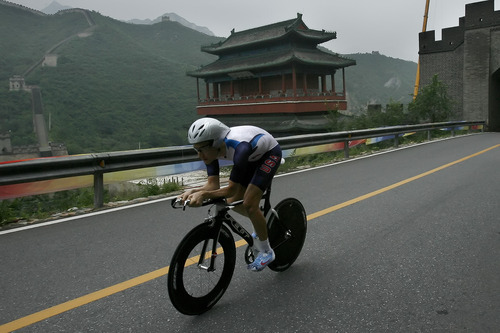
Zabriskie has been banned from cycling for six months and loses all results from May 12, 2003 until July 31, 2006. Among voided results are a first-place finish in the 2004 U.S. Elite National Time Trial Championship and his time trial in the opening stage of the 2005 Tour de France, which allowed him to wear the yellow jersey for three stages.
Levi Leipheimer
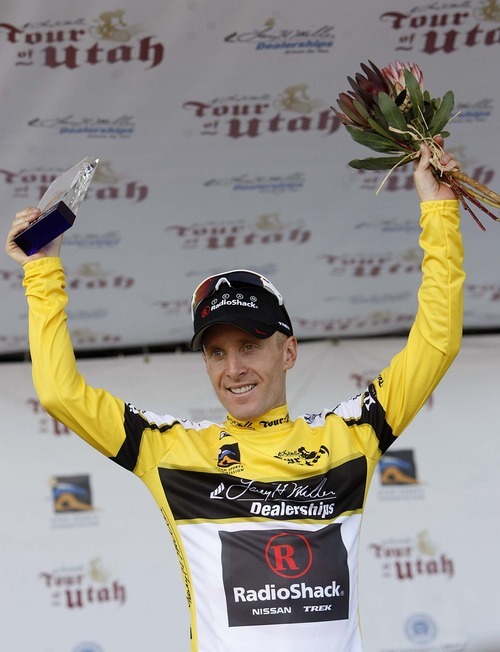
A member of the U.S. Postal team from 2000-01, Leipheimer testified he used the synthetic blood booster Erythropoietin (EPO) in the 1990s, used a version of testosterone called "Andriol" in 2005, and underwent blood transfusions in 2005, 2006 and 2007.
Like Zabriskie, Leipheimer has been banned from cycling for six months until March 1, 2013, and was stripped of all race results from June 1999 to July 2006 as well as results from July 2007. Among voided results are his eighth-place finish in the 2002 Tour de France, a ninth-place finish in the 2004 Tour de France and a first-place finish in the 2006 Dauphine Libere.