


This is an archived article that was published on sltrib.com in 2012, and information in the article may be outdated. It is provided only for personal research purposes and may not be reprinted.
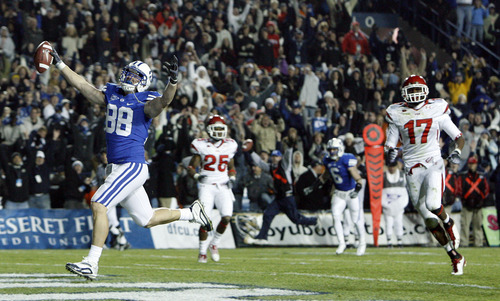
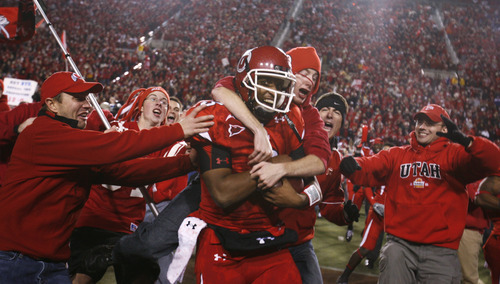
There was a time not so long ago when the Utah-BYU rivalry game was burning this place down. It didn't matter if the calendar said June or November, the rivalry was a hunk-a-hunk-a-burning hate. Or spate … which is an informal contraction for sports hate, which is different than hate hate. Sometimes, spate seemed an awful lot like hate, but that mostly was on the rivalry's edges.
Let's say it the way it is here: Ten percent of any group — be it Ute fans or Cougar fans — is one can short of a six-pack, whether that six-pack contains Coors or caffeine-free Coke.
But every so often, come game time, that insanity would spill over and, next thing, one of those beverages would get poured on a quarterback's family … and, then, in the post game, all hell would break loose, to the point where spate really was hate and bumper stickers were being printed up with the words: "Honk if Max Hall hates you, too."
That was then.
It's different now.
Conditions have conspired to turn down the spigot on one of the great football rivalries in America, even tainted as it sometimes was by dopes who used the football game between the state's two biggest schools, one state-owned and one church-owned, as an excuse to revolt against a religion or to swing self-righteousness like a hammer.
That was the occasional cost of doing strong business.
Business is not so strong, not anymore.
Utah's move to the Pac-12 and BYU's independence are having adverse effects on a rivalry game once at the core of sports here. Two universities located just 45 miles apart that had always been members of the same league suddenly were torn into different realms. The Utes were looking for roses, the Cougars for wider exposure. And each wanted more of what is now the lifeblood of college sports: money.
Then, supposedly on account of Pac-12 conflicts, the game was moved from every regular season's exclamation point at the end of November to a mere comma in the third week of September. It got worse when Utah athletic director Chris Hill decided earlier this year not to play BYU in 2014 and 2015, in part, because he didn't want to overschedule, which is a euphemism for not wanting to play more than one good team in the Utes' three annual nonconference slots. He preferred an easier route that included scheduling smaller schools — read: automatic wins — at home.
So, for two seasons, and maybe more in the future, a game that had been played for the better part of a century, a game that had in large measure anchored and symbolized sports in Utah, was headed into cold storage — to be thawed back when convenient for the Utes.
It's still a rivalry game, but collectively, a toll has been taken.
The importance of the game has been mitigated and as a result the rivalry is evolving.
"It certainly is still a rivalry," BYU coach Bronco Mendenhall said. "But there are different conferences now and the game's played earlier in the year. I still think the game matters, but there's a different feel to it."
Said Utah coach Kyle Whittingham: "We're still in the infancy of the transition. It's definitely changing, but everyone will have a better idea four or five years from now exactly what's going on."
One positive about that evolution, according to Mendenhall, is that the stupidity of some of the fans has been tamped down: "It just seems like it's more about actually playing the game now than all the stuff that leads up to it or [comes] after it. That's better."
Still, in an unscientific survey of former BYU and Utah players and fans from both schools this week, the consensus is that the rivalry game won't have the same force it once had, nor will it be as intense. A few believed it could become just as emotional as it once was, even with the Utes in one conference and BYU in none: "They still want to prove they're better than their neighbor," one fan said.
But Utah tight end Dallin Rogers tossed water on that, saying: "We treat everybody the same, whether it's BYU or Northern Colorado."
Kalani Sitake, who like Whittingham played at BYU and now coaches at Utah, said on the one hand:
"It's different. You play the game early and then you kind of move on. And no one really cares about the game last year because you had a bunch of games in-between. It's transforming into a different type of game. It's still heated. It's still a rivalry game you want to win really badly, but it's a different feel."
On the other hand, he said:
"Once the ball is in the air, it's going to be the same. Our guys are going to play hard. It's going to be an emotional game. It's going to be a physical game. It's going to be exciting. It's great for the state of Utah. It's great for both schools. It's awesome for the game of football, to see just how close we are — families, neighborhoods, everyone having to root for their own team. It's a special type of deal. Hopefully, this thing keeps going."
Ute running back John White spoke for Utah's players, but he could just as well have been speaking for either team, when he said: "I'm ready to go out this week and pound these guys. … I'm ready to go out there and pound BYU, these Cougars, and get these guys out of town. … They're going to give us their best shot and we're going to give them our best shot. We've got to come out with some swagger this week. We've got to come out and stick it to them right off the bat."
So, the rivalry lives on, after all. It's not dead yet.
Down with dopes that hate, then, up with hopes that spate will have its run and its fun for another year on rivalry Saturday, and a thousand rivalry Saturdays to come.
Gordon Monson hosts "The Big Show" weekdays from 3-7 p.m. on 1280 and 960 AM The Zone and 97.5 FM. Twitter: @GordonMonson.