



This is an archived article that was published on sltrib.com in 2012, and information in the article may be outdated. It is provided only for personal research purposes and may not be reprinted.
The year 2008 was a time of great optimism for the Utah Jazz. They had made it to the Western Conference finals the season before, their two best players were talented and young, and better days — maybe even a shot at a title — were straight ahead.
But even as abundant promise rose, so did doubt.
It wasn't so much that Andrei Kirilenko had cried on a practice court between playoff games. It wasn't that Derek Fisher had broken his contract to leave for the Lakers. It wasn't that Carlos Boozer was … well, Boozer Inc.
It was Curt Flood's fault.
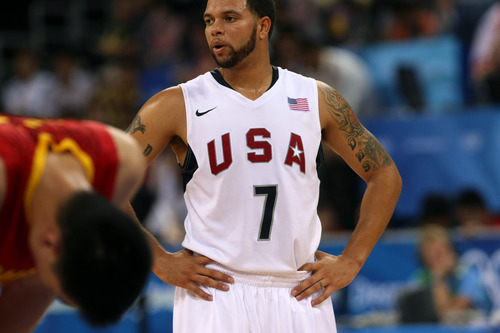
Fans here were excited that summer about having two Jazz players — Deron Williams and Boozer — on an Olympic team restoring American basketball to its proper place atop the world.
There were concerns heading into that Olympic competition that Williams and Boozer, who had just finished a long season, could get hurt or worn down playing for their country.
Turned out, something worse than injury happened.
An idea was planted in Williams' head.
In the course of representing the red, white and blue in China, Williams and Olympic teammate Dwight Howard talked, coming to the conclusion that playing together — in Orlando — sounded like a decent plan. The seedling, then, of Williams' departure from Utah was deposited into rich soil.
God bless the USA.
And the whole idea of the Jazz's bright future, all while fans here poured their hearts into a leader and a team that never did fulfill their collective potential, was quietly compromised.
It was like a bride planning her exit strategy while wedding guests were still throwing rice.
The Jazz, and their fans, were being played for fools.
No wonder Greg Miller and Kevin O'Connor a couple of years later had their "gut feeling" that Williams would not re-sign with the Jazz. By then, he'd been thinking about playing with Howard for multiple seasons.
Williams and Howard might still get their wish — not in Orlando, but in Brooklyn — although the complicated, once-imminent trade between the Nets and Magic bringing the big man to New York took a major hit on Wednesday, when the Nets went ahead and signed Brook Lopez to a $61 million deal. Now, according to CBA rules, Lopez cannot be traded until Jan. 15.
That doesn't absolutely shut down Howard's heading to Brooklyn to play with Williams, but it clouds the short-term possibility. Regardless of where Howard ends up, he'll be a free agent after next season. And if the Nets can shed some of the ridiculous money they have tied to their new roster in a trade — Howard has alternately said he wants to be in Brooklyn — it's still possible the Nets will get him.
Which brings us back to Flood, the center fielder for the Cardinals who through a string of legal battles with Major League Baseball and its Reserve Clause after being traded against his will in 1969 changed the face of professional sports in the United States.
Flood's antitrust lawsuit set the stage for the advent of free agency beyond just baseball. Oscar Robertson, president of the NBA Players Union, followed by filing a class-action suit on behalf of his players, eventually giving them options — and money — they never before dreamed of having.
That was good for them and good for justice on too many levels to discuss here.
But it sucked — and still sucks — for small-market fans, who were — and are — left to wonder whether the players in whom they invest so much energy and emotion will simply leave them at the end of their deals, be it for a bigger market, for better weather, for new teammates, for an easier path to a title.
If the archaic Reserve Clause, which gave complete player rights to the team that owned them, was too restrictive, and it was, free agency now is too … free. At least for the sound initial strategic moves of small-market teams and the good faith of their fans.
Even as the Jazz make their moves this offseason, and hope their young core continues to improve, fans have to worry whether the brightest parts of that core — Derrick Favors and Gordon Hayward — will make that improvement under the Jazz's guidance and then, afterward, decide to jump ship.
Anybody stop to think, as Favors and Hayward were in Vegas playing for the Select Team as it prepared Team USA for London, with which future teammates they might be making plans?
We get it. Free agency is just.
Just awful for small-market fans, who are put upon the same short cycle as players, ever hoping the good ones stick around. The difference being, good players can bolt if they want. For good fans, it's not so easy.
The Eagles' Don Henley and Glenn Frey could have had them in mind when they wrote their famous lyrics: "You can check out any time you like, but you can never leave." Of course, in the same song they wrote: "This could be heaven or this could be hell."
GORDON MONSON hosts "The Big Show" weekdays from 3—7 p.m. on 1280 and 960 AM The Zone. Twitter: @GordonMonson.