


This is an archived article that was published on sltrib.com in 2013, and information in the article may be outdated. It is provided only for personal research purposes and may not be reprinted.
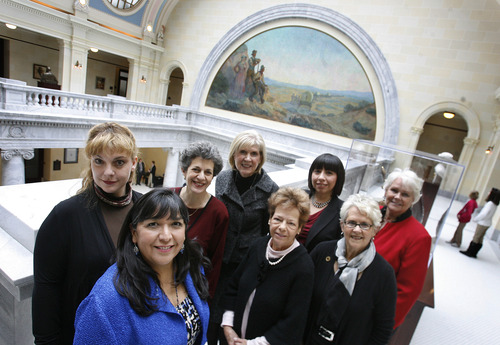
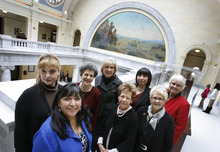
For the first time in the history of the Utah Legislature, women make up the majority of one party in both the House and Senate.
The Senate Democratic caucus has three women and two men, while in the House, female Democrats outnumber men in the party eight to six. Overall, women form a 58 percent majority of Democratic seats in the Legislature.
This happens, however, at a time when the Democratic Party has its smallest presence on Utah Capitol Hill in 46 years, holding just 19 seats to the Republicans' 85. And women occupy just six of those GOP seats, or 7 percent.
Utah had twice as many Republican women lawmakers a decade ago, when they outnumbered Democratic women.
But that has changed, as Republicans elect fewer women legislators and the overall number of female lawmakers continues on a downward trend. Women make up just 16.3 percent of the institution currently, the same as last year — and that's the lowest percentage since 1997 and down from an all-time high of 23.1 percent in 2001.
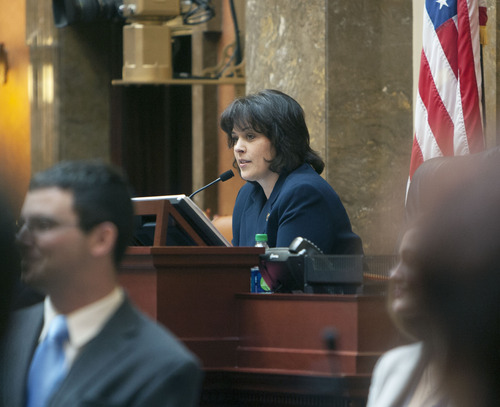
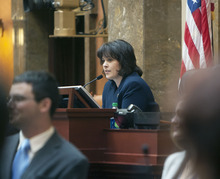
Rep. Becky Lockhart, Utah's first female House speaker, said it's difficult getting women to run for public office in the state.
"Women in Utah make choices about their lives; some of it is cultural," says the Provo Republican.
"Women are choosing to have a career or to stay at home. And those are good choices. Staying at home and being a mom full-time is a good choice. I don't think we should disparage that if that's what they're choosing to do. The challenge is getting women to understand the valuable contribution they can make that would be welcome; it's encouraged. If they choose to do it, we should support them."
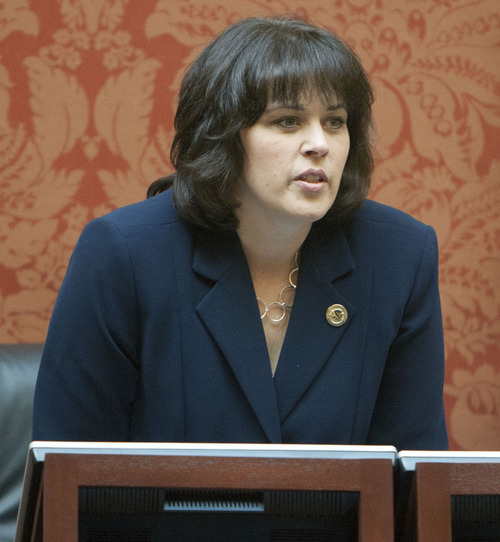
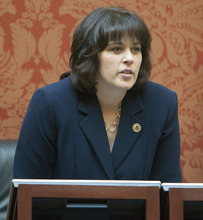
Lockhart's counterpart in the House, Minority Leader Jennifer Seelig, D-Salt Lake City, subscribes to the notion that political bodies function best when they mirror the populace. To Seelig, that means more women.
—
Insight, experience • "We have a different experience and different insight living this life and it's important that that experience be represented," Seelig said. "So right now, in a male-dominated Legislature, everything about the institution is a reflection of who creates it. Formal and informal rules of engagement might be different; how success is defined, how effectiveness is translated, what power means, all of those things."
Senate Minority Leader Gene Davis, D-Salt Lake City, agrees women bring a different — and valuable — perspective to lawmaking.
"Do they come from a different point of view? Absolutely," said Davis, who was reared by his mother and grandmother. "They are the mothers of the children. They understand that side of the issue. The women in our caucus are very strong women. They're leaders. And they've proven it by being re-elected."
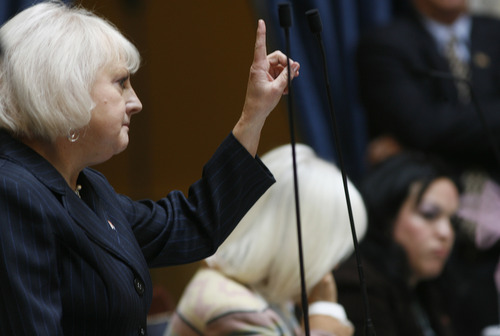
Sen. Luz Robles, D-Salt Lake City, who works closely with Davis, has been active in the nonpartisan coalition Real Women Run, which encourages women to run for elective office and to participate in politics.
"Fifty percent of the population in Utah is women; having that representation only benefits the discussion and policy-approach and the outcome of the Legislature as a whole," Robles said. "Women are able to articulate issues in a different way than men, not wrong or better, just different. It strengthens our state as whole."
Robles, like Seelig, says it's about representation of constituents.
"Most of your women in the Legislature are Democrats. Why? I don't think the constituents know. There is a big difference in how many women are in the majority party versus the minority party."
It hasn't always been that way.
—
Women and parties • GOP women in Utah's Legislature matched or exceeded the number of Democratic women in the Capitol for most of the 1990s and most of the past decade, according to Rutgers Center for Women and Politics. But beginning in 2009, Democrats began electing more women than Republicans even as the Democratic caucus shrank.
Rep. Becky Edwards, R-North Salt Lake, points to the long Utah history of strong women leaders, including Martha Hughes Cannon, who in 1896 became the first woman in the nation elected to a state Senate.
"Somehow we have morphed to this place where we are — where our elected officials do not represent the same thing. I think our pioneer foremothers would be mightily surprised with the makeup of our legislative bodies," said Edwards.
A participant in Real Women Run, Edwards says the gender gap does make a difference.
"We see that even in a political environment that it further removes women from feeling like they have a voice in the issues," Edwards says. "It matters for public involvement in issues. It's difficult for women to feel like this is a relevant place for their voice to be heard when there is not a real presence by women on the Hill."
Dan Harrie contributed to this report. —
Gender gap between the parties
Utah isn't alone in seeing women making far greater gains in the Democratic Party than in the GOP.
Of the 1,783 women state legislators across the nation, 63.6 percent are Democrats, 35.6 percent are Republicans (there are a handful of third-party and nonpartisan members), according to the National Conference of State Legislatures.
In the U.S. Congress, a record 97 women now serve in the 535-member body. Democratic women outnumber Republican women by more than 3 to 1, according to Rutgers Center for American Women and Politics.