


This is an archived article that was published on sltrib.com in 2012, and information in the article may be outdated. It is provided only for personal research purposes and may not be reprinted.
Washington • Of all the Utahns elected as delegates to the Democratic National Convention, Jamie Hartley is the outlier. She isn't a party insider or union leader, a politician or a campaign strategist.
Hartley has no real political experience at all.
But as a Utah County resident struggling with a painful genetic disorder she's very familiar with the nation's medical system, and that's something she wants to bring to the big political gathering in Charlotte, N.C.
"I wanted to be a voice for other people like me who have a severe disability, who are too sick to get out and say we need affordable health care," she said.
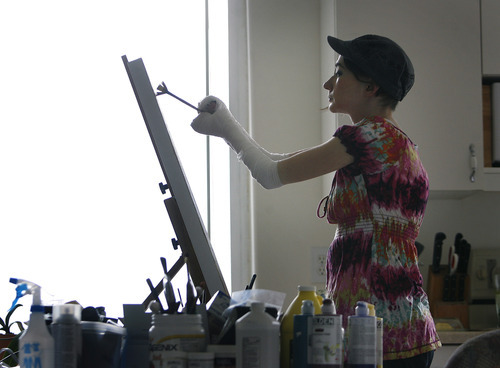
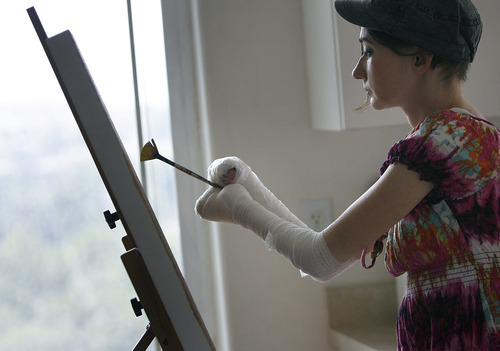
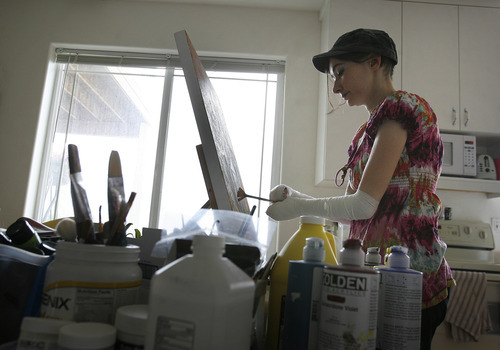
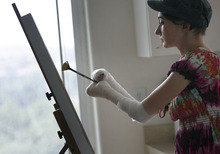
Every morning Hartley receives help bandaging what is left of her fingers, her fragile hands and arms. Next, she wraps her feet.
Her rare skin disorder is called epidermolysis bullosa, or EB. Essentially it means her layers of skin don't stay together, creating blisters and open wounds. It has damaged her esophagus, impacting her small, almost childlike voice, and it makes her susceptible to skin cancer, which she has battled for the past 12 years, a fight that's getting increasingly difficult and likely only to get worse.
Only 12,000 people in the U.S. have EB, according to the National Institutes of Health, and it is fatal, with most never making it out of their 20s. Just last week, Hartley turned 35.
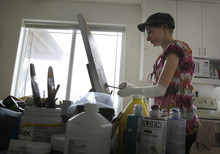
With the help of her husband, Taylor, Hartley has created a nonprofit called EB Survivors to help others battling the disorder and struggling with medical costs. To cope with her own pain, she picked up painting, a skill she developed after learning she may have to eventually amputate an arm.
"I thought of all the things I wanted to do that I haven't with my hands," said Hartley, who paints pictures of wildflowers and fanciful depictions of animals mostly in acrylics.
But until 2009, she hadn't been paying that much attention to politics. That's when President Barack Obama began work on his signature health care law, which tugged at her desire for universal coverage.
She sees the new law as a positive development. Still, Hartley fears a day when the government says she no longer qualifies for Medicaid and must get coverage in the private market.
"I know insurance companies, and I know they are not going to want to cover what I need," she said, and yet she's not thrilled with Medicaid's restrictions, either. "The government kind of runs my life. If everyone had to do what I had to do, it would get worked out fast."
Her husband estimates they would spend at least $12,000 each month on her special bandages and other medical care if they were not on Medicaid. And to make that work, he has to keep their income at less than 150 percent of the poverty line. To do that, Taylor Hartley, a criminal defense attorney, keeps a minimal caseload.
They met at Brigham Young University in 2001, when they lived in the same apartment building. Jamie Hartley's degree is in American studies. It was in one of those early classes that she discovered she was a Democrat. It came as a shock.
The professor put two truncated political platforms before his students and asked them to pick the one they most believed in. Then he revealed which party supported each set of ideas.
Beyond the issue of health care, she liked that the Democratic platform was more inclusive and focused more on helping those who were struggling.
Like many at BYU, Taylor Hartley was a Republican, a political difference that has meant little to their daily lives, but when he wanted to go to the Republican precinct meeting in March, she decided to hit the one held for Democrats.
Turns out she was one of only four who showed up, and two were temporarily moving, meaning Jamie became an automatic state delegate. From there her interest grew, and she decided to campaign to be a national delegate, giving a speech that turned heads.
"I talked about how much it means to me to have affordable health care, and I wanted to go and cheer on the man who is helping make it happen," she said.
She was elected by a crowd of strangers and joins a 40-person Utah delegation, none of whom she knows, but some of them remember her.
"She is quite an amazing young woman," said Gail Turpin, a delegate from Salt Lake City. "I just remember she was the last person to speak, and she did talk about her disease and her interest in health care."
"I was impressed by her speech. It got her elected," said Jim Gonzales, a longtime Democratic campaign adviser.
Taylor Hartley is also proud of his wife's positive spirit and her determination, which led him to recently take the same test his wife did back in college.
He went plank by plank through the platforms of the Republican and Democratic parties and, just like his wife, determined that the Democratic Party, at least the Utah County variety, was where he belonged.
He switched his party affiliation and will attend this week's convention with his wife.
"He's converted," Jamie Hartley says with a giggle.
mcanham@sltrib.comTwitter: @mattcanham