


This is an archived article that was published on sltrib.com in 2012, and information in the article may be outdated. It is provided only for personal research purposes and may not be reprinted.
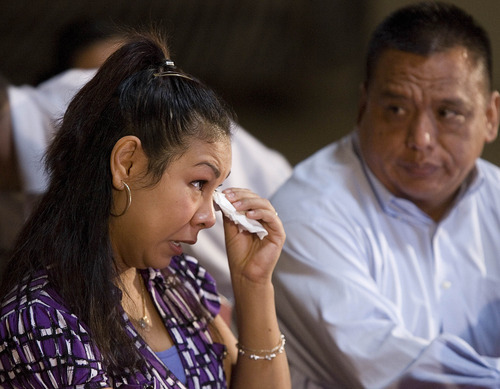
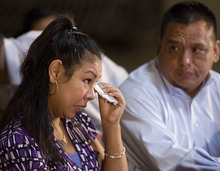
Silvia Salguero's 12-year nightmare got a little dreamier when she awoke Friday morning.
During those years, the 29-year-old student at the University of Utah had scraped together money for tuition, was raising an 8-year-old son and hoped to graduate with a degree in business administration.
But because she was brought to the country illegally from Mexico when she was 13, there were no scholarships and no loans to help her and she had no chance of working legally to pay the bills.
Then came President Barack Obama's executive order Friday that directed U.S. Immigration and Customs Enforcement and U.S. Citizenship and Immigration Services to stop deportations of those who would be eligible to participate in the Development, Relief and Education for Alien Minors Act — commonly dubbed the Dream Act.
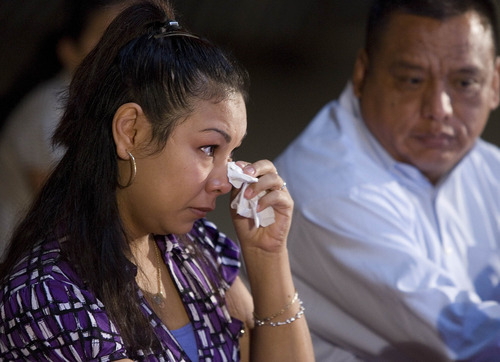
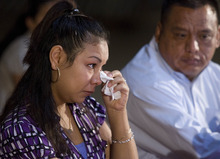
Salguero wept when she heard the news.
"It's a miracle," she said. "It's hard to believe."
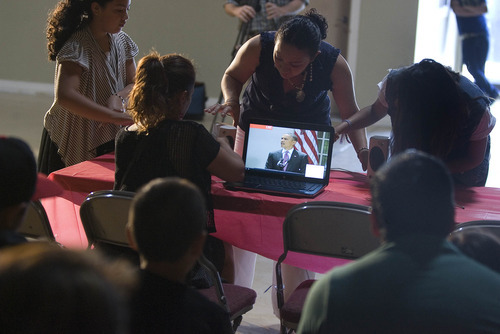
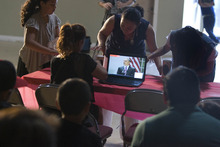
She sat with dozens either directly affected by the executive order or those who knew people that would be impacted — an audience gathered around the soft glow of a tiny laptop broadcasting Obama's big words Friday at Centro Civico headquarters in Salt Lake City.
"And as long as I'm president, I will not give up on this issue, not only because it's the right thing to do for our economy — and CEOs agree with me — not just because it's the right thing to do for our security, but because it's the right thing to do, period," Obama's voice echoed in the nonprofit's darkened gymnasium.
The order will give those who qualify a two-year deferred action — meaning they won't be deported — and they can apply for work authorization. They also can apply for renewal after the second year.
USCIS and ICE have 60 days to put the order into effect. Hot lines to assist students will launch Monday.
For eligibility under the order, the person must have come to the United States before age 16 and be under age 30. They must have lived continuously here for five years and have no felonies or significant misdemeanors. They also must be in school or have a high school diploma.
Obama's decree hews closely to the failed attempt by Congress to pass Dream Act legislation in 2010.
That bill — originally co-sponsored by Sen. Orrin Hatch, R-Utah, more than a decade ago — fell short in the Senate. Hatch wasn't present for that vote, but has publicly denounced it as a "distorted" version of what he initially pitched. No member of Utah's congressional delegation voted for the Dream Act in 2010.
Some anti-illegal-immigration hard-liners were quick to criticize Obama's move.
Dan Stein, spokesman for the Federation for American Immigration Reform, called it a "brazen usurpation" of congressional authority.
"Over the past 10 years, Congress has repeatedly rejected the Dream Act," Stein said. "Now, five months before the presidential election, the Obama administration is unilaterally rewriting our immigration laws, defying congressional authority and threatening our constitutional framework."
Utah conservative activist Candace Salima — who agrees with "parts" of the Dream Act — accused Obama of pandering to Latino voters and "overreaching" by issuing the executive order.
In neighboring swing states such as Nevada and Colorado, Latinos proved to be a vital bloc in 2008, when Obama carried 76 percent and 61 percent, respectively, of those voters to capture those states.
Itza Hernandez, a 20-year-old who was brought to the country illegally from Mexico when she was 4, lamented many children who might have benefited from the executive order have already been deported.
The Midvale resident also said the parameters for qualifying remained too narrow.
"So many parents and uncles who don't meet the age criteria can be removed," Hernandez said. "And people aren't perfect. What if somebody didn't graduate or doesn't want to continue their college education? Does that make them deserving of deportation? And what about the Dreamers who have already been deported? This doesn't help them either."
The numbers of people who affected by this new policy are uncertain — though the Pew Hispanic Center said nationally it could impact 1.4 million people. There are an estimated 11.2 million people in the United States illegally.
In Utah, the center estimates the illegal immigrant population at roughly 110,000.
Pam Silberman, spokeswoman for the Office of the Commissioner for Higher Education, said, 4,592 students fell under the category of "nonresident alien" at the beginning of fall semester 2011. Of that number, 716 qualified under Utah's law allowing in-state tuition of illegal immigrants — meaning most of those are in Utah on student visas.
Those figures represent about 3 percent of the roughly 174,000 students attending eight colleges throughout the state, including the University of Utah.
Utah Attorney General Mark Shurtleff, who has been a leader on immigration reform and helped spearhead The Utah Compact as a way to bring a more compassionate approach to the controversial issue, praised Obama's move.
"This is a great step in encouraging these kids to go to school, stay out of trouble or away from drugs and gangs," he said. "It's the right thing to do. It's justice for a lot of good kids who want to get out of the shadows."
Sol Jimenez, a who will be attending the U. this fall, said she couldn't believe the news in the morning because she had just failed to get a job the day before due her immigration status. She was brought to the country illegally when she was 2.
Now, the 17-year-old Jimenez said, she'll be able to work legitimately and attend school.
"It's such a huge step," she said. "We could still be waiting for something. This was action and it actually happened and it gave me even greater hope. We should be thankful for it."
Some are approaching the change with caution.
Tim Wheelwright, a Salt Lake City-based immigration lawyer, said a memo issued by ICE Director John Morton that sought to prioritize deportations based on those with criminal records has been "anything but efficient." According to data culled by the Immigration Policy Center, barely 7 percent – or 20,648 eligible cases — had been reviewed through May 29.
Bishop John C. Wester of the Catholic Diocese of Salt Lake City said he understood there might be some skepticism — especially among those who haven't been identified as in the country illegally. But he said his diocese will be ramping up efforts to educate the affected community and to let them know "it's something they can trust."
And Wheelwright said Obama's move should still be applauded.
That's exactly what the crowd at Centro Civico did when the president finished talking Friday afternoon.
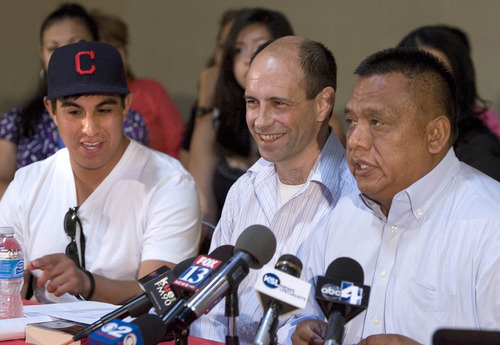
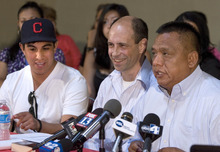
"I'm so pleased. So happy," Proyecto Latino de Utah Director Tony Yapias said. "We are excited we finally have an executive order of the Dream Act."
Twitter: @davemontero —
Hot lines set up starting Monday
USCIS • 1-800-375-5283
ICE • 1-888-351-4024
Information is available at following websites: